Andrew Newberg
What Neurology Can Tell Us About How We Think And Why It Matters

Dr Andrew Newberg
is regarded as one of leading pioneers in the field of neuroscientific
study of religious and spiritual experiences, increasingly referred to
as – neurotheology.
His research work focuses on the nature of religious and spiritual practices and experiences and specifically how brain function is associated with various mental states, especially the relationship between brain function and mystical or religious experiences.
Andrew Newberg - "Demystifying the Human Brain: SPECT Scans, Neurotheology, and the Aging Brain."
Why Andrew Newberg's work matters
Andrew Newberg's work provides further compelling
evidence for the neurological underpinning of the core theme of this
site, namely how to think and how to not think.
In "Thinking Styles Assessment" we reviewed the work of Dr Katherine Benziger and her evidenced based neurological insights into how our brain structures predicate our thinking style.
Benziger's model recognises that the brain has four specialised areas
responsible for different brain functions. Significantly we each
have natural strengths in only one of these specific areas. Benziger outline the importance of using
your natural preferred thinking style, and what happens when you don't.
In "Why we think the way we do" I attempted to introduce you to "why we think the way we do" from the perspective of the physiology and neurology - the "hardware" - of our minds.
I outlined why I feel that a basic understanding of the neurology of what is going on inside our heads when we engage in meditative and other spiritual practices is important:
The relevance of this understanding of the neurology of left-brain/ right-brain balance is that it is the crux of the whole "balanced" or integrated approach to life.
When we engage with these meditation practises, all that we are doing is re-shaping or re-programming the physical neurological connections between the left and right lobes of our brains via the corpus-callosum to achieve the lived experience of a physiologically better balanced brain!
In my own view, based on the evidence, at the current stage of evolution of the "average" or "normal" human brain - the "left brain" and the "right brain" do not communicate easily or much at all. The same is also true for the "the emotional centre" and "the reptile brain" or the survival instinct).
So the evidence suggests that this fundamental lack of
brain balance, is the underlying evolutionary and neurological reason
why we experience life the way we do and why we all suffer so much, it's
also the root cause of our personal internal conflict and inner
resistance or immunity to change.
At a macro level, it is why as humans we inflict so much appalling suffering on each other.
Attempting to address this imbalance lies at the root of most meditative practises - although it is rarely presented in these terms.
Andrew Newberg's work explains why we find meditation hard and why it takes so long to benefit from it
A further reason why understanding Andrew Newberg's work matters is that it explains:
(1) Why we find meditation practises so hard to do with any consistence or very much persistence.
(2) Why it takes us so long to derive significant and lasting personal change and benefit from these practises as we are quite literally re-wiring or re-routing the neurological pathways in our brains.
And this is why I feel that the use of some form of binaural meditation tool is so very helpful as it makes this "rewiring" process so much easier (just put on the head phones!) and quicker.
I have discussed this in more detail and shared my own specific experiences of this in my "Meditation Programme" product review.
Ted Talk - "Finding Our Enlightened State"
* SEE: "How to find your own path to enlightenment" @ 12.01
Further resources from Dr Andrew Newberg [video & transcript]:
How Enlightenment Changes the Brain
Andrew Newberg - Resources
Return to:Inspirational people

LATEST ARTICLES


The Kingdom Is Here, Now - Awakening Is Not Later
 What contemplative traditions point to - and how progress quietly replaces presence. Across contemplative traditions, a strikingly consistent message appears: truth is not somewhere else, not in the…
Adult Development Without Becoming Someone Else - Growth Without Identity Upgrade
 You do not grow by becoming someone else - you grow by placing authority where choice becomes possible. So much of what is written and taught about personal growth quietly assumes an identity upgrade…
Belief and Thought: What Zen Tools Works With - What It Leaves Alone
 A Clarification Of Scope Within Zen Tools - Not A Position On Belief As soon as people begin to notice their own thinking more clearly, questions about belief and thought naturally follow: - If though…
How Thought Becomes Identity - The Hidden Mechanism Behind Overthinking, Self-Worth, and Inner Conflict
 Thought Is an Event, Not a Self Most people believe identity is something they have - a stable sense of who they are. In reality, identity is something the mind is continuously producing. It is not fo…
When the Brain Is Hijacked - Where Does Choice Sit?"
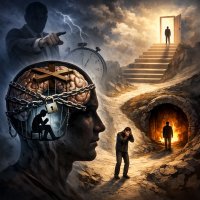 Pressure, the Hijacked Brain, and the Question of Authority
When the brain is hijacked, people are often told they have “lost control”.That language is understandable - and misleading. In reality, man…
Pressure, the Hijacked Brain, and the Question of Authority
When the brain is hijacked, people are often told they have “lost control”.That language is understandable - and misleading. In reality, man…Reduce Digital Overthinking To Lower Your Constant Inner Noise
 Why Constant Micro-Stimulation Increases Your Internal Noise. Modern digital life generates a level of mental activity that previous generations never had to deal with, and this is fundamentally why w…
Pausing Before You Act - Make It a Meta-Habit
 How A Tiny Moment Unlocks Clarity, Choice, And Self-Leadership. There is a moment in life so subtle you barely register it. A colleague questions your idea. A notification flashes. A moment of uncerta…
How to Interrupt Emotional Spirals Using Thought-Awareness
 The spiral is fueled by your mind believing the story your thoughts tell. No one sets out to be swept away by a surge of emotion. One second you’re handling life, and the next, your mind has broken in…
Universal Awareness and the Machinery of Thought
 You Can’t Control Thoughts - But You Can Learn To See Them. Why do our thoughts have so much power over us - and how do we reclaim clarity? The foundation of thought-awareness is the ability to see yo…
Rewiring Your Autopilot – How To Harness Your Subconscious Mind
 How to harness your subconscious mind and move from passenger to pilot. The case for rewiring your autopilot is that most of what drives your thoughts, reactions, and decisions happens below your cons…
Why You Need To Be Intimate With Your Own Thinking
 How self-awareness and insight transforms delusion into wisdom. We live inside an invisible weather system - one made not of clouds and wind, but of thoughts - and this invisibilty is why you need to…
The Illusion of Closeness in Always-On Relationships
 Closeness that cannot survive absence was never intimacy - only constant stimulation mistaken for connection. We live inside an unprecedented experiment in human connection. For the first time in hist…