Thinking Styles Assessment
How Your Brain Makes You Think
Why It Matters To Understand This
Dr Katherine Benziger takes a completely different approach to thinking styles assessment.
This is in complete contrast to the theoretical and philosophical basis of most psycho-metric tests, that focus on the physiological and neurological aspects of how our brains actually function.
As this is a physiological and neurological assessment it is arguably a more objective method of assessment than psychometric tests.
Katherine Benziger's assessment tools are based on the measurement of brain function and energy consumption in the brain.
Her model recognises that the brain has four specialised areas responsible for different brain functions - and significantly we each have natural strengths in only one of these specific areas.
Thinking Styles Based On Your Brain Functions
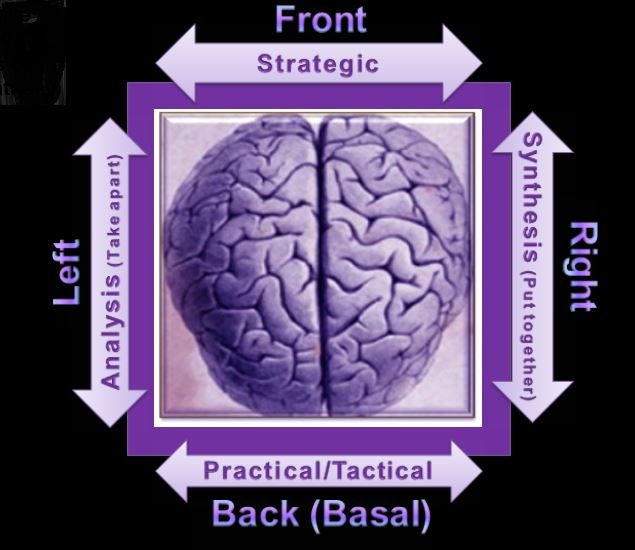
- Mode 1 located in the basal left
- Brain functions: order and habit; ordered procedures; sequential routines
Response to stimulus: remembers definitions; remembers what is - as described - Mode 2 located in the basal right
- Brain functions: spiritual experience; rhythm and feeling; harmony
Response to stimulus: remembers definitions; picks up emotional tone and the presence or absence of harmony; how things are and how we feel about it - Mode 3 located in the frontal right
- Brain functions: internal imaging; metaphor and imagination; expressiveness
Response to stimulus: sees the essence of things, in pictures and metaphors - Mode 4 located in the frontal left
- Brain functions: structural analysis; prioritising and logic; mathematics
Response to stimulus: converts into logical results or effects; leads to, or produces results
The Importance Of Using Your Natural Preferred Thinking Styles
We quite naturally prefer to use the thinking style associated with our natural strength - this is referred to as the "preferred thinking and behavioural mode".
This is important and has a very practical application for you:
1. Adapting your natural thinking style to accommodate others affects your performance
Katherine Benziger has identified that when people adapt their natural thinking and working styles to fit expectations of others, [normally created by work and career, tension and stress] people tend to "falsify type" as they think and behave in ways that are unnatural to them, and predictably this creates problems in how they function and perform, specifically in a work environment.
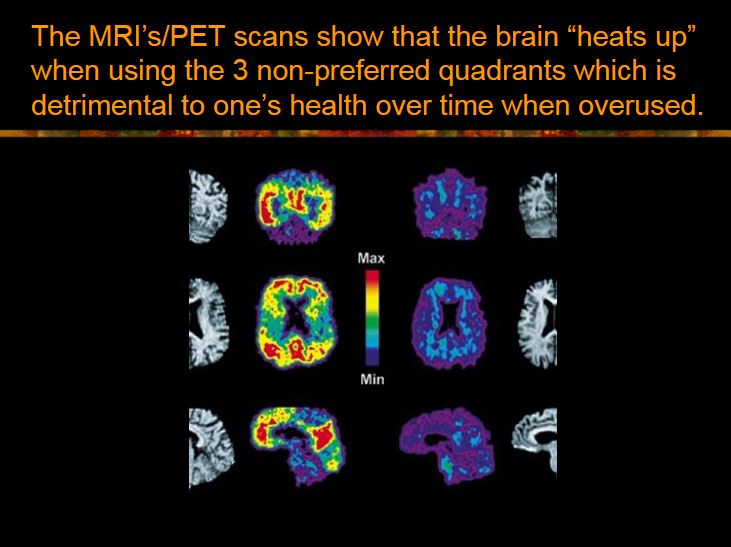
2. The cost of falsifying your thinking style to accommodate others can lead to "Prolonged Adaption Stress Syndrome"
Dr Arlene Taylor, a long time collaborator with Benziger, has developed Benziger's observations about the "cost of falsifying type", and as published in 1999 in their joint paper 'The Physiological Foundations of Falsification of Type and PASS' [published as a book] has identified a range of symptoms collectively known as "Prolonged Adaption Stress Syndrome" (PASS) that arise as a result of falsification of type.
1. Fatigue
2. Hyper-vigilance
3. Immune system alterations
4. Memory impairment
5. Altered brain chemistry
6. Diminished frontal lobe functions
7. Discouragement and or depression
8. Self-esteem problems
Thinking Styles - Resources
Further reading: Books By Katherine Benziger
Presentation Slideshow: Benziger Thinking Styles Assessment
Note - there are c80 slides in this presentation but it contains some very useful information.
Do the test: My Benziger
Note:
- This is not a free test. It is currently on offer at a reduced price of $39.99
- I have no commercial relationship with this company and do not receive any commission or financial payment if you do the test.
- Here is a sample executive summary of a test result
- Here is a sample full test report
Return to: Managing Personal Change

LATEST ARTICLES


Belief and Thought: What Zen Tools Works With - What It Leaves Alone
 A Clarification Of Scope Within Zen Tools - Not A Position On Belief As soon as people begin to notice their own thinking more clearly, questions about belief and thought naturally follow: - If though…
How Thought Becomes Identity - The Hidden Mechanism Behind Overthinking, Self-Worth, and Inner Conflict
 Thought Is an Event, Not a Self Most people believe identity is something they have - a stable sense of who they are. In reality, identity is something the mind is continuously producing. It is not fo…
When the Brain Is Hijacked - Where Does Choice Sit?"
 Pressure, the Hijacked Brain, and the Question of Authority
When the brain is hijacked, people are often told they have “lost control”.That language is understandable - and misleading. In reality, man…
Pressure, the Hijacked Brain, and the Question of Authority
When the brain is hijacked, people are often told they have “lost control”.That language is understandable - and misleading. In reality, man…Reduce Digital Overthinking To Lower Your Constant Inner Noise
 Why Constant Micro-Stimulation Increases Your Internal Noise. Modern digital life generates a level of mental activity that previous generations never had to deal with, and this is fundamentally why w…
Pausing Before You Act - Make It a Meta-Habit
 How A Tiny Moment Unlocks Clarity, Choice, And Self-Leadership. There is a moment in life so subtle you barely register it. A colleague questions your idea. A notification flashes. A moment of uncerta…
How to Interrupt Emotional Spirals Using Thought-Awareness
 The spiral is fueled by your mind believing the story your thoughts tell. No one sets out to be swept away by a surge of emotion. One second you’re handling life, and the next, your mind has broken in…
Universal Awareness and the Machinery of Thought
 You Can’t Control Thoughts - But You Can Learn To See Them. Why do our thoughts have so much power over us - and how do we reclaim clarity? The foundation of thought-awareness is the ability to see yo…
Rewiring Your Autopilot – How To Harness Your Subconscious Mind
 How to harness your subconscious mind and move from passenger to pilot. The case for rewiring your autopilot is that most of what drives your thoughts, reactions, and decisions happens below your cons…
Why You Need To Be Intimate With Your Own Thinking
 How self-awareness and insight transforms delusion into wisdom. We live inside an invisible weather system - one made not of clouds and wind, but of thoughts - and this invisibilty is why you need to…
The Illusion of Closeness in Always-On Relationships
 Closeness that cannot survive absence was never intimacy - only constant stimulation mistaken for connection. We live inside an unprecedented experiment in human connection. For the first time in hist…
Why Approval Feels Like Safety And Distance Feels Like Danger
 Safety is not found in being approved - it appears when approval is no longer required. When approval feels like safety, connection stops being something we enjoy and quietly becomes something we rely…
You Do Not Need Better Boundaries - You Need Clearer Thought
 What no longer feels like your responsibility no longer crosses your boundaries. This article explains why you don’t need better boundaries - you need clearer thought - how modern life systematically…