The Fat Tail Fractal Factor
Learn How To Benefit From The Fat Tail Fractal Factor
Less than 1% of your efforts and resources can deliver over 50% of your results
Introducing the Fat Tail Fractal Factor
One of the pleasures of writing material for this site is that I get to research subjects that are new to me. The mental models
section falls into this category. I have gained many new insights from
this research and the area that I have found most instructive can be
broadly categorized as chance, probability and statistics.
For a non-statistically trained lay person such as myself, this has introduced a whole new dimension to my understanding of life and has added more tools to my balanced toolkit.
In layman's terms - what exactly is the fat tail fractal factor?
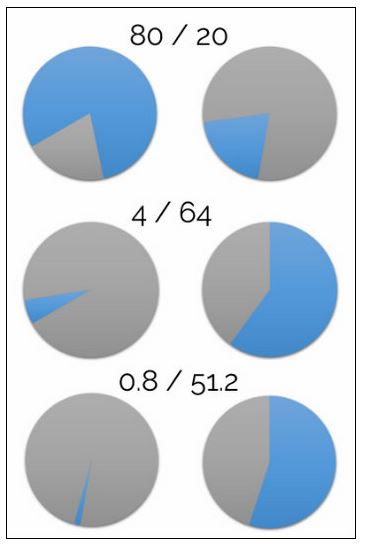
We are all familiar with the 80/20 rule [also know as the Pareto Principal] which basically means that as a general observation 80% of your results come from 20% of your efforts. So the take away with this is to focus your time, energy and resources on that productive 20% to maximise your results.
What you may not know, and I certainly didn't, is that that the 80/20 rule can be applied to itself - that's what the fractal factor means.
So 20% of your 20% best efforts [i.e. 4%] will deliver 64% of your best results. This is illustrated in the second line of the graphic above.
And the 80/20 rule can be applied to this 4% so 20% of that 4% [i.e. 0.8%] will deliver 51.2% of your best results. This illustrated in the third line of the graphic above.
So in very simple terms this means that:
1% of your efforts and resources can deliver 50% of your results!
The challenge lies in finding that key subset of your productive 20%.
In this article I want to share some insights I gained from learning how to apply the fat tail fractal factor and find that elusive 1%. But first, an anecdote:
My first experience of the fat tail fractal factor

Early in my career as a salesman I worked for the marketing services division of the credit reporting agency Dun & Bradstreet. My sales target was £10,000 per month and over the first 6 months I consistently managed to achieve target.
My
average order value was about £1,000 and this involved a huge amount of
cold-calling and about 1,000 miles of driving every week to achieve the
10 orders to make my sales target.
I realised that there had to be a more efficient way of working as there was no way I could maintain that workload over the long term, so I decided to aim for one order worth £10,000 per month.
Although I had never heard of the 80/20 rule, that is exactly what I applied. I thought carefully about the type of client that had a big enough requirement to order in that quantity. I figured out that this had to be a client who had a requirement for added value services, so in addition to selling the raw data I decided to sell the additional services required to fulfill a direct mail or telesales campaign.
The following month I smashed my target with an order for £10,000 and then repeated that success the following month.
As I basked in the warm glow of this early success it occurred to me that the only difference between a £10,000 order and a £100,000 order was an extra zero. So all I had to do was figure out what type of client could place an order of that size.
Further analysis revealed that if I could create a bespoke lead generation service for one of the major financial services companies who employed thousands of salesmen trying to sell pension schemes to small business owners then I could achieve this. Whilst I was obviously unaware of it at the time I was then applying the fat tail fractal factor.
Fast forward another two months and I had approached the regional director of one of these financial services companies and secured an order for £100,000. This covered most of my annual sales target, and I then repeated this process on a smaller scale with a couple of other clients and I closed that financial year on sales of £250,000.
The effect of that first big sale was totally disproportionate to the effort I expended on winning it:
- Achieved the largest single order that had ever been achieved in that division.
- Became top salesman of that year.
- Promoted to Business Development Manager
- Earned £40,000 in commission which adjusted for inflation is £200,000 [or $265,000 USD].
2 Key Ideas That Underpin the Fat Tail Fractal Factor
[1] The Power Law
A power law describes a relationship between two things in which a change in one thing can lead to a large change in the other, regardless of the initial quantities.
Statistically it also describes a range of variations from the mean that can be very large.
[2] The Fat Tail
The fat tail is the 80% of result that comes from the 20% of effort.
Statistically, there is a relatively high probability of extreme outcomes in the fat tail.
Clearly the fat tail is where all the serious action is, and the fat tail fractal factor describes the scenario where the effort applied to the critical 1% will yield a massive return that is totally disproportionate to effort invested.
Exceptions and Qualifications to The Fat Tail Fractal Factor
There are circumstances where 80% of your return may not be derived from 20% of your efforts. When we talk about the "fat tail" we are referring to markets and situations where there is a greater-than-expected probability of extremely high values [i.e, revenues and profit]. However, we also have to consider the "long tail" which is about almost limitless opportunities to create/sell/distribute bespoke/niche products or services in low volumes and at high profit. A typical example of this is the phenomenal growth of online business reflecting the much lower costs of marketing and distribution coupled with changing consumer preference that has led to the growth of high profit, low volume, niche products and services. The effect of this is to expand the "long tail" and reduce the amount of revenue and profit derived from the "fat tail". This means that there are situations where, for example, 50% or less of your desired outcomes [e.g. revenue and profit] are derived from the "fat tail" and 50% or more from the "long tail". When this occurs, the 80/20 rule would now be the 50/50 rule or 40/60 rule! Qualifying the application of the fat tail fractal factor [1] As a general observation does the 80/20 principle apply to your situation? Is approximately 80% of your desired outcome [e.g. revenue and profit] derived from approximately 20% of your effort? [2] If the answer to that question is "No", then we can expand the 80/20 criteria to consider 3 further important qualifications - is there: [Factors that could cause a concentration of control of distribution or influence on decision making behaviour could be legislative, technical, brand related, social media/influencers or any number of other factors.] If none of this applies then the 80/20 rule, and thus the fat tail fractal factor, does not apply to your situation.
As you focus on the top 20%, you know that somewhere in amongst that
group is a subset - which may be just one or two individuals - who will
deliver over 50% of your results. Here are 5 practical tips that I have used, and continue to use, to find that critical 1%: [1] Focus on Quality Not Quantity [2] Attract Luck - Be The Best At What You Do [3] Hunt With A Rifle Not A Shotgun [4] Accept the Failure Rate [5] Play The Long Game The fat tail fractal factor is not just about business and money.
This is applies to relationships, hobbies, and areas of special interest to
you. If you can master the dynamics of making this happen you can take a quantum leap in your personal effectiveness, in any area of life that really matters to you, and make a big difference in the lives of others.
How To Find That Critical 1%

Closing Reflections
Further Reading:
The Pareto Principle - the 80/20 Rule
Understanding Complex Systems Thinking - It's Not Complicated
Why Understanding Ergodicity Is Critical To Your Long Term Survival
How Positive Asymmetry Can Transform Your Life
How To Benefit From The Unseen Margins
Third Party Resource:
The Real Meaning of 80/20 - The Rise Of The Fat Tail
Next Article: Dunbar's Number
Return from the "Fat Tail Fractal Factor"
to: Walking The Talk
Or to: Mental Models

LATEST ARTICLES


When Insight Is Not Enough - The Missing Piece in Behaviour Change
 What Mindfulness Reveals - And What It Leaves Unresolved. Many people reach a point where something genuinely shifts. They can see their thoughts as thoughts. Patterns are recognised.Triggers are obvi…
Why the Brain Replays Threat at Night - And What It’s Responding To
 Bad Dreams, Mental Overload, and the Cost of Unresolved Threat Processing in the Brain. Many people lie awake at night wondering why the mind turns hostile when the day goes quiet. Thoughts that felt…
The Kingdom Is Here, Now - Awakening Is Not Later
 What contemplative traditions point to - and how progress quietly replaces presence. Across contemplative traditions, a strikingly consistent message appears: truth is not somewhere else, not in the…
Adult Development Without Becoming Someone Else - Growth Without Identity Upgrade
 You do not grow by becoming someone else - you grow by placing authority where choice becomes possible. So much of what is written and taught about personal growth quietly assumes an identity upgrade…
Belief and Thought: What Zen Tools Works With - What It Leaves Alone
 A Clarification Of Scope Within Zen Tools - Not A Position On Belief As soon as people begin to notice their own thinking more clearly, questions about belief and thought naturally follow: - If though…
How Thought Becomes Identity - The Hidden Mechanism Behind Overthinking, Self-Worth, and Inner Conflict
 Thought Is an Event, Not a Self Most people believe identity is something they have - a stable sense of who they are. In reality, identity is something the mind is continuously producing. It is not fo…
When the Brain Is Hijacked - Where Does Choice Sit?"
 Pressure, the Hijacked Brain, and the Question of Authority
When the brain is hijacked, people are often told they have “lost control”.That language is understandable - and misleading. In reality, man…
Pressure, the Hijacked Brain, and the Question of Authority
When the brain is hijacked, people are often told they have “lost control”.That language is understandable - and misleading. In reality, man…Reduce Digital Overthinking To Lower Your Constant Inner Noise
 Why Constant Micro-Stimulation Increases Your Internal Noise. Modern digital life generates a level of mental activity that previous generations never had to deal with, and this is fundamentally why w…
Pausing Before You Act - Make It a Meta-Habit
 How A Tiny Moment Unlocks Clarity, Choice, And Self-Leadership. There is a moment in life so subtle you barely register it. A colleague questions your idea. A notification flashes. A moment of uncerta…
How to Interrupt Emotional Spirals Using Thought-Awareness
 The spiral is fueled by your mind believing the story your thoughts tell. No one sets out to be swept away by a surge of emotion. One second you’re handling life, and the next, your mind has broken in…
Universal Awareness and the Machinery of Thought
 You Can’t Control Thoughts - But You Can Learn To See Them. Why do our thoughts have so much power over us - and how do we reclaim clarity? The foundation of thought-awareness is the ability to see yo…
Rewiring Your Autopilot – How To Harness Your Subconscious Mind
 How to harness your subconscious mind and move from passenger to pilot. The case for rewiring your autopilot is that most of what drives your thoughts, reactions, and decisions happens below your cons…