Beginners Mind And The Voice Of Experience
Only The Experts Survived Evolution

Survival On The Savannah Plain With Beginners Mind
"In the beginner's mind there are many possibilities, but in the expert's there are few."
These are the famous words of Shunryu Suzuki in "Zen Mind, Beginner's Mind" who did so much to promote and popularize Zen Buddhism in the US during the 1960's.
As Harry Truman once said: “An expert is someone who doesn’t want to learn anything new, because then he wouldn’t be an expert.”
The implication is that to have knowledge and experience of a subject - to have the mind of an expert - is limiting and we should always assume the mindset of a novice with no prior knowledge or expertise and maintain an open mind.
From an evolutionary perspective only the experts survive
If our paleolithic ancestors had behaved like that we would not be here today. From an evolutionary perspective only those with developed survival instincts and skills - only the experts - survived.
At time of writing, serving soldiers in the Ukrainian frontline in Donbas region are not fighting with beginner's mind. They are highly trained and experts in the use of military technology.
When I go and visit the dentist with a raging toothache, I do not want the dentist to have a beginner's mind - I want him [or her] draw on his extensive training and experience to extract my tooth and treat the underlying infection.
In my "day job" I am regularly presented with large contract offers for the purchase or sale of fuel products. The people who approach me want my expert opinion - usually very quickly - on whether or not the offer is genuine [i.e. not fraudulent], and whether or not the procedures are likely to be acceptable to their potential buyer or seller.
They do not want the beginner's mind I had 10 years ago when I first got into this business, they want my hard earned knowledge and experience - my expert mind.
So what exactly was Suzuki driving at?
“In the beginner's mind there is no thought, 'I have attained something.'
When we have no thought of achievement, no thought of self, we are true beginners.”
The key to this is "no thought of self".
So what we are talking about here is an expert performing with no ego involved. An expert with humility and openness.
The Beginners Mind In Action

England Women's Team Win 2022 European Cup Final
The beginner's mind in action is best displayed by an expert who has mastered the art of "doing without doing".
This does not mean that the expert doesn't take action but rather it is about how she takes action.
It means that the expert is at peace whilst taking action - so she can perform with maximum skill and efficiency.
She is able to do this because she has put in the work to have achieved unconscious competence in exercising the necessary skills to undertake the required tasks and activities.
"You have a confident mind when you have a sense of certainty about your ability, which allows you to bypass conscious thought and execute unconsciously." [Dr Nate Zinsser]
Peak performance is meditation in motion.
Here in the UK we saw a great example of that recently when the England Women's Team won the 2022 European cup final.
The Beginners Mind In Meditation
On this site we place a lot of emphasis on learning how to think effectively and in order to do that you also need to learn how to stop thinking.
The most powerful and proven technique for learning how to stop thinking, and how to develop beginner's mind, is mindfulness meditation.
Many articles on this site focus on the practice of this form of meditation within a structured practice setting, but what I also find very useful are the many daily opportunities for practicing mindfulness in the simple everyday tasks and activities that I would otherwise do on "auto-pilot".
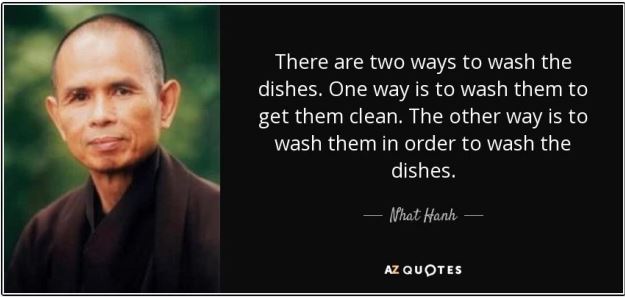
So let me introduce you to the "washing the dishes" meditation and also to a wider range of mindfulness exercises that you can incorporate into your daily life.
Further Reading:
5 Zen Mindsets For Mastery In Any Area Of Life
Can You Stop Thinking? Discover The Joy Of A Quiet Mind
Tao Te Ching - Connecting To Your True Source Of Power
Next Article: The Art Of Being Alone Is A Skill
Return from "Beginners Mind" to: Walking The Talk

LATEST ARTICLES


When Insight Is Not Enough - The Missing Piece in Behaviour Change
 What Mindfulness Reveals - And What It Leaves Unresolved. Many people reach a point where something genuinely shifts. They can see their thoughts as thoughts. Patterns are recognised.Triggers are obvi…
Why the Brain Replays Threat at Night - And What It’s Responding To
 Bad Dreams, Mental Overload, and the Cost of Unresolved Threat Processing in the Brain. Many people lie awake at night wondering why the mind turns hostile when the day goes quiet. Thoughts that felt…
The Kingdom Is Here, Now - Awakening Is Not Later
 What contemplative traditions point to - and how progress quietly replaces presence. Across contemplative traditions, a strikingly consistent message appears: truth is not somewhere else, not in the…
Adult Development Without Becoming Someone Else - Growth Without Identity Upgrade
 You do not grow by becoming someone else - you grow by placing authority where choice becomes possible. So much of what is written and taught about personal growth quietly assumes an identity upgrade…
Belief and Thought: What Zen Tools Works With - What It Leaves Alone
 A Clarification Of Scope Within Zen Tools - Not A Position On Belief As soon as people begin to notice their own thinking more clearly, questions about belief and thought naturally follow: - If though…
How Thought Becomes Identity - The Hidden Mechanism Behind Overthinking, Self-Worth, and Inner Conflict
 Thought Is an Event, Not a Self Most people believe identity is something they have - a stable sense of who they are. In reality, identity is something the mind is continuously producing. It is not fo…
When the Brain Is Hijacked - Where Does Choice Sit?"
 Pressure, the Hijacked Brain, and the Question of Authority
When the brain is hijacked, people are often told they have “lost control”.That language is understandable - and misleading. In reality, man…
Pressure, the Hijacked Brain, and the Question of Authority
When the brain is hijacked, people are often told they have “lost control”.That language is understandable - and misleading. In reality, man…Reduce Digital Overthinking To Lower Your Constant Inner Noise
 Why Constant Micro-Stimulation Increases Your Internal Noise. Modern digital life generates a level of mental activity that previous generations never had to deal with, and this is fundamentally why w…
Pausing Before You Act - Make It a Meta-Habit
 How A Tiny Moment Unlocks Clarity, Choice, And Self-Leadership. There is a moment in life so subtle you barely register it. A colleague questions your idea. A notification flashes. A moment of uncerta…
How to Interrupt Emotional Spirals Using Thought-Awareness
 The spiral is fueled by your mind believing the story your thoughts tell. No one sets out to be swept away by a surge of emotion. One second you’re handling life, and the next, your mind has broken in…
Universal Awareness and the Machinery of Thought
 You Can’t Control Thoughts - But You Can Learn To See Them. Why do our thoughts have so much power over us - and how do we reclaim clarity? The foundation of thought-awareness is the ability to see yo…
Rewiring Your Autopilot – How To Harness Your Subconscious Mind
 How to harness your subconscious mind and move from passenger to pilot. The case for rewiring your autopilot is that most of what drives your thoughts, reactions, and decisions happens below your cons…