Zen Enlightenment [Satori]
The Stink Of Zen

What is Zen Enlightenment [Satori]?
Zen Enlightenment means to be free of the effects of the mind, to be 100% present-moment-aware, and unencumbered with thoughts about the past or the future. This is sometimes referred to as a "Unity Consciousness".
The whole subject of enlightenment is much misunderstood. In my experience there is at least as much a lack of understanding about
this within Buddhist circles as there in the non-Buddhist and secular
world.
There is something in human nature - a desire to glamorise, sanctify, objectify and idolise – that elevates people who have offered deep insights to the human race and thus put distance between them and the rest of us.
But these great ones have exactly the same psychological, emotional, and physiological equipment as the rest of us. To put it bluntly – we all share the same basic equipment.
If you feel that you can't wait the ten thousand innumerable lifetimes that some buddhists seem to think are required to experience enlightenment then check out the "Big Mind" process created by Genpo Roshi which offers a facilitated and rapid access to the enlightenment experience.
Although enlightenment may seem like an unreachable goal, we’re actually having glimpses of enlightenment all the time.
If one can do it so can we all.
As a note of caution, even profound awakening does not automatically relocate the decision-making authority that leads to lasting behaviour change as explained in Why Insight Alone Does Not Change Behaviour.
Stuck In Seeking

We get very hung up on the idea that enlightenment - or any form of expression of "spiritual progress" is ahead of us
- something to be attained - something to be aspired to - something
that we may experience one day in the next life or subsequent lives (for
those who subscribe to a belief in reincarnation).
We see it as always in the future - yet never the only place it can be - NOW!
Being stuck in seeking is the single biggest stumbling block to present moment awareness.
There is nothing of truth that we can find anywhere but NOW right here in this present moment.
The enlightenment state is just that - a state, an experience. It is not a state that can or should be maintained. An experience of unity consciousness is wonderful thing but of itself is little to no use to anyone this side of the grave other than the person experiencing it. To live and be fully functional in the dualistic world we live in we need to integrate these transcendent experiences to be of use and benefit to others. If you think of other transcendent experiences that we can enjoy in many other areas of life, they are wonderful and our lives are enhanced by them, but we can not live in those states all the time. We have to come back "down to earth" and engage in the world of duality as we experience it with the rest of the human race. Former American Zen Master Dennis Merzel aka Genpo Roshi (creator of the "Big Mind" process) expresses all this rather well:
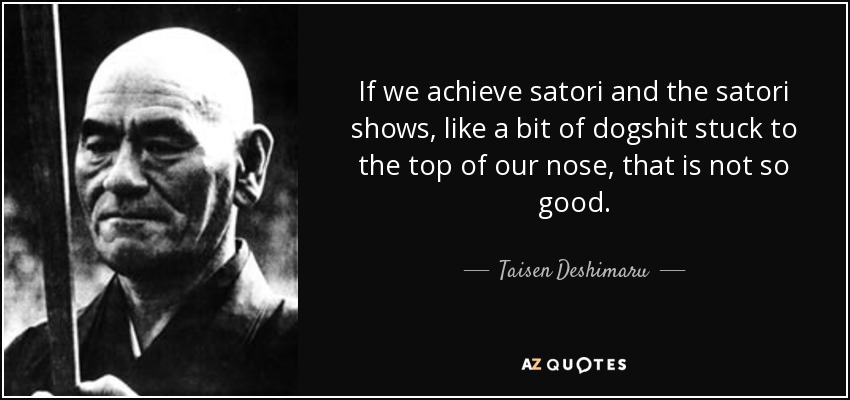
Lost In Our Delusions About Enlightenment - "The Stink Of Zen"
If you can spare 10 minutes, read this extended interview with Genpo Roshi talking about integrating enlightenment experiences and the "Stink Of Zen" or see it on video.
States Become Stages Become Sages
The initial state of awakening is a state that may only last briefly – but once we have experienced it, we can’t unlearn it.
And with practise, dedication and discipline that state becomes a more frequent part of our experience until eventually we enter it as a stage – where we can stop thinking at will – and access transcendent states of awareness at will.
The only difference between highly developed spiritual people and the rest of us is one of degree.
They have acquired or developed or been blessed with (however you choose
to express it) the capacity to enter and maintain a present
moment awareness state whenever they want to or need to and can do so at
will for as long as they choose to or need to – and then to re-engage with
the everyday dualistic world.
The key to this is having the capability to move freely between these states at will and NOT to become stuck in enlightenment or duality.
What is Nirvana?
The late Thich Nhat Hanh gave us a lucid and profound explanation that defines nirvana as the cessation of all suffering, and our suffering comes from our wrong perceptions...
The Neurology of The Enlightened State
Dr Andrew Newberg is regarded as one of leading pioneers in the field of neuroscientific study of religious and spiritual experiences, increasingly referred to as – neurotheology.
His research work focuses on the nature of religious and spiritual practices and experiences and specifically how brain function is associated with various mental states, especially the relationship between brain function and mystical or religious experiences.
Neurologist Dr Andrew Newberg explains:
How to find your own path to enlightenment
Further Reading:
Beginners Mind [Shoshin] And The Voice Of Experience
5 Zen Mindsets For Mastery - In Any Area Of Your Life
Return to: How To Practise Mindfulness"

LATEST ARTICLES


Why the Brain Replays Threat at Night - And What It’s Responding To
 Bad Dreams, Mental Overload, and the Cost of Unresolved Threat Processing in the Brain. Many people lie awake at night wondering why the mind turns hostile when the day goes quiet. Thoughts that felt…
The Kingdom Is Here, Now - Awakening Is Not Later
 What contemplative traditions point to - and how progress quietly replaces presence. Across contemplative traditions, a strikingly consistent message appears: truth is not somewhere else, not in the…
Adult Development Without Becoming Someone Else - Growth Without Identity Upgrade
 You do not grow by becoming someone else - you grow by placing authority where choice becomes possible. So much of what is written and taught about personal growth quietly assumes an identity upgrade…
Belief and Thought: What Zen Tools Works With - What It Leaves Alone
 A Clarification Of Scope Within Zen Tools - Not A Position On Belief As soon as people begin to notice their own thinking more clearly, questions about belief and thought naturally follow: - If though…
How Thought Becomes Identity - The Hidden Mechanism Behind Overthinking, Self-Worth, and Inner Conflict
 Thought Is an Event, Not a Self Most people believe identity is something they have - a stable sense of who they are. In reality, identity is something the mind is continuously producing. It is not fo…
When the Brain Is Hijacked - Where Does Choice Sit?"
 Pressure, the Hijacked Brain, and the Question of Authority
When the brain is hijacked, people are often told they have “lost control”.That language is understandable - and misleading. In reality, man…
Pressure, the Hijacked Brain, and the Question of Authority
When the brain is hijacked, people are often told they have “lost control”.That language is understandable - and misleading. In reality, man…Reduce Digital Overthinking To Lower Your Constant Inner Noise
 Why Constant Micro-Stimulation Increases Your Internal Noise. Modern digital life generates a level of mental activity that previous generations never had to deal with, and this is fundamentally why w…
Pausing Before You Act - Make It a Meta-Habit
 How A Tiny Moment Unlocks Clarity, Choice, And Self-Leadership. There is a moment in life so subtle you barely register it. A colleague questions your idea. A notification flashes. A moment of uncerta…
How to Interrupt Emotional Spirals Using Thought-Awareness
 The spiral is fueled by your mind believing the story your thoughts tell. No one sets out to be swept away by a surge of emotion. One second you’re handling life, and the next, your mind has broken in…
Universal Awareness and the Machinery of Thought
 You Can’t Control Thoughts - But You Can Learn To See Them. Why do our thoughts have so much power over us - and how do we reclaim clarity? The foundation of thought-awareness is the ability to see yo…
Rewiring Your Autopilot – How To Harness Your Subconscious Mind
 How to harness your subconscious mind and move from passenger to pilot. The case for rewiring your autopilot is that most of what drives your thoughts, reactions, and decisions happens below your cons…
Why You Need To Be Intimate With Your Own Thinking
 How self-awareness and insight transforms delusion into wisdom. We live inside an invisible weather system - one made not of clouds and wind, but of thoughts - and this invisibilty is why you need to…