Shantideva - The Way Of The Bodhisattva
Walking The Path Of Compassion
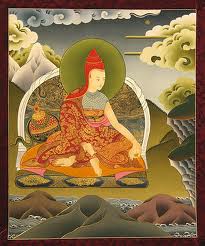
Shantideva the 8th century Indian Buddhist sage is famous for his treatise "The Way of the Bodhisattva" delivered as an extended teaching to the monks at the Buddhist university of Nalanda monastery.
Over the last 1,500 years Buddhist scholars and teachers have discussed at length the finer points of his teachings but at heart this classic Buddhist work can best be considered an "...essential guidebook on the ideal of compassion and the methods of attaining it". [Pema Chödrön]
In Buddhist terminology a "Bodhisattva" is someone who has taken a vow to put others first and to postpone his/her entry to Nirvana [a permanent state of enlightenment] until all other sentient beings have achieved enlightenment.
What Does This Really Mean?
This all sounds very worthy and dramatic, but what does this really mean in practice?
In my view there is an inherent faultline in the teachings of Buddhism and other major world religions, and it is this: ultimately its nearly all just words and concepts. They have practical value to the extent that they show us exactly what we can do, what steps we can take, to transform ourselves and our direct experience of life.
The cutting edge of this teaching from Shantideva is how you and I choose to live right now.
Commitment To Others
His Holiness the Dalai Lama, commenting on the text suggests says the real heart of Buddhism is complete commitment to others:
"In his famed text 'The Way of the Bodhisattva', Shantideva states that all happiness and joy are the consequences of cherishing the well-being of other sentient beings, while all problems, tragedies and disasters are the consequences of self-cherishing attitudes."
The recently departed, greatly revered and saintly Vietnamese Zen Master Thich Nhaht Hanh describes the Bodhisattva as:
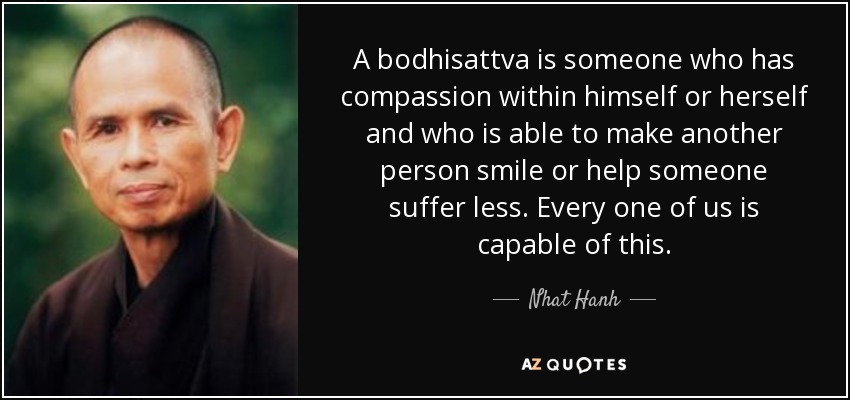
Compassion
The word compassion is derived from the Latin words "com pati" meaning to suffer with. It has been defined as an empathic understanding of a person's feelings, accompanied by
altruism, or a desire to act on that person's behalf.
In practical terms it is when you relate to someone’s situation, and you want to help them. You see someone having a hard time, and you show up beside them and offer a helping hand.
Compassion Is Good For All Involved
It is not only the recipient who benefits, so does the person who is behaving compassionately.
Alongside the spiritual benefits, there are many personal benefits to be derived from the
expression of compassion and some of these benefits
include:
-
Increasing feelings of social
connection
- A broadening ability to see a wider perspective outside of oneself
- A buffering effect against stress
- Increased perceptions of happiness
- An experience of pleasure
- An increase in longevity
- Reduced levels of cellular inflammation
Let's briefly consider 3 key takeaways from Shantideva
- The mindset of compassion
- The foundation of compassion
- The action of compassion
Shantideva - [1] The MINDSET Of Compassion Is Surrender

Surrender is often referred to as dying to self in the Christian tradition and dropping the ego in Buddhism.
This is about correcting the inbuilt, hardwired tendency to assume that everything revolves around me.
Dying to self and dropping the ego is not a one-time experience but a frequent activity that should be undertaken at least daily and often many times throughout the day.
It is a practice and it grows with focused attention and repetition.
Surrender occurs quite naturally when you quieten your mind with mindfulness practice and shift your focus away from yourself by putting someone else first and acting in a selfless way.
This practice is echoed in other major traditions.
In the Tao we are advised:
"If You Want To Be Given Everything, Give Everything Up." [Tao Te Ching [22]]
The Bible says:
"Whoever seeks to preserve his life will lose it, but whoever loses his life will keep it." [Gospel of Luke 17.33]
Shantideva - [2] The FOUNDATION Of Compassion Is Mindfulness

The practise of mindfulness will enable you:
- To witness or observe (without narrative or analysis) the recurring or autonomic nature of your thoughts and feelings.
- To watch how your very own inner "personal-map-of-reality" filters your interpretation of your experience.
- To see how you become immersed in and identified with your thoughts and feelings.
- To learn how to stop thinking – to turn your thoughts off - at will.
Thich Nhat Hanh gave us a lucid and profound explanation that defines nirvana as the cessation of all suffering, and how our suffering comes from our wrong perceptions.
He explains how the practise of mindfulness can enable us to look deeply and remove our wrong perceptions.
Shantideva - [3] The ACTION Of Compassion Is Engagement
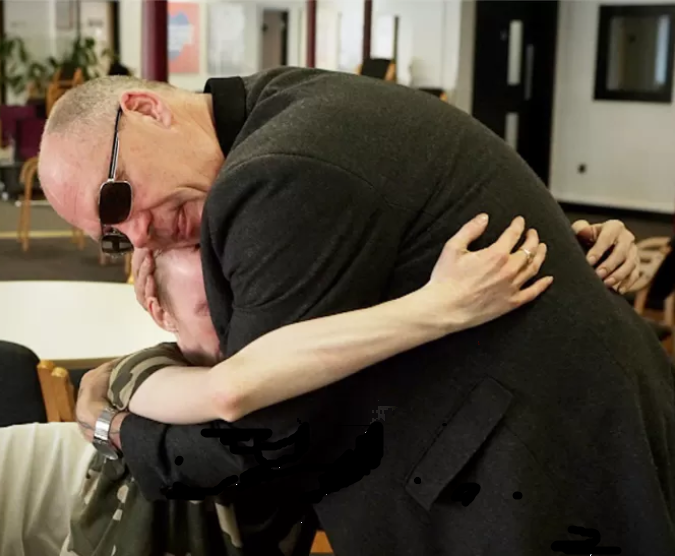
"I can't cope with life, I just don't want to live any more," says a woman's softly spoken voice. "Nobody has listened, I just want to go to sleep and not wake up."
Mick, head in hands, tries to reassure her.
"I
know that feeling," says Mick, "but there is a light that is stronger
than the darkness...
"I just don't want to live, Mick, I'm in a dark tunnel and can't get out," says the woman.
He pleads with her. "There's always hope..."
Mick wants others who have had troubles to find hope - just like he has.
In his 20s, Mick was a drug dealer consumed by cocaine and violence. He has now found faith and feeds the poor at his "Church On The Street" in Burnley, UK.
Pastor Mick is a good example of the engagement of compassion.
Be The Light At The End Of Someone Else's Tunnel Of Darkness

To be the light at the end of someone else's tunnel of darkness means to offer hope, encouragement, kindness and compassion to someone else who needs it.
His Holiness The Dalia Lama makes the point that it is in our self interest to do this:
"Even from the point of view of our own self-interest, if others are happy and satisfied, then we ourselves can also be happy.
If you want others to be happy, practice compassion. If you want to be happy, practice compassion."
He continues:
"Furthermore, based on our own personal experience, we can observe that the more we hold on to a strong sense of self—cherishing our own self-interest—the greater our own emotional and psychological problems."
On Becoming The Ferryman

"Compassion is threatening to the ego. We might think of it as something warm and soothing, but actually it’s very raw.
When we set out to support other beings, when we go so far as to stand in their shoes, when we aspire to never close down to anyone, we quickly find ourselves in the uncomfortable territory of 'life not on my terms'.” [Pema Chödrön]
The traditional life of The Ferryman is all about transporting passengers from one side of a river or estuary to the other. He is needed where the water is too deep for a crossing on foot and where there is no bridge.
In literature and mythology he is often seen as an agent of transition from life to death.
In Buddhist thought and teaching The Ferryman is a metaphor for the Bodhisattva as a champion of compassion.
- The Ferryman knows that we all cross the river of life together, that we are all in the same boat, we are all fundamentally want the same things.
- The attitude of The Ferryman is that the pain that usually drags you down and causes you to withdraw into yourself is the stepping-stone for awakening your compassion and your understanding of the pain of others.
- The Ferryman seeks the best in all people and does his or her best to help everyone open to their true nature together.
Applying Shantideva - One Step At A Time

- The path of compassion is altruistic but not idealistic.
- Walking this path we are not asked to lay down our life, find a solution for all of the struggles in this world, or immediately rescue all beings.
- The path of compassion is cultivated one step and one moment at a time.
- Each of those steps lessens mountains of sorrow in the world.
Further Reading:
5 Zen Mindsets For Mastery - In Any Area Of Your Life
Tao Te Ching - Connecting To Your True Source Of Power
Return from "Shantideva" to: Walking The Talk

LATEST ARTICLES


The Kingdom Is Here, Now - Awakening Is Not Later
 What contemplative traditions point to - and how progress quietly replaces presence. Across contemplative traditions, a strikingly consistent message appears: truth is not somewhere else, not in the…
Adult Development Without Becoming Someone Else - Growth Without Identity Upgrade
 You do not grow by becoming someone else - you grow by placing authority where choice becomes possible. So much of what is written and taught about personal growth quietly assumes an identity upgrade…
Belief and Thought: What Zen Tools Works With - What It Leaves Alone
 A Clarification Of Scope Within Zen Tools - Not A Position On Belief As soon as people begin to notice their own thinking more clearly, questions about belief and thought naturally follow: - If though…
How Thought Becomes Identity - The Hidden Mechanism Behind Overthinking, Self-Worth, and Inner Conflict
 Thought Is an Event, Not a Self Most people believe identity is something they have - a stable sense of who they are. In reality, identity is something the mind is continuously producing. It is not fo…
When the Brain Is Hijacked - Where Does Choice Sit?"
 Pressure, the Hijacked Brain, and the Question of Authority
When the brain is hijacked, people are often told they have “lost control”.That language is understandable - and misleading. In reality, man…
Pressure, the Hijacked Brain, and the Question of Authority
When the brain is hijacked, people are often told they have “lost control”.That language is understandable - and misleading. In reality, man…Reduce Digital Overthinking To Lower Your Constant Inner Noise
 Why Constant Micro-Stimulation Increases Your Internal Noise. Modern digital life generates a level of mental activity that previous generations never had to deal with, and this is fundamentally why w…
Pausing Before You Act - Make It a Meta-Habit
 How A Tiny Moment Unlocks Clarity, Choice, And Self-Leadership. There is a moment in life so subtle you barely register it. A colleague questions your idea. A notification flashes. A moment of uncerta…
How to Interrupt Emotional Spirals Using Thought-Awareness
 The spiral is fueled by your mind believing the story your thoughts tell. No one sets out to be swept away by a surge of emotion. One second you’re handling life, and the next, your mind has broken in…
Universal Awareness and the Machinery of Thought
 You Can’t Control Thoughts - But You Can Learn To See Them. Why do our thoughts have so much power over us - and how do we reclaim clarity? The foundation of thought-awareness is the ability to see yo…
Rewiring Your Autopilot – How To Harness Your Subconscious Mind
 How to harness your subconscious mind and move from passenger to pilot. The case for rewiring your autopilot is that most of what drives your thoughts, reactions, and decisions happens below your cons…
Why You Need To Be Intimate With Your Own Thinking
 How self-awareness and insight transforms delusion into wisdom. We live inside an invisible weather system - one made not of clouds and wind, but of thoughts - and this invisibilty is why you need to…
The Illusion of Closeness in Always-On Relationships
 Closeness that cannot survive absence was never intimacy - only constant stimulation mistaken for connection. We live inside an unprecedented experiment in human connection. For the first time in hist…