Be The Light At The End Of Someone Else's Tunnel
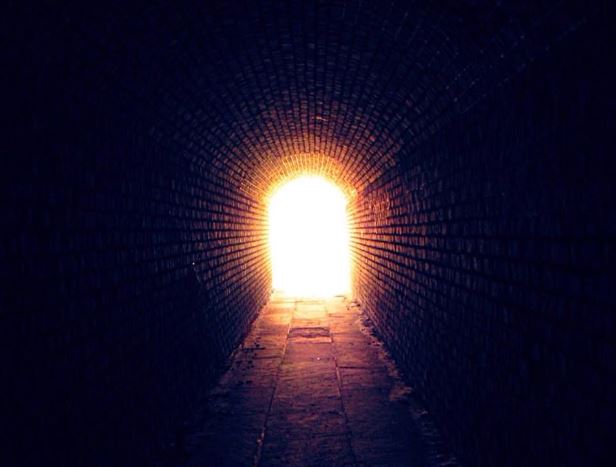
What Does It Mean To Be the Light?
"I can't cope with life, I just don't want to live any more," says a woman's softly spoken voice. "Nobody has listened, I just want to go to sleep and not wake up."
Mick, head in hands, tries to reassure her.
"I
know that feeling," says Mick, "but there is a light that is stronger
than the darkness...
"I just don't want to live, Mick, I'm in a dark tunnel and can't get out," says the woman.
He pleads with her. "There's always hope..."
Mick wants others who have had troubles to find hope - just like he has. In his 20s, Mick was a drug dealer consumed by cocaine and violence. He has now found faith and feeds the poor at his Church On The Street in Burnley, UK.
Believing There Is A Light At The End Of The Tunnel
A notable proponent of believing in the light at the end of the tunnel was the late James Stockdale, former US vice presidential candidate, naval commander and prisoner of war during the America-Vietnam war and who survived 8 years of imprisonment and torture.
Stockdale had an unshakeable faith that he would eventually, one day, be released and return home to his family:
“I never lost faith in the end of the story. I never doubted not only that I would get out, but also that I would prevail in the end and turn the experience into the defining event of my life, which, in retrospect, I would not trade.”
But Admiral Stockton balanced his faith in the light at the end of his tunnel with the discipline to confront the most brutal facts of his everyday reality as prisoner of war.
Stockton had no place for optimism:
“The optimists... Oh, they were the ones who said, ‘We’re going to be out by Christmas.’ And Christmas would come, and Christmas would go. Then they’d say, ‘We’re going to be out by Easter.’ And Easter would come, and Easter would go. And then Thanksgiving, and then it would be Christmas again. And they died of a broken heart..."
"You must never confuse faith that you will prevail in the end — which you can never afford to lose — with the discipline to confront the most brutal facts of your current reality, whatever they might be."
This balance between realism and hope in a dire situation has become known as The Stockdale Paradox.
The UK journalist, broadcaster and Rector Giles Fraser echoes this point:
But What About Those Of Us Who Travel Most Of Our Way To Heaven By Night...
Admiral James Stockton and the Rev Giles Fraser are both men of faith
Stockton was a believer in Stoicism and a keen follower of Epitetus and Fraser is a believer in Christianity.
What about those of us of little or no faith?
What about those of us who feel that we have been so let down by life that faith in anything is just a chimera, an illusion, a wisp of smoke on the breeze...?
I want to offer a perspective that is grounded in my own experience. I am experiencing intractable problems that I have lived with for over 20 years and that from time to time cause me to feel so full of despair and shame at my inability to resolve them that I don't want to carry on.
Let me just make clear that I am very blessed in many areas of life and I am surrounded by supportive caring friends and family, and that thankfully I am not depressive. I also know that compared with so many I lead a privileged life.
But nevertheless, the attrition factor of the constant keeping on keeping on sometimes feels too much, and the older I get the stronger this feeling becomes, but I have learned 3 things:
- That there maybe no single all encompassing solution that will allow me, with one jump, to be free and until there is, I face a continuum of experiences to each of which I have a choice as to how I will respond.
- It is the cumulative and compounding effect of these responses that will transform my situation.
- The most powerful key to seeing the light at the end of my personal tunnel is to shift my focus away from myself and my situation and look for opportunities to be the light to someone else.
This website is one such way. Every time I write and post another article, I hold in mind the hope that somewhere, sometime, someone will read it and it will become a light at the end of their personal tunnel of darkness.
Further Reading:
- Burnley's Pastor Mick: ‘If I lock this door, he dies’
- I plotted to kill my rapist
- Giles Fraser- Secular Christmas is a lie
Next Article: Asking The Right Questions
Return from "Be The Light" to: Walking The Talk
Or to: What Is Spirituality?

LATEST ARTICLES


Belief and Thought: What Zen Tools Works With - What It Leaves Alone
 A Clarification Of Scope Within Zen Tools - Not A Position On Belief As soon as people begin to notice their own thinking more clearly, questions about belief and thought naturally follow: - If though…
How Thought Becomes Identity - The Hidden Mechanism Behind Overthinking, Self-Worth, and Inner Conflict
 Thought Is an Event, Not a Self Most people believe identity is something they have - a stable sense of who they are. In reality, identity is something the mind is continuously producing. It is not fo…
When the Brain Is Hijacked - Where Does Choice Sit?"
 Pressure, the Hijacked Brain, and the Question of Authority
When the brain is hijacked, people are often told they have “lost control”.That language is understandable - and misleading. In reality, man…
Pressure, the Hijacked Brain, and the Question of Authority
When the brain is hijacked, people are often told they have “lost control”.That language is understandable - and misleading. In reality, man…Reduce Digital Overthinking To Lower Your Constant Inner Noise
 Why Constant Micro-Stimulation Increases Your Internal Noise. Modern digital life generates a level of mental activity that previous generations never had to deal with, and this is fundamentally why w…
Pausing Before You Act - Make It a Meta-Habit
 How A Tiny Moment Unlocks Clarity, Choice, And Self-Leadership. There is a moment in life so subtle you barely register it. A colleague questions your idea. A notification flashes. A moment of uncerta…
How to Interrupt Emotional Spirals Using Thought-Awareness
 The spiral is fueled by your mind believing the story your thoughts tell. No one sets out to be swept away by a surge of emotion. One second you’re handling life, and the next, your mind has broken in…
Universal Awareness and the Machinery of Thought
 You Can’t Control Thoughts - But You Can Learn To See Them. Why do our thoughts have so much power over us - and how do we reclaim clarity? The foundation of thought-awareness is the ability to see yo…
Rewiring Your Autopilot – How To Harness Your Subconscious Mind
 How to harness your subconscious mind and move from passenger to pilot. The case for rewiring your autopilot is that most of what drives your thoughts, reactions, and decisions happens below your cons…
Why You Need To Be Intimate With Your Own Thinking
 How self-awareness and insight transforms delusion into wisdom. We live inside an invisible weather system - one made not of clouds and wind, but of thoughts - and this invisibilty is why you need to…
The Illusion of Closeness in Always-On Relationships
 Closeness that cannot survive absence was never intimacy - only constant stimulation mistaken for connection. We live inside an unprecedented experiment in human connection. For the first time in hist…
Why Approval Feels Like Safety And Distance Feels Like Danger
 Safety is not found in being approved - it appears when approval is no longer required. When approval feels like safety, connection stops being something we enjoy and quietly becomes something we rely…
You Do Not Need Better Boundaries - You Need Clearer Thought
 What no longer feels like your responsibility no longer crosses your boundaries. This article explains why you don’t need better boundaries - you need clearer thought - how modern life systematically…