The ETTO Principle
Why Near Enough Can Be Good Enough
How To Balance the Efficiency-Thoroughness Trade Off

Introduction
The ETTO Principle was introduced by Professor Erik Hollnagel in 2009 and he describes the inherent trade-off between working efficiently and working thoroughly.
This trade-off is something that affects us all both in our working lives and also in our personal lives.
We are all under pressure to perform and to deliver.
Expectations are high.
Many of us are also under pressure to perform as fast as possible and at lowest possible resource cost, they call this "production efficiency".
We also operate in an environment of ever-increasing competition.
Modern life is no longer complicated it is complex. Knowing which levers to pull is hard when there is no obvious direct link between cause and effect. It's no longer enough to understand the part to understand the whole.
In this article I am going to share two practical tools that you can use to manage this trade-off and that will help reduce your stress and feelings of overwhelm. It will also make you more efficient!
These tools are:
More bricks with less straw
Hollnagel observes that it is a common characteristic of human performance, whether individual or collective, that the resources that we need to do something are nearly always too few.
Most commonly we do not have enough time, but other resources such as information, materials, tools, energy, and manpower may also be in short supply.
Human resourcefulness
However, we usually manage to meet the requirements of acceptable
performance by adjusting how we do things to meet the demands and the
current conditions - or in other words to balance demands and
resources.
Hollnagel notes that this ability to adjust performance to match the conditions can be seen as a trade-off between efficiency and thoroughness which is described by The ETTO principle, and can be summarise as follows:
"In their daily activities, at work or at leisure, people (and organisations) routinely make a choice between being effective and being thorough, since it rarely is possible to be both at the same time.
If demands to productivity or performance are high, thoroughness is reduced until the productivity goals are met. If demands to safety are high, efficiency is reduced until the safety goals are met.
It follows from the ETTO principle that it is never possible to maximise efficiency and thoroughness at the same time."
The ETTO Principle - Summary & Resources
There are nearly always 2 driving forces at play:
[1] The drive for Efficiency

- Focuses on achieving goals with minimal time, effort and resources.
- This is all about maximising an opportunity at the lowest possible cost of all resources.
- "Get it done as quickly as posssible for the lowest possible cost".
- But... prioritising efficiency might save time and money but could increase the risk of errors and failure and the consequential loss and damage that may occur.
[2] The drive for Thoroughness

- Focuses on achieving reliability, durability and safety.
- By identifying and taking account of all potential risks, variations, and details that are sufficent and necessary to achieve the required reliability, durability and safety.
- "Failure is not an option."
- But if we prioritise thoroughness and enhance reliability, durability and safety this will come at a cost of time and/or resources and may also come as an opportunity cost against other projects and priorities.
The ETTO principle acknowledges that this trade-off is:
- Dynamic
- Context-dependent
- Influenced by factors like urgency, available resources, and task criticality.
Note:
I said there are "nearly always" two driving forces because there are some situations that are so huge that there is only one driving force and Governments will do anything and pay anything to get the required solution. The 2008 Global Financial Crisis and the 2019 Covid pandemic are relatively recent examples of this, and are the exception rather than the rule.
Resources:
Hollnagel is a psychologist by training and has a major focus on safety and resilience. He has undertaken work related to system management and performance, system safety, resilient health care, resilience engineering, human reliability analysis.
Hollnagel's basic explanatory notes re the ETTO Principle
Hollnagel's expanded notes re the ETTO Principle
Applying The ETTO Principle
The 70% Rule

If you want a statistical explanation of all this read Taylor Pearson's excellent article on "The 70% Rule"
In Summary
In summary, the 70% rule is a general principle used across various disciplines to ensure efficiency, practicality, and balance.
It suggests that completing something to 70% is often sufficient for establishing significant progress without requiring perfection.
Please note:
- There are some situations where a fully optimized delivery is essential e.g brain surgery, building a space rocket.
- This is a general rule - we are not all brain surgeons nor are we building a Spacex rocket.
- There are also some situations where 70% is sufficient.
Here's how it applies:
Productivity and Time Management
Definition
Focus on completing tasks to 70% of perfection rather than striving for 100%, which can lead to diminishing returns and may not even meet full expectations.
So, rather than driving yourself crazy trying to finish what you started to a level of perfection, just deliver it as soon as your project or initiative reaches a basic acceptable level or when you have reached the due date for finishing/delivering it.
In many [but not all] situations, where hitting delivery dates [milestones] form part of the key performance indicators the customer, client or user would rather see a well developed version at 70% than a missed delivery.
Why It Works
It allows the customer, client or user early sight of the delivery and
- here's the secret sauce
- it
creates an opportunity for iterative collaboration to adapt, amend and enhance and thus ensure the full delivery meets highest expectations.
Example From My Own Experience
Some years ago I was working with a programme director on a very large IT project. There were continual delays on getting each phase of the software released and delivered by the developers, and key project milestones were being missed.
We changed the delivery protocol with the developers and insisted they always deliver on time. The project milestones had to be hit.
As you can imagine, the developers [these were 3 large sub-contracting companies] went crazy and said they could not meet these deadlines and deliver to full specification.
We told them to deliver what was ready by the due date - regardless of the level of completion - and then to issue subsequent updated releases over the following week or two until the original delivery was at full spec.
Improving the end user/customer's experience
This gave the business users early visibility of the software as it was
being built and subsequently led to higher, and earlier, levels of user
acceptance.
Following this change of procedure we ensured that all subsequent 181 milestones were hit [not one was missed] over the following 9 months.
The system was delivered on time and in budget and passed all user acceptance testing with flying colours!
Satisficing - When Near Enough Is Good Enough
In Summary
The phrase "When Near Enough Is Good Enough" is commonly used to express the idea that perfection isn’t always necessary, and that an approximate result or solution can suffice depending on the context.
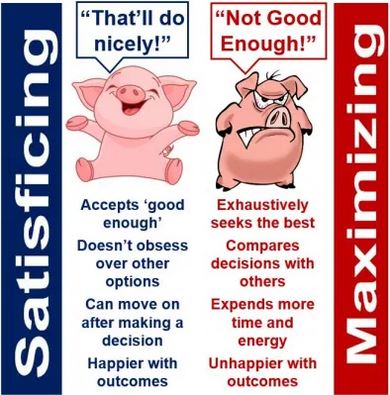
This is known as satisficing - a term that was
introduced by Herbert A. Simon (1916-2001), an American economist, political
scientist, sociologist and computer scientist in his 1956 paper, “Rational
Choice and the Structure of the Environment”.
Summary Overview
- A decision-making process that strives for adequate rather than perfect results.
- A pragmatic approach that saves on time, resources and costs by narrowing the range of options considered to achieve an adequate outcome.
- Not engaging in intensive, complex, and exhaustive efforts to attain the optimised solution.
- Adopting a more minimalist approach that looks for the first solution that meets basic acceptable outcomes.
The opposite decision-making process to satisficing is optimisation [or maximisation] where you collate and analyse all the necessary data that is required to make the optimal choice.
Balancing Satisficing With Task Optmisation
- This is about knowing the point at which continued focused activity on a task takes you beyond the point which meets your predetermined requirements.
- This is about knowing the point at which an essential task becomes inessential.
- You also need to establish clear metrics that enable you to know when you have reached that optimum point.
How to satisfice a decision
- Establish your requirements — work out upfront what you’ll need to be satisfied.
- Allocate the resources - decide just how much time, energy and resource you’ll need to put in.
- Search for an option - that meets those requirements within the allocated resources.
- Stop when you find a satisfactory option — satisficed!
Example From My Own Experience
When I started this website, I worked to a schedule of creating and posting one webpage per day.
In order to achieve this successfully I needed to accomplish a series of tasks in a specific sequence and within a defined time window.
So, in the morning I knew that my subject for that day and in order to achieve my objective for the day there were 3 main tasks.
1] Reading and research of subject material for the article and considering my own real life experiences in the area of this subject.
2] Drafting and formatting the material.
3] Posting this material as a webpage.
After a while, I found from considerable experience of this process that I needed about two to three hours for steps 2 and 3, but unless I was careful step 1 could take far longer than it should.
One morning I found myself getting drawn deeper and deeper into the physics of the subject I was writing about, which as a non-academic I found interesting and challenging.
After a while I realised that I was wasting time and that continued research was beyond the scope of the article I was writing. So, in practical terms, I had reached the optimum allocation of resource and effort that was required to complete step 1, and I moved on to steps 2 and 3.
Further Reading:
Speed And Velocity - Not To Confuse Activity With Accomplishment
Finish What You Start - Action Will Destroy Your Procrastination
Understanding Complex Systems Thinking - It's Not Complicated
Return from: "The ETTO Principle" to: Walking The Talk Or Mental Models
Next Article:
Master The Art Of Drawing The Bow - Focus On Process Not Outcome

LATEST ARTICLES


When Relationships Become Identity - Self-Worth is Based On Connection
 Much of our relationship suffering comes from a subtle cognitive shift in which relationships become fused with identity. When relationships become identity, connection is no longer simply experienced…
How Digital Communication Fuels Relationship Anxiety
 Micro-Signals, Macro-Meaning. Modern relationships based on digital communication do not usually break down because of betrayal, cruelty, or lack of care. They fracture under the weight of interpretat…
Why Absence Feels Like Rejection - Thought Patterns in Relationships
 The mind doesn’t just experience absence. It interprets absence. You send a message. It’s casual. Nothing heavy. Maybe a question, maybe a light comment. Normally you’d get a reply within an hour or t…
Why Insight Alone Does Not Change Behaviour - Locking In The Gains
 Insight Changes Understanding, But Not Jurisdiction. This article explores why insight alone does not change behaviour, not by dismissing thought awareness, but by showing what must come after it if c…
The Mechanics Of Inner Conflict - Not Confusing Signals As Instructions
 No Internal Signal Requires Immediate Obedience. Most people experience inner conflict as something emotional: tension, anxiety, guilt, hesitation, self‑doubt. It feels personal and psychological. Som…
Master The Season You Are In - The Key to Fulfilling Your Purpose
 To fulfil your purpose, you must first master the season you are in. One of the biggest mistakes you can make in life is focusing all your energy on the next season instead of learning to master the s…
The Inner Weight of Shame - Sustained By Attentional Fixation
 A Mind That Is Continuously Engaged In Self-Surveillance. Shame is one of the heaviest inner burdens a human being can carry. It does not announce itself loudly or demand attention through drama. Inst…
Does Prayer Work? The Psychology of Prayer, Meditation and Outcomes
 Reality Is A Complex System Of Countless Interactions - Including Yours. So does prayer work? The problem is that the question itself is usually framed in a way that guarantees confusion. We tend to a…
Living in Survival Mode Without Surrendering Mental Authority
Living in Survival Mode Without Surrendering Mental Authority
 Clear Thinking When You’re Just Trying to Stay Afloat. Many people today are overwhelmed because they are living in survival mode - not temporarily, but as a persistent condition of life. For many, th…
Manifestation Without Magic: A Practical Model
 Manifestation without magic is not a softer or more intellectual version of popular manifestation culture. It is a different model altogether. Popular manifestation teachings tend to frame reality as…
Staying Committed When You Can't See Progress - The Psychology of Grit
 Uncertainty Is Not The Absence Of Progress, Only The Absence Of Reassurance. One of the most destabilising experiences in modern life is not failure, but uncertainty and staying committed when you can…