Stages Of Learning
Why 95% Of Your Thoughts Are An Unconscious Competence
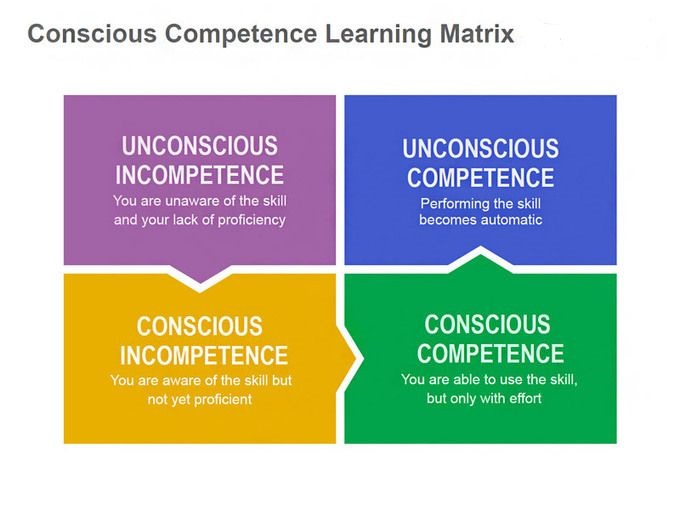
The stages of learning represented in the conscious competence model are a popular and intuitive approach.
The model is attributed to many different possible originators.
The primary value of the model is that it helps us to realistically manage our own emotions and expectations during what is often a difficult, prolonged and challenging learning process.
On this site, the stage of learning model is included in the same section as Bridges Transition Model and Kubler Ross Change Curve.
The purpose of these models is to put the business of personal change into a framework and context of what you may be encountering, and a framework for deeper understanding of what has to happen for your personal change goal to be achieved.
The 10,000 Hours Rule
We are probably all familiar with the "10,000-Hour Rule", based on a study by Dr. K. Anders Ericsson postulates that great achievement (based on great competence) requires an enormous amount of time, 10,000 hours to be precise.
“Many people think what Anders discovered is that quantity of practice makes you a champion,” said Angela Duckworth, a professor of psychology at the University of Pennsylvania. “That’s disastrously incomplete. It’s quantity AND quality. One of his insights that I hope will have a lasting legacy is people need to work hard, but also smart.”
Professor Ericsson focused on what he called “deliberate practice,” which entails immediate feedback, clear goals and focus on technique.
According to his research, the lack of deliberate practice explained why so many people reach only basic proficiency at something, whether it be a sport, pastime or profession, without ever attaining elite status.
Anders Ericsson, Psychologist and ‘Expert on Experts
The 4 Stages Of Learning
How to move from “I don’t know what I DON’T know” to “I don’t know what I DO know!
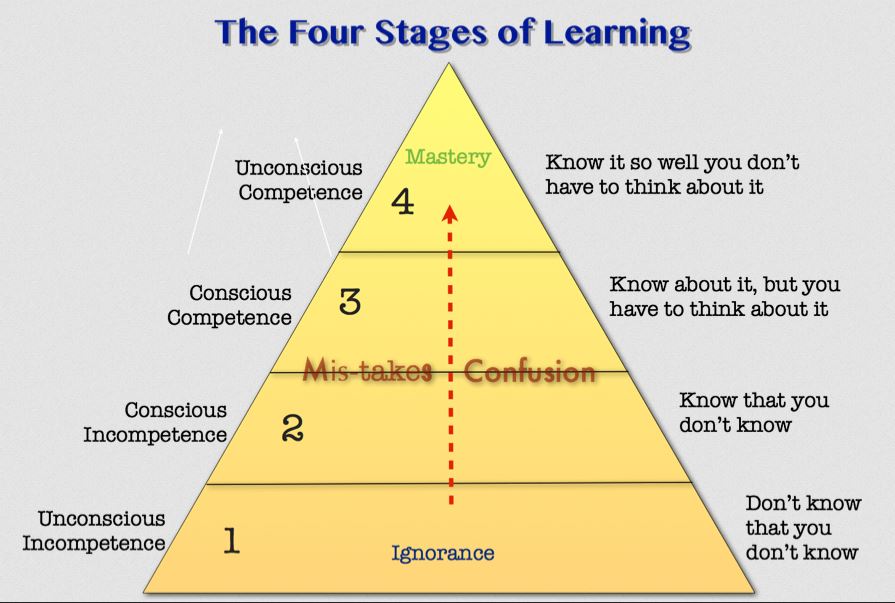
According to the conscious competence model there are 4 stages of learning:
Stages Of Learning 1. Unconscious Incompetence
You Don't Know that You Don't Know
At this stage you are in a state of blissful ignorance.
You have a complete lack of knowledge and skills in the subject in question.
On top of this, you are unaware of your lack of skill, and your confidence will therefore exceed your abilities.
Stages Of Learning 2. Conscious Incompetence
You Know that You Don't Know
At this stage you find that there are skills you need to learn, and it may come as a shock to find that there are others who are far more competent than you are.
As you realise this, your confidence drops, and you go through an uncomfortable period as you learn these new skills.
Stages Of Learning 3. Conscious Competence
You Know that You Know
At this stage you acquire the new skills and knowledge.
You put your learning into practice and you gain confidence in carrying out the tasks or jobs involved.
You are still concentrating on the performance of these activities, but as you gain more practice and experience, the exercising of these skills becomes increasingly automatic.
Stages Of Learning 4. Conscious Competence
You Don't Know that You Know – You Are Functioning On 'Auto-Pilot'"
At this stage your new skills are now habits, and you perform the task and exercise your skills without conscious effort – you are functioning “on-auto-pilot” and thus with ease.
You are now at the peak of your confidence and ability.
Personal change is not a hobby, and it is not a "pick and mix" counter. It is a serious business. You can read all you like about personal change and you may, over time, become well informed about it. But you won't change. You can make promises and commitments to yourself about personal change, buy all the latest books and DVDs and go to meditation classes - but still it unlikely that you will change. Managing personal change is inherently tricky. People usually assume that it is skills based, and that you can be taught to change. However, whilst it is true that you can be taught, generally you won't change. Your failure to achieve a personal change goal isn’t the result of a
lack of will-power, it’s your "emotional immune system" trying to
protect you. Most of our deepest beliefs were instilled in us by design or default when we were very young and their primary intention was to keep us safe. It is estimated that approximately 95% of your thoughts are subconscious To slightly amend Jung's famous saying : “Until you make the sub-conscious conscious, it will direct your life and you will call it fate.” So if we relate stages of learning to this, we are saying in effect that 95% of your thoughts are running as unconscious competence. Therefore to successfully implement any personal change goal you have to know how to uncover your innate resistance and make it conscious; and then to change, to know how to re-install a more supportive belief. All of this is the foundation of the purpose and core themes of this site, namely:
"Knowing how to think effectively matters because the outcomes that you
experience are determined by your responses to the events in your life.
The strength and quality of your response is determined by the skills
and the experience you bring to it - and that is all based on knowing
how to think effectively."
"How Can I Change" which sets out a framework involving the 4 key stages of personal change and 10 steps within these stages. "3 Keys Solutions" which are one page summary sheets of key action points and resources based on material on this site that will show you to take action now, to think effectively and to change your life. Personal change is hard, but it is possible. The compounded long term benefit to the improved quality of the outcomes you can achieve make it immensely worthwhile. But this is only for the committed: "Narrow is the gate and difficult is the way which leads to a better life, and there are few who find it." This site can help you become one of those few.
Further Reading: Rewiring Your Autopilot – How To Harness Your Subconscious Mind Return from "Stages Of Learning" to: Managing Personal ChangeStages Of Learning and Managing Personal Change
This can be paraphrased as: change comes from within.
As a start point, I would refer you to:

LATEST ARTICLES


Why the Brain Replays Threat at Night - And What It’s Responding To
 Bad Dreams, Mental Overload, and the Cost of Unresolved Threat Processing in the Brain. Many people lie awake at night wondering why the mind turns hostile when the day goes quiet. Thoughts that felt…
The Kingdom Is Here, Now - Awakening Is Not Later
 What contemplative traditions point to - and how progress quietly replaces presence. Across contemplative traditions, a strikingly consistent message appears: truth is not somewhere else, not in the…
Adult Development Without Becoming Someone Else - Growth Without Identity Upgrade
 You do not grow by becoming someone else - you grow by placing authority where choice becomes possible. So much of what is written and taught about personal growth quietly assumes an identity upgrade…
Belief and Thought: What Zen Tools Works With - What It Leaves Alone
 A Clarification Of Scope Within Zen Tools - Not A Position On Belief As soon as people begin to notice their own thinking more clearly, questions about belief and thought naturally follow: - If though…
How Thought Becomes Identity - The Hidden Mechanism Behind Overthinking, Self-Worth, and Inner Conflict
 Thought Is an Event, Not a Self Most people believe identity is something they have - a stable sense of who they are. In reality, identity is something the mind is continuously producing. It is not fo…
When the Brain Is Hijacked - Where Does Choice Sit?"
 Pressure, the Hijacked Brain, and the Question of Authority
When the brain is hijacked, people are often told they have “lost control”.That language is understandable - and misleading. In reality, man…
Pressure, the Hijacked Brain, and the Question of Authority
When the brain is hijacked, people are often told they have “lost control”.That language is understandable - and misleading. In reality, man…Reduce Digital Overthinking To Lower Your Constant Inner Noise
 Why Constant Micro-Stimulation Increases Your Internal Noise. Modern digital life generates a level of mental activity that previous generations never had to deal with, and this is fundamentally why w…
Pausing Before You Act - Make It a Meta-Habit
 How A Tiny Moment Unlocks Clarity, Choice, And Self-Leadership. There is a moment in life so subtle you barely register it. A colleague questions your idea. A notification flashes. A moment of uncerta…
How to Interrupt Emotional Spirals Using Thought-Awareness
 The spiral is fueled by your mind believing the story your thoughts tell. No one sets out to be swept away by a surge of emotion. One second you’re handling life, and the next, your mind has broken in…
Universal Awareness and the Machinery of Thought
 You Can’t Control Thoughts - But You Can Learn To See Them. Why do our thoughts have so much power over us - and how do we reclaim clarity? The foundation of thought-awareness is the ability to see yo…
Rewiring Your Autopilot – How To Harness Your Subconscious Mind
 How to harness your subconscious mind and move from passenger to pilot. The case for rewiring your autopilot is that most of what drives your thoughts, reactions, and decisions happens below your cons…
Why You Need To Be Intimate With Your Own Thinking
 How self-awareness and insight transforms delusion into wisdom. We live inside an invisible weather system - one made not of clouds and wind, but of thoughts - and this invisibilty is why you need to…