Applying Systems Thinking to Personal Behaviour, Teams & Relationships
The Hidden Feedback Loops That Turn Good Intentions Into New Problems In Personal Behaviour, Teams and Relationships

What Applying Systems Thinking Reveals About Human Behaviour
How Good Intentions Make Systems Worse
Applying systems thinking means understanding how behaviour emerges from interacting pressures, incentives, feedback loops, and assumptions rather than from isolated causes.
Many persistent problems in teams, relationships, and personal behaviour do not arise from bad intentions or lack of effort.
They arise because people misunderstand the systems they are operating within.
When difficulties appear, the instinctive response is to look for a direct cause and apply a direct fix.
- A team misses deadlines, so monitoring increases.
- Motivation falls, so pressure increases.
- Procrastination appears, so self-discipline is intensified.
These responses appear logical. Yet they often produce the opposite result.
- More pressure reduces motivation.
- More control generates resistance.
- More effort produces burnout.
These outcomes are not accidental. They reflect the human dynamics within complex systems.
__________
When Fixes Become Part of the Problem

One of the most common patterns in human systems is the backfire loop.
An intervention designed to solve a problem triggers reactions that unintentionally reinforce the original issue.
For example, consider a manager concerned about declining productivity. To increase accountability, the manager introduces stricter monitoring procedures.
Initially this appears logical. However the system response may include:
- Reduced autonomy
- Lower motivation
- Defensive behaviour
- Decreased initiative
Productivity falls further, prompting even tighter monitoring.
The intervention becomes part of a reinforcing loop that deepens the problem it was intended to solve.
Similar dynamics occur in many human environments.
- A parent increases control over a teenager and triggers resistance.
- A partner attempts to eliminate conflict through reassurance and unintentionally increases dependency.
- A person pushes harder against procrastination and intensifies avoidance.
These outcomes are not random failures. They are the predictable result of hidden feedback loops within the system.
__________
The Attempted Solution Trap

Another common pattern occurs when the attempted solution becomes the sustaining cause of the problem.
A difficulty appears and a corrective action produces temporary relief. But the deeper system dynamics remain unchanged.
Because the underlying conditions persist, the problem returns.
The same intervention is applied again, often more aggressively.
Examples include:
- Increasing pressure to improve performance
- Avoiding difficult conversations to maintain harmony
- Forcing motivation through self-criticism
Understanding this pattern is one of the most practical benefits of applying systems thinking to human behaviour.
The Iceberg Beneath Behaviour
The diagram below illustrates one of the most important insights in systems thinking.
Events are only the visible surface of a system. The deeper drivers lie beneath the waterline.
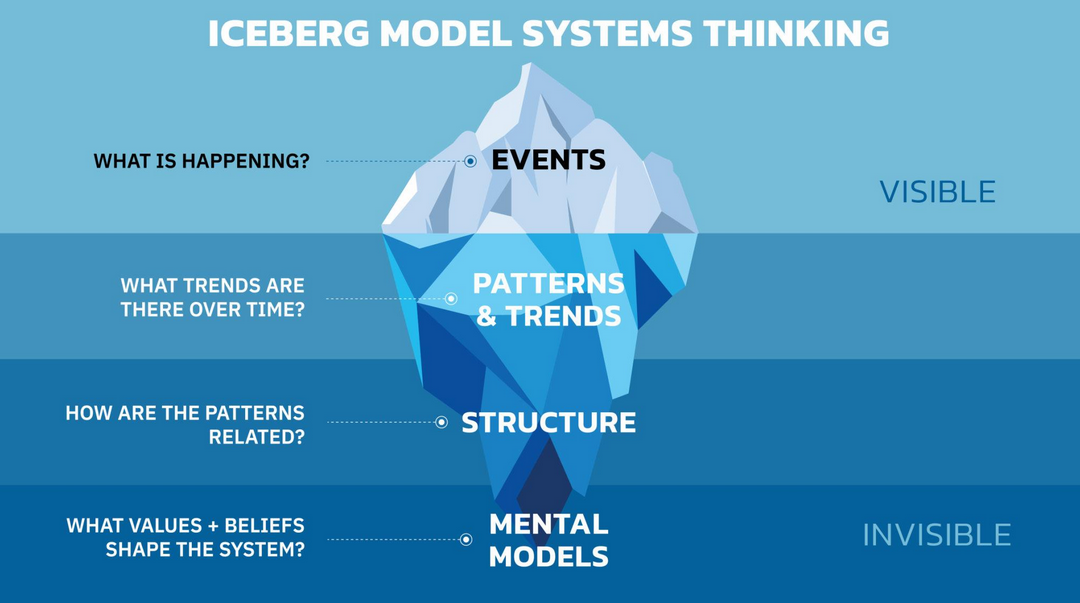
Four levels can be identified:
- Events
- Patterns
- System structures
- Group Culture
Each level requires different diagnostic questions and different forms of intervention.
Recognising these layers is essential when applying systems thinking to real-world problems.
__________
Diagnosing the Hidden Layers of Human Systems
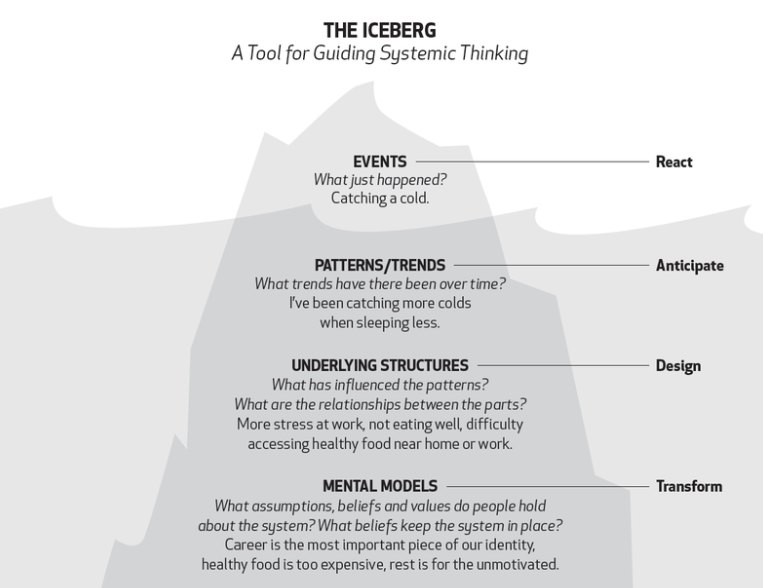
Level 1 — Events [Visible Symptoms]
Events are the immediate incidents we observe. Examples include:
- Missed deadlines
- Arguments
- Declining motivation
- Sudden mistakes
Most responses occur at this level because events are emotionally immediate. However interventions here usually represent weak leverage points.
Diagnostic questions:
- What exactly happened?
- Who experienced the impact?
- What triggered the event?
- How often does this occur?
These questions clarify the symptom but not the deeper cause.
__________
Level 2 — Patterns [Recurring Trends]
Patterns reveal that the event is not isolated. Examples include:
- Recurring missed deadlines
- Ongoing team conflict
- Repeated burnout cycles
- Persistent avoidance behaviour
Patterns shift attention from reaction to anticipation.
Diagnostic questions:
- When has this happened before?
- What usually happens before the problem appears?
- What behaviour typically follows the event?
- Who benefits or loses from this pattern?
Patterns often reveal the feedback loop sustaining the behaviour.
__________
Points of Increasing Leverage
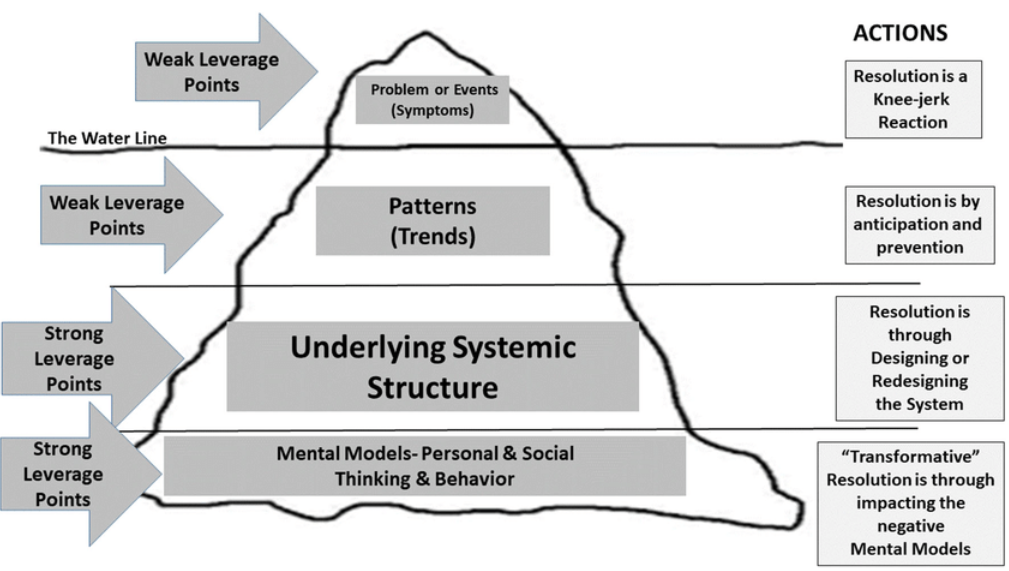
Level 3 — System Structures [Conditions Producing Behaviour]
Structures are the arrangements shaping behaviour. Examples include:
- Incentive systems
- Authority structures
- Information flow
- Workload distribution
- Decision rights
Structures generate behavioural pressures that individuals respond to.
Diagnostic questions:
- What incentives encourage this behaviour?
- What pressures shape people’s choices?
- What signals does the system send about success or failure?
- Where is decision authority unclear?
Changes at this level often produce far greater leverage than reacting to events.
__________
Level 4 — Cultural Assumptions [Group Culture]
At the deepest level of human systems sit the shared assumptions and cultural expectations that shape behaviour - "how we do things round here".
These assumptions are rarely stated explicitly, yet they influence how people interpret success, authority, responsibility, and acceptable behaviour.
See: Group Culture - The Invisible Software That Rules Your Life
Examples include:
- “Working long hours proves commitment.”
- “Leaders must always control outcomes.”
- “Conflict should be avoided.”
- “Mistakes are unacceptable.”
These cultural assumptions quietly shape the structures and incentives that generate behaviour patterns within the system.
- What beliefs about success are influencing behaviour?
- What assumptions guide decisions in this system?
- What behaviour is rewarded socially?
- What fears or identity pressures may be driving reactions?
This level often provides the strongest leverage for change.
The Impact Of Reactive or Reflective Decision Making in Human Systems

A distinctive challenge in human systems occurs when decision-making authority shifts away from reflective judgement and collapses into reactive signals
This phenomenon can be called [decision making] authority collapse and it occurs when urgent thoughts, emotions, or identity pressures automatically dictate behaviour.
Examples include:
- Fear driving defensive decisions
- Urgency driving rushed choices
- Identity threats triggering conflict
- Emotional reactions escalating disagreement
When authority collapses in this way, people react to the loudest signal in the system, rather than responding deliberately and reflectively to the situation.
These reactions often intensify the very feedback loops causing the problem.
Zen Tools describes the alternative as Authority Above Thought which means that whilst thoughts may arise freely, the decision-making authority over those thoughts is held at a higher-level decision point aligned with values and context, rather than automatically granted to the thought itself.
This brief shift interrupts reactive system responses. From this reflective position, it becomes possible to observe the system dynamics before intervening.
Systems awareness reveals the feedback loop. Decision making authority relocation prevents the automatic reaction that would reinforce it.
__________
A Systems Insight About Individual Agency
Systems thinking explains the pressures operating within a group, and group culture explains how those pressures are interpreted and normalised.
Yet every individual inside the system still encounters a decision point in the moment of response:
- When decision-making authority is automatically handed to urgency, fear, or identity pressure, behaviour simply reinforces the existing system dynamics.
- But when an individual recognises that moment and deliberately places decision-making authority above the immediate reaction, the quality of their response changes.
- That change may appear small, yet in complex human systems it alters the signals circulating within the group — tone, escalation patterns, expectations, and behavioural norms.
- Over time, such shifts can propagate through feedback loops, meaning that a reflective response from one agent can sometimes exert a disproportionate influence on the wider system.
__________
The Leverage Point: The Reflective Agent
Complex systems research repeatedly shows that small interventions at key leverage points can have disproportionate impact.
An individual acting reflectively inside a reactive system can become such a leverage point.
For example, one:
- Calm response interrupts an escalating conflict
- Person refusing urgency slows a panic loop
- Leader modelling reflective decision-making shifts team norm
Turning Hidden Feedback Loops Into Positive Ones

Feedback loops do not only create problems. They can also reinforce positive behaviour when systems are designed carefully.
Several principles help redirect feedback loops toward constructive outcomes:
# Align Incentives With Desired Behaviour
People naturally follow the signals embedded in a system.
If collaboration is rewarded, collaboration increases.
If visible busyness is rewarded, busyness increases.
Systems amplify whatever behaviour they signal as valuable.
# Improve Information Flow
Many dysfunctional loops persist because people lack accurate feedback.
Clear information about results allows behaviour to adjust constructively.
Examples include:
- Transparent performance data
- Open communication channels
- Regular reflection on outcomes
Better information allows systems to self-correct.
# Clarify Decision-Making Authority
Ambiguity around decision authority often creates delay, conflict, and defensive behaviour.
Clear authority structures reduce friction and improve responsiveness.
This principle applies equally within organisations and personal decision-making.
# Reduce Reactive Pressure Signals
Constant urgency creates feedback loops of stress, errors, and further pressure.
Reducing unnecessary urgency signals allows behaviour to stabilise and improve.
# Strengthen Reflective Decision-Making
Many destructive feedback loops arise because immediate emotional reactions dictate behaviour.
By briefly relocating decision-making authority above thought, individuals create the space needed to respond deliberately.
This simple pause prevents reactive interventions from reinforcing negative system dynamics.
__________
A Practical Systems Question
Before intervening in a problem, a useful question is:
“If the system adapts to this action, what behaviour might it encourage?”
This single question often reveals unintended consequences before they occur.
Closing Reflections on Applying Systems Thinking

A Different Way to Approach Human Problems
Human behaviour does not occur in isolation. It emerges from systems of incentives, expectations, pressures, and beliefs.
When interventions ignore these dynamics, well-intentioned actions can unintentionally reinforce the problems they were meant to solve.
By applying systems thinking, individuals begin to see behaviour as the visible expression of deeper system structures.
And by maintaining decision-making authority above reactive signals, they avoid strengthening the feedback loops that sustain dysfunction.
Understanding both the system and the decision point from which we respond allows interventions to become more thoughtful, more strategic, and ultimately more effective.
__________
Reflection Points
- When a recurring difficulty appears in your work or relationships, what immediate fix do you instinctively reach for?
- Have you observed situations where repeated attempts to solve a problem seem to reinforce it instead?
- What signals might the people in your environment be responding to that you may not have considered?
- Are there patterns in your own behaviour that persist despite repeated attempts to correct them?
- What deeper structures or assumptions might be shaping those patterns?
Action Points
- Before reacting to a behavioural problem, pause long enough to identify whether you are seeing an event or a pattern.
- Look for feedback loops rather than single causes. Ask how the system might respond to your intervention.
- Consider whether incentives, authority structures, or expectations may be shaping the behaviour you observe.
- Practise briefly placing decision-making authority above immediate emotional reactions before intervening.
- Focus on understanding the system dynamics before attempting to impose control.
Academic References (Minimal Authority List)
- Sterman, J. (2000). Business Dynamics: Systems Thinking and Modeling for a Complex World.
- Senge, P. (2006). The Fifth Discipline.
- Meadows, D. (2008). Thinking in Systems: A Primer. Chelsea Green Publishing.
Recommended Further Reading
- Understanding Complex Systems Thinking – It's Not What You Think
- The Illusion of Inevitability in Complex Decisions
- Not Every Urge Is a Decision: The Missing Gap Between Feeling & Action
- How Thought Becomes Identity – Overthinking & The Loss of Perspective
Return from: "Applying Systems Thinking" to: Home Page or Inner Mastery For Outer Impact
Next Article: The Illusion of Inevitability in Complex Decisions

LATEST ARTICLES


Belief and Thought: What Zen Tools Works With - What It Leaves Alone
 A Clarification Of Scope Within Zen Tools - Not A Position On Belief As soon as people begin to notice their own thinking more clearly, questions about belief and thought naturally follow: - If though…
How Thought Becomes Identity - The Hidden Mechanism Behind Overthinking, Self-Worth, and Inner Conflict
 Thought Is an Event, Not a Self Most people believe identity is something they have - a stable sense of who they are. In reality, identity is something the mind is continuously producing. It is not fo…
When the Brain Is Hijacked - Where Does Choice Sit?"
 Pressure, the Hijacked Brain, and the Question of Authority
When the brain is hijacked, people are often told they have “lost control”.That language is understandable - and misleading. In reality, man…
Pressure, the Hijacked Brain, and the Question of Authority
When the brain is hijacked, people are often told they have “lost control”.That language is understandable - and misleading. In reality, man…Reduce Digital Overthinking To Lower Your Constant Inner Noise
 Why Constant Micro-Stimulation Increases Your Internal Noise. Modern digital life generates a level of mental activity that previous generations never had to deal with, and this is fundamentally why w…
Pausing Before You Act - Make It a Meta-Habit
 How A Tiny Moment Unlocks Clarity, Choice, And Self-Leadership. There is a moment in life so subtle you barely register it. A colleague questions your idea. A notification flashes. A moment of uncerta…
How to Interrupt Emotional Spirals Using Thought-Awareness
 The spiral is fueled by your mind believing the story your thoughts tell. No one sets out to be swept away by a surge of emotion. One second you’re handling life, and the next, your mind has broken in…
Universal Awareness and the Machinery of Thought
 You Can’t Control Thoughts - But You Can Learn To See Them. Why do our thoughts have so much power over us - and how do we reclaim clarity? The foundation of thought-awareness is the ability to see yo…
Rewiring Your Autopilot – How To Harness Your Subconscious Mind
 How to harness your subconscious mind and move from passenger to pilot. The case for rewiring your autopilot is that most of what drives your thoughts, reactions, and decisions happens below your cons…
Why You Need To Be Intimate With Your Own Thinking
 How self-awareness and insight transforms delusion into wisdom. We live inside an invisible weather system - one made not of clouds and wind, but of thoughts - and this invisibilty is why you need to…
The Illusion of Closeness in Always-On Relationships
 Closeness that cannot survive absence was never intimacy - only constant stimulation mistaken for connection. We live inside an unprecedented experiment in human connection. For the first time in hist…
Why Approval Feels Like Safety And Distance Feels Like Danger
 Safety is not found in being approved - it appears when approval is no longer required. When approval feels like safety, connection stops being something we enjoy and quietly becomes something we rely…
You Do Not Need Better Boundaries - You Need Clearer Thought
 What no longer feels like your responsibility no longer crosses your boundaries. This article explains why you don’t need better boundaries - you need clearer thought - how modern life systematically…