How to Interrupt Emotional Spirals Using Thought-Awareness

Introduction - How To Interrupt Emotional Spirals
This article will teach you how to interrupt emotional spirals using a single, learnable skill: thought-awareness - the ability to notice thoughts as mental events rather than unquestioned truths.
This shift puts the brakes on emotional escalation and restores your capacity to choose your response.
You’ll learn:
- What’s happening in your brain during an emotional spiral.
- Why spirals accelerate rapidly once they start.
- A practical method to interrupt spirals in real time.
- How to return to clarity even when emotions are intense.
This is not about suppressing feelings or positive thinking. It’s about reclaiming your mind from runaway thoughts, and returning to the grounded reality that was there all along.
A Mind That Runs Away With You
No one sets out to be swept away by a surge of emotion. One second you’re handling life, and the next, your mind has broken into a full sprint, dragging you through worst-case scenarios faster than you can breathe.
A harmless comment suddenly means rejection. A small setback becomes a sign you’re failing. A delay triggers “nothing will ever work out.”
These are emotional spirals - and we all know what they feel like.
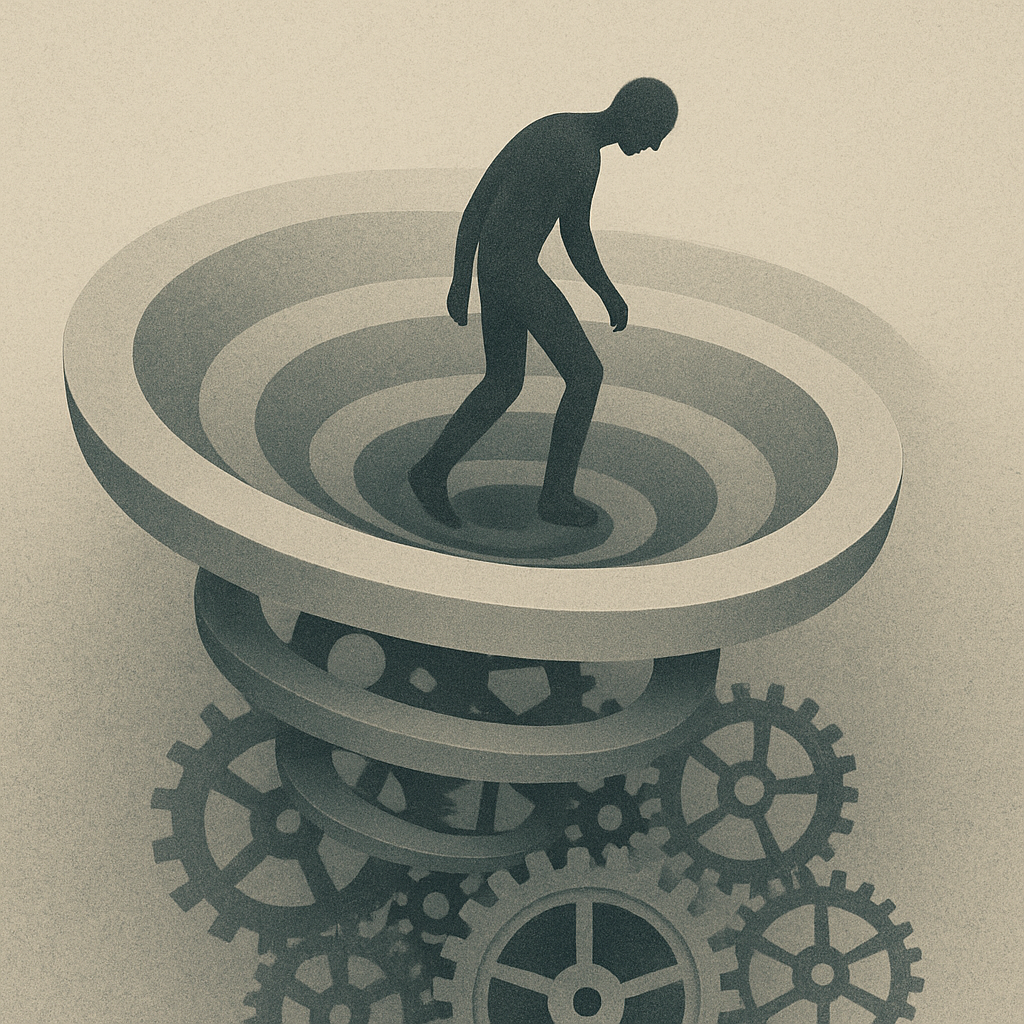
They’re the moments when thinking speeds up and clarity disappears. When fear or frustration hijacks the nervous system. When you no longer see reality - you only see what a single thought suggests reality might be.
What most people don’t realise is that this isn’t caused by the situation itself:
Introduction - How To Interrupt Emotional Spirals
The Hidden Mechanics of an Emotional Spiral
An emotional spiral doesn’t begin with a feeling. It begins with a thought that is often subtle, often automatic.
It might be:
“Why would they say it like that?”
“I should be further ahead by now.”
“What if something goes wrong?”
Before you even notice the thought, the brain has already assigned meaning to it.
The meaning triggers an emotional surge - faster than conscious reasoning can intervene. This isn’t a flaw. It’s biology.
From the brain’s perspective, every thought is potentially a survival threat. Neuroscience shows that the amygdala [the part of your brain that detects danger] reacts before the prefrontal cortex [the rational decision-maker] has a chance to evaluate anything. By the time you’re aware of the fear, worry, or anger, the brain has already launched into protection mode.
You feel it intimately:
- The pressure in the chest
- The heat rising in the body
- The mind racing to predict outcomes and “prepare” you
A single thought quickly becomes a chain of catastrophic assumptions. The nervous system tightens. Visibility collapses to a narrow point. You lose track of what’s true and what’s imagined.
This is how emotional spirals begin - innocently, invisibly, automatically.
How Thought-Awareness Changes Everything
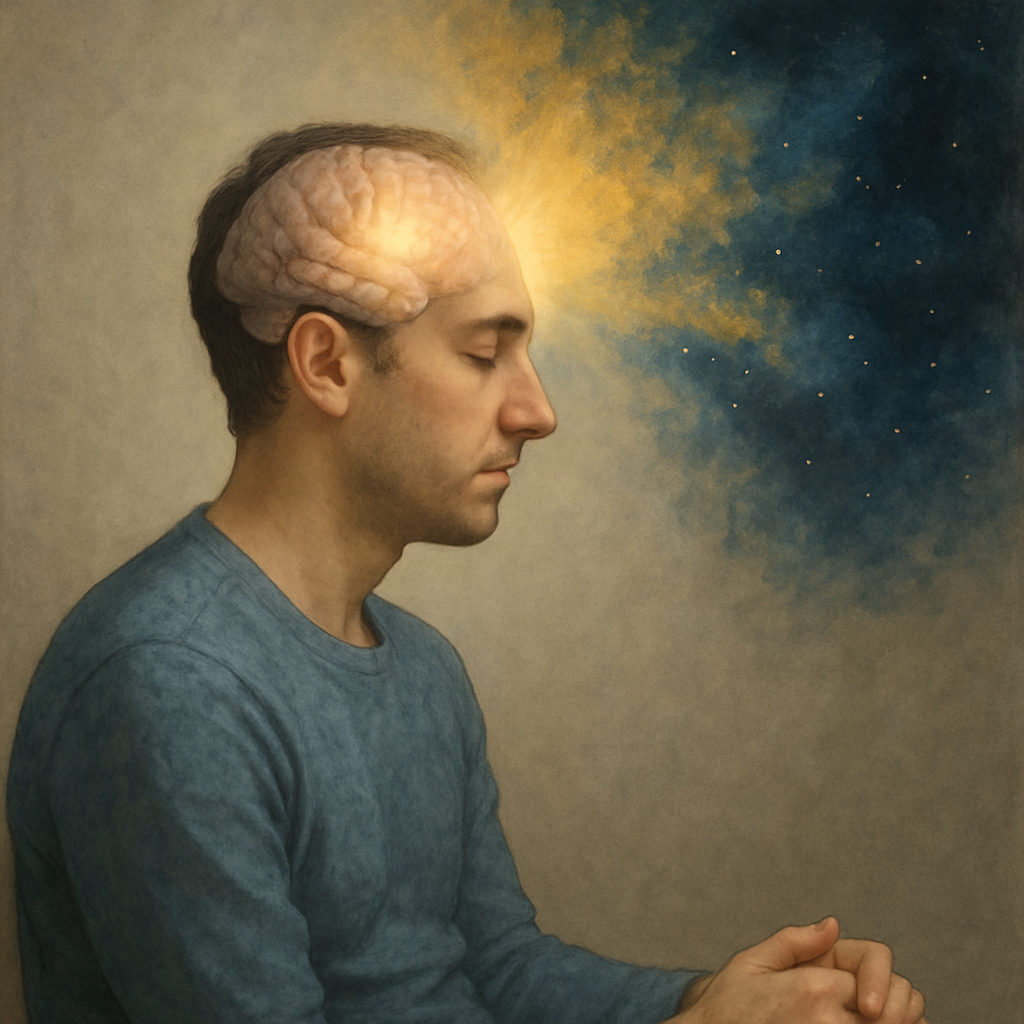
Most people don’t realize that thoughts aren’t inherently dangerous.
It’s believing the thought without noticing it that activates the spiral.
Thought-awareness inserts a small but powerful gap:
- There is the situation.
- Then there is the story my mind is telling about it.
That space changes the entire trajectory of the moment.
Instead of:
- Unconsciously absorbing the thought as truth.
- Reacting emotionally to the story.
- Fueling more thoughts based on that emotion.
You simply observe the thought as a mental event.
The brain shifts from threat-mode to awareness-mode. And awareness-mode is where clarity lives.
Zen Tools teaches this in many contexts, like in:
- Rewiring Your Autopilot – How To Harness Your Subconscious Mind
- Universal Awareness and the Machinery of Thought
- How to See Your Thoughts Without Becoming the Story
The core idea remains consistent:
A Real Story: The Meeting That Went Sideways
Emma was preparing for a performance review. She was confident she’d exceeded expectations. But halfway through the meeting, her manager paused and frowned at a spreadsheet detail.
That single frown became the spark:
“I messed up.”
“I should have double-checked everything.”
“They think I’m incompetent.”
“I might lose my job.”
Her pulse shot up. She lost the ability to track the conversation. Her voice got shaky.
The meeting went worse - not because anything bad had happened - but because the spiral changed her reality.
Later, when she finally stepped back, she realized:
- There was no criticism
- The numbers were correct
- Her manager’s frown was unrelated
The spiral had been entirely created by thought.
Emma didn’t fail in the meeting.
She failed to notice the moment her mind left reality.
How to Interrupt Emotional Spirals - The BREAK Method
Interrupting spirals isn’t about fixing or suppressing thoughts. It’s about disengaging from automatic belief.
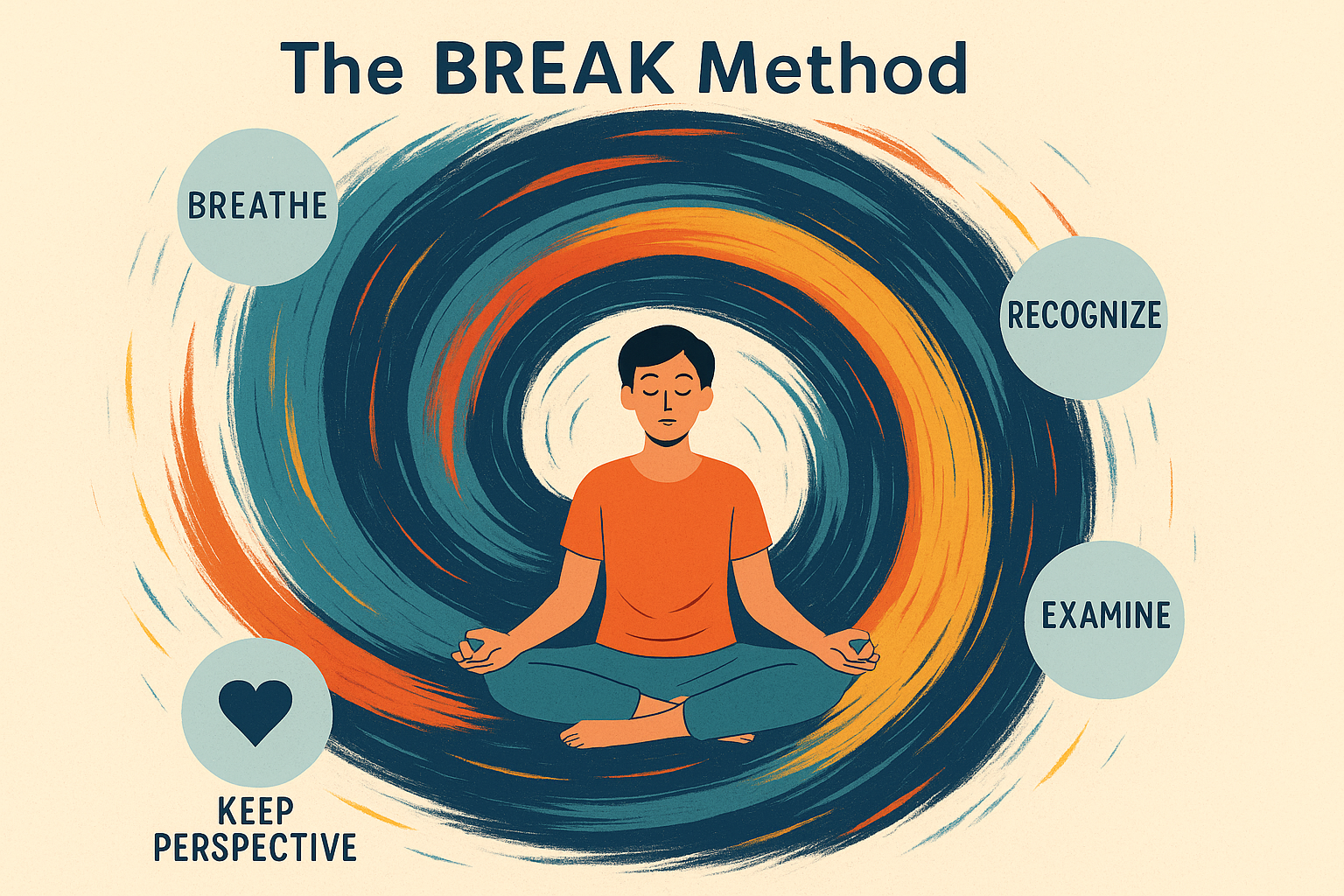
A simple method to do this is the BREAK technique:
- Breathe - reset the nervous system.
- Recognize - notice the thought that triggered the shift.
- Examine - observe how that thought is affecting you.
- Allow - let the emotion exist without fighting it.
- Keep perspective - reality-check the story your mind is spinning.
But instead of approaching this as a checklist or mental hack, think of BREAK as a conversation with your mind:
- “I see the story you’re telling.”
- “I feel the emotion it brings.”
- “And I don’t have to follow it.”
The skill grows faster than people expect. Each time you interrupt a spiral, the brain learns a new path - reducing the likelihood of future overreactions.
The neurological reason why this is possible is neuroplasticity - the ability of your brain to reorganize itself, create new pathways, and dismantle habits and behaviours that are no longer serving you.
Why Allowing the Emotion Matters
A common mistake is trying to stop the feeling. But suppression increases the spiral’s intensity.
When the brain senses rejection of emotion, it interprets that as danger:
- “If this feeling can’t exist, something is seriously wrong.”
Thoughts multiply. Fear grows. The spiral accelerates.
Allowing emotion isn’t resignation - it’s a biological safety signal:
- “This feeling is uncomfortable but harmless.”
The amygdala stands down. The prefrontal cortex re-engages. The body softens. Clarity returns.
This shift is often surprisingly fast.
Returning to Reality
Once the spiral slows down, the situation usually looks different:
- The comment wasn’t an attack.
- The delay wasn’t a disaster.
- The silence wasn’t rejection.
- The mistake wasn’t catastrophic.
- The feeling wasn’t a prophecy.
You realize the only danger present was the one thought created.
And that truth is liberating. It means that:
Practice: The First 5 Seconds Matter
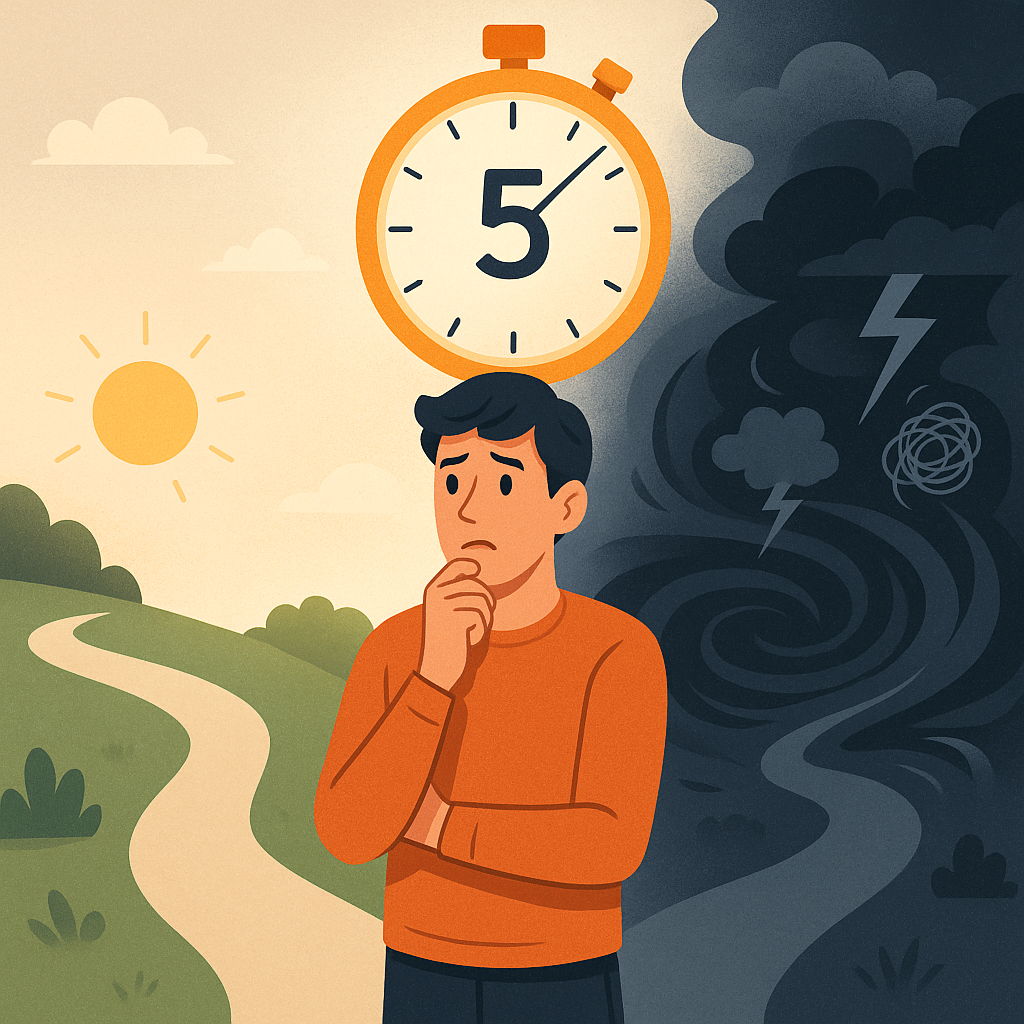
The key to successfully learning how to interrupt emotional spirals is catching the moment when you shift from clarity to panic.
Notice early signs:
- Sharp emotional spikes.
- Rapid interpretive thinking.
- Tension rising in the body.
- Urge to escape or find reassurance.
The earlier the interruption, the easier the recovery.
With repetition, the skill becomes instinctive - like noticing you’re about to trip and catching yourself before you fall.
Thought-awareness doesn’t remove challenges. It removes unnecessary suffering layered on top.
A New Default: From Spiral to Stability
Imagine this becoming your normal pattern:
- A trigger appears → You notice the thought → You breathe →
- You observe the meaning your mind is trying to invent →
- You stay with the emotion →
- You re-enter reality with clarity.
This is emotional self-leadership. Each step builds the neural pathways that make calm more automatic - not as a mood, but as a mental habit.
Summing Up & Next Steps

Overthinking and emotional escalation are not personal failures - they are the predictable consequence of a mind designed to detect danger everywhere.
Emotional spirals happen when the brain mistakes a thought for reality and reacts as if the story must be true.
Learning how to interrupt emotional spirals is about reclaiming a basic human capacity: the ability to step back from your thoughts and see them clearly.
Thought-awareness creates a moment of choice - the moment where the spiral can end instead of accelerate.
With practice, you become able to:
- Notice the exact moment the spiral begins.
- Separate story from fact.
- Calm the nervous system quickly.
- Respond with clarity instead of fear.
The BREAK technique serves as a simple, embodied way of applying this in real time. A breath, a recognition, a gentle examination, an allowance - and finally, a return to perspective.
This isn’t about being stoic or emotionless. It’s about learning to trust reality more than imagination. When you do, the mind stops dragging you into battles that don’t exist.
If there’s one message to take with you, let it be this:
Recommended Further Reading
- How to See Your Thoughts Without Becoming the Story
- Universal Awareness and the Machinery of Thought
- You Are Not Your Thoughts
- Rewiring Your Autopilot – How To Harness Your Subconscious Mind
- The Battle for Your Mind
- Why You Need to Be Intimate with Your Own Thinking
Return from: "How to Interrupt Emotional Spirals " to: Inner Mastery For Outer Impact or Walking The Talk
Next Article: Pausing Before You Act - Make It a Meta-Habit

LATEST ARTICLES


The Kingdom Is Here, Now - Awakening Is Not Later
 What contemplative traditions point to - and how progress quietly replaces presence. Across contemplative traditions, a strikingly consistent message appears: truth is not somewhere else, not in the…
Adult Development Without Becoming Someone Else - Growth Without Identity Upgrade
 You do not grow by becoming someone else - you grow by placing authority where choice becomes possible. So much of what is written and taught about personal growth quietly assumes an identity upgrade…
Belief and Thought: What Zen Tools Works With - What It Leaves Alone
 A Clarification Of Scope Within Zen Tools - Not A Position On Belief As soon as people begin to notice their own thinking more clearly, questions about belief and thought naturally follow: - If though…
How Thought Becomes Identity - The Hidden Mechanism Behind Overthinking, Self-Worth, and Inner Conflict
 Thought Is an Event, Not a Self Most people believe identity is something they have - a stable sense of who they are. In reality, identity is something the mind is continuously producing. It is not fo…
When the Brain Is Hijacked - Where Does Choice Sit?"
 Pressure, the Hijacked Brain, and the Question of Authority
When the brain is hijacked, people are often told they have “lost control”.That language is understandable - and misleading. In reality, man…
Pressure, the Hijacked Brain, and the Question of Authority
When the brain is hijacked, people are often told they have “lost control”.That language is understandable - and misleading. In reality, man…Reduce Digital Overthinking To Lower Your Constant Inner Noise
 Why Constant Micro-Stimulation Increases Your Internal Noise. Modern digital life generates a level of mental activity that previous generations never had to deal with, and this is fundamentally why w…
Pausing Before You Act - Make It a Meta-Habit
 How A Tiny Moment Unlocks Clarity, Choice, And Self-Leadership. There is a moment in life so subtle you barely register it. A colleague questions your idea. A notification flashes. A moment of uncerta…
How to Interrupt Emotional Spirals Using Thought-Awareness
 The spiral is fueled by your mind believing the story your thoughts tell. No one sets out to be swept away by a surge of emotion. One second you’re handling life, and the next, your mind has broken in…
Universal Awareness and the Machinery of Thought
 You Can’t Control Thoughts - But You Can Learn To See Them. Why do our thoughts have so much power over us - and how do we reclaim clarity? The foundation of thought-awareness is the ability to see yo…
Rewiring Your Autopilot – How To Harness Your Subconscious Mind
 How to harness your subconscious mind and move from passenger to pilot. The case for rewiring your autopilot is that most of what drives your thoughts, reactions, and decisions happens below your cons…
Why You Need To Be Intimate With Your Own Thinking
 How self-awareness and insight transforms delusion into wisdom. We live inside an invisible weather system - one made not of clouds and wind, but of thoughts - and this invisibilty is why you need to…
The Illusion of Closeness in Always-On Relationships
 Closeness that cannot survive absence was never intimacy - only constant stimulation mistaken for connection. We live inside an unprecedented experiment in human connection. For the first time in hist…