Why Insight Alone Does Not Change Behaviour
Authority Above Thought & Locking In The Gains

The Fundamental Reason Why Insight Alone Does Not Change Behaviour
This article explores why insight alone does not change behaviour, and the next step that must come after thought awareness if change is to hold under pressure.
There is a moment in inner work that is both clarifying and deeply unsettling.
- You finally see what is happening.
- You can describe the pattern with accuracy.
- You understand the mechanics of your own mind.
- You may even predict your behaviour before it occurs.
And yet - when pressure arrives - nothing reliably changes.
This experience leads many thoughtful, self-aware people to a quiet conclusion:
“Perhaps insight isn’t enough.”
They are right.
Insight Changes Understanding, But Not Jurisdiction
Thought awareness reveals something crucial: thoughts are events, not commands.
This alone is liberating. It breaks unconscious identification and introduces space between impulse and action.
From a neuroscience perspective, this corresponds with increased engagement of prefrontal monitoring and executive networks associated with meta-cognition, rather than reflexive action, and referred to as executive functions.
But insight has a limit.
Much human behaviour is governed by older, faster systems: habit loops in the basal ganglia and emotionally charged salience circuits in the limbic system.
These systems are not persuaded by understanding. They respond to urgency, reward, fear, and repetition.
This is why someone can know exactly what they are doing and still feel compelled to do it.
- Awareness has changed perception.
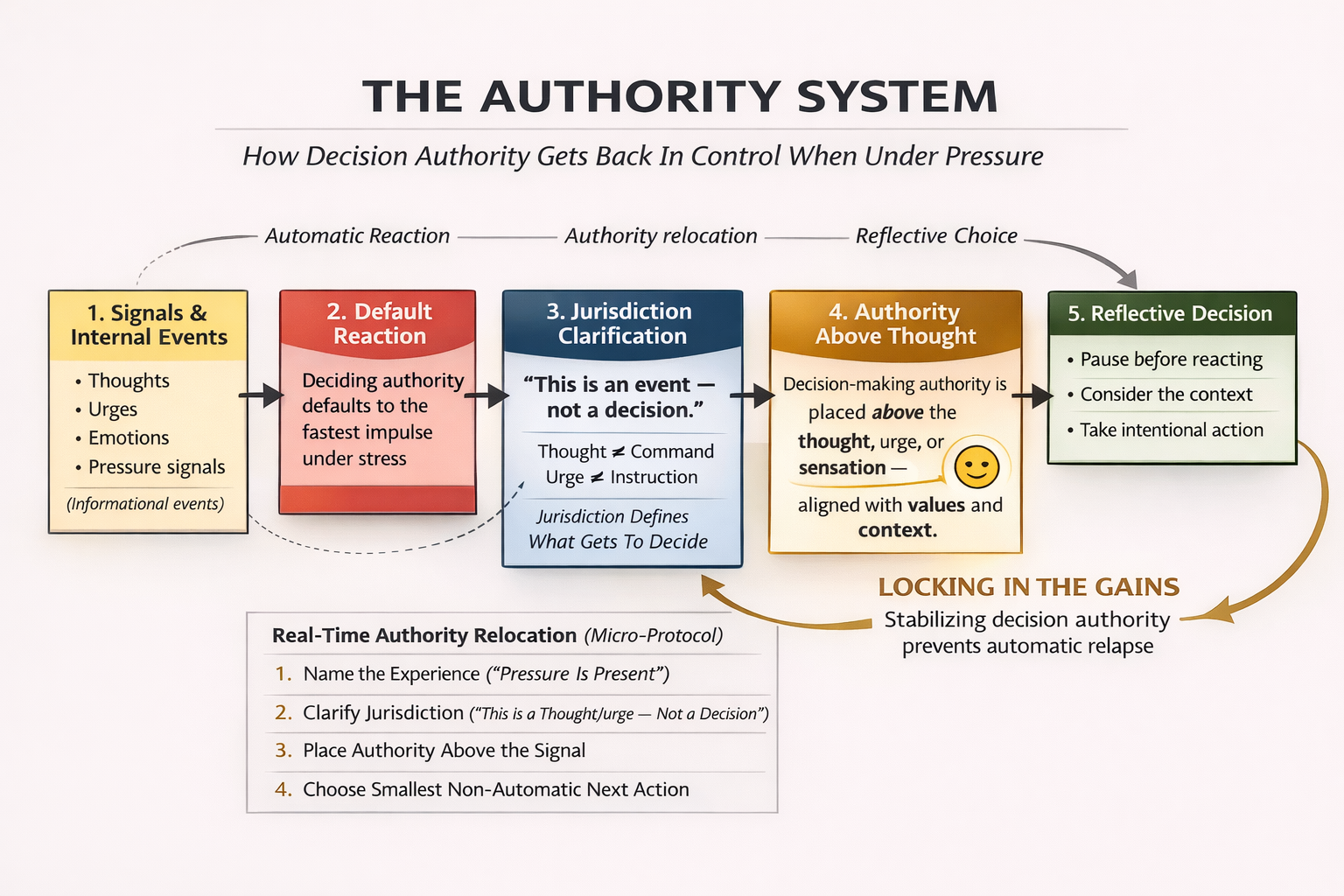
- Authority has not moved.
Why Insight Alone is NOT Enough and Collapses Under Pressure
If insight alone were enough, relapse would not exist.
Yet across addiction, compulsive behaviour, emotional reactivity, and everyday habits, the same pattern appears.
Under stress, fatigue, loneliness, or emotional overload, the old behaviour returns demonstrating why insight alone does not change behaviour.
Psychology has described this divide as dual-process models - the two systems in your brain which are constantly in conflict for control of your behaviour and actions: system one thinking is fast, automatic and impulsive and system two thinking which is slower, reflective and considered.
For a more detailed explanation of how awareness and decision-making authority separate under pressure, see:
Authority Above Thought - The Missing Layer After Thought Awareness

- What is missing is not more insight.
- It is a shift in who decides:
Zen Tools calls this "Authority Above Thought" - the moment when thought is still present, but no longer in charge.
Different traditions describe this differently.
- Psychology speaks of executive authority.
- Buddhism speaks of non-identification.
- Christianity speaks of surrender to God.
The mechanism is the same. Only the language changes.
When Change Happens Instantly
In the Zen Tools article "Self Dialogue" I shared an example of how I stopped smoking instantly, the change did not occur when I learned smoking was harmful. That insight had existed for years.
The shift occurred when the decision was no longer debated at the level of craving.
Authority was removed from the urge and transferred elsewhere to a higher mental function.
Neuroscience supports this distinction. Habit circuits can continue firing even after behaviour changes.
The presence of an urge does not indicate failure. What matters is whether it retains jurisdiction.
People often describe this moment simply:
“The urge was there — but it didn’t matter.”
That sentence points directly to the missing layer.
__________
Defining Our Terms This material is important so it is essential that we have a shared understanding of exactly what we are talking about here.
THE 2 BRAIN SYSTEMS
MENTAL AUTHORITY THE DEFAULT POSITION AUTHORITY ABOVE THOUGHT LOCKING IN THE GAINS
When Insight Must Become Authority Above Thought This is not a gentle practice. This practice is not about calming the mind, improving motivation, or managing urges. It is about ending the reactive mind’s right to decide. This deals directly with the fundamental issue of why insight alone does not change behaviour. When a craving, impulse, or familiar pull appears, the problem is rarely lack of understanding. By this point, the pattern is already clear. The problem is that the same level of mind is still in charge. At this stage, gentle observation is not enough. Authority must be moved - explicitly. __________ Locking In The Gains - A Stabilisation Protocol for When Insight Is at Risk of Collapse Locking In The Gains
is a stabilisation protocol used when insight is present but behaviour
is at risk of automatic reversion, reinforcing the relocation of
decision-making authority so that thoughts and urges no longer dictate
action under pressure.
Because this shift of authority is inherently unstable, Zen Tools treats Authority Above Thought as something that requires deliberate reinforcement - a protocol referred to here as Locking In The Gains. As
noted above, this involves invoking the power and support of a source
of authority, appropriate to your personal beliefs, that sits above and
beyond your thoughts and that is aligned with your reflective brain. The source of authority may be anchored in whatever personal belief framework you hold, provided that it:
Examples referenced below in this article are illustrative only, not definitive. They exist to demonstrate how authority anchoring can function across different belief contexts, without asserting or implying any preferred worldview. Below are three complete framings:
Each one invokes a legitimate source
of authority and support to ensure that control does not collapse back into
effort, monitoring, or self-attack. [1] Christian Framing Authority: God — Empowerment Through the Holy Spirit In Christian
teaching, the Holy Spirit is seen as the
invisible, personal presence of the creator God. The Holy Spirit is
called the Comforter, a title from the Greek word Parakletos, meaning
someone
called to your side as a helper, advocate, counselor, or strengthener,
especially in times of need, weakness, or confusion. This framing works because it ends ego jurisdiction and provides sustaining power so authority does not collapse back into effort. Step 1 — Admit powerlessness without shame
At the moment of impulse, say plainly:
“I cannot govern myself here.” Step 2 — Yield authority to God “Father God, this decision belongs to You.” Step 3 — Invoke the Holy Spirit for protection and empowerment “Holy Spirit, take authority in me now.” Step 4 — Remain under Spirit-led authority You rest in trust:
“This is no longer mine to manage.”
[2] Secular Framing
Authority:
Your Reflective Decision-Making Capacity
This approach places decision-making authority with your capacity to step back, reflect and choose deliberately, rather than allowing an immediate thought or impulse to decide.
This framing works by removing authority from the reactive mind and placing it firmly with the clarity-oriented, non-reactive executive function that is central to the Zen Tools perspective. This is a mental
capacity long recognised by wise leaders throughout history.
Neurologically, it reflects higher-order control and compassion networks in the brain, enabling calm perspective and self-guidance. It is not a fixed inner entity, but an adaptive capability that emerges as the mind learns to regulate thought and emotion with clarity rather than reaction. Step 1 — Admit the limit of the reactive mind “This part of my mind cannot be trusted to decide.” Step 2 — Revoke authority “This impulse does not decide.” Step 3 —
Establish reflective authority
Now bring the reflective mind online:
“
My reflective mind holds authority here.” Step 4 —
Remain with that authority
You do not persuade. You stand with the reflective mind as the decision-maker:
“
This decision remains with my reflective mind.”
[3] Buddhist Framing
Authority: Wisdom Held in Metta [Self Compassion] This framing works because it breaks identification. Metta is a core
Buddhist concept and meditation practice focused on cultivating
unconditional loving kindness, goodwill, friendliness, and benevolence towards oneself
and all beings. In the context of this practice we can think of it as self compassion. This framing combines non-identification with compassionate stability. In Buddhism, wisdom without metta becomes brittle; metta without wisdom becomes indulgent. Both are required.
Step 1 — Name craving accurately “This is craving arising.” Step 2 — End identification “This is not self. Step 3 — Invoke Metta as stabilising support “May this mind be held in kindness.” Step 4 — Rest in compassionate awareness
The Meta View: What All Three Are Doing Remove the cultural language and the same structure remains: This is not belief. This is jurisdictional mechanics.
Words activate emotional memory, signal authority hierarchies, and either end or invite negotiation. This is why legal language, vows, and the first three of the twelve steps of Alcoholics Anonymous carry such force: This requires seriousness of intent.
It also takes courage borne of commitment, honesty and a preparedness to admit weakness and vulnerability to make these declarations.
Locking In The Gains
[How To Practice Authority Above Thought]


State clearly:
Now make the crucial move:
“Guard my mind and will.”
“Give me the strength to remain yielded.”
You do not monitor feelings.
You do not test yourself.

When the impulse appears, say plainly:
State firmly and without negotiation:
“ I choose from clarity, not impulse.
.”
You do not manage feelings.

When desire arises, say:
State clearly:
This does not decide.”
Now consciously bring kindness into the system — not to indulge the craving, but to support wisdom:
“May clarity and care govern this moment.”
You remain present, firm, and kind.
Why Word Power Matters

Closing Reflections On Authority Above Thought

Points for Reflection
- Where do you clearly see the pattern but still feel compelled?
- When pressure rises, who actually decides?
- What words reliably stop your mind negotiating?
- Which authority frame already carries weight for you?
- What changes when desire is allowed to exist but not decide?
Action Points
- Identify your recurring decision-collapse moments.
- Choose one authority frame — and commit to it.
- Use language that feels final, not motivational.
- Practise revoking authority, not fighting desire.
- Stop monitoring outcomes — authority works when left alone.
Free Worksheets:
- Action Steps For Relocating Decision Making Authority Above Thought
- Action Steps For Authority Above Thought - Locking In The Gains
Recommended Further Reading [Zen Tools]
- When Insight Is Not Enough - The Missing Piece in Behaviour Change
- Not Every Urge Is a Decision: The Gap Between Feeling & Action
- The Mechanics of Inner Conflict – Not Confusing Signals & Instructions
- The Wise Advocate – Inner Mastery for Outer Impact
- Self Dialogue – How to Resolve Inner Conflict Without Suppression
- Shame as a Form of Mental Over-Attention
- Does Prayer Work? The Psychology of Prayer, Meditation and Outcomes
Return from: "Why Insight Alone Does Not Change Behaviour" to: Home Page or Inner Mastery For Outer Impact
Next Article: The Inner Weight of Shame - Sustained By Attentional Fixation

LATEST ARTICLES


The Kingdom Is Here, Now - Awakening Is Not Later
 What contemplative traditions point to - and how progress quietly replaces presence. Across contemplative traditions, a strikingly consistent message appears: truth is not somewhere else, not in the…
Adult Development Without Becoming Someone Else - Growth Without Identity Upgrade
 You do not grow by becoming someone else - you grow by placing authority where choice becomes possible. So much of what is written and taught about personal growth quietly assumes an identity upgrade…
Belief and Thought: What Zen Tools Works With - What It Leaves Alone
 A Clarification Of Scope Within Zen Tools - Not A Position On Belief As soon as people begin to notice their own thinking more clearly, questions about belief and thought naturally follow: - If though…
How Thought Becomes Identity - The Hidden Mechanism Behind Overthinking, Self-Worth, and Inner Conflict
 Thought Is an Event, Not a Self Most people believe identity is something they have - a stable sense of who they are. In reality, identity is something the mind is continuously producing. It is not fo…
When the Brain Is Hijacked - Where Does Choice Sit?"
 Pressure, the Hijacked Brain, and the Question of Authority
When the brain is hijacked, people are often told they have “lost control”.That language is understandable - and misleading. In reality, man…
Pressure, the Hijacked Brain, and the Question of Authority
When the brain is hijacked, people are often told they have “lost control”.That language is understandable - and misleading. In reality, man…Reduce Digital Overthinking To Lower Your Constant Inner Noise
 Why Constant Micro-Stimulation Increases Your Internal Noise. Modern digital life generates a level of mental activity that previous generations never had to deal with, and this is fundamentally why w…
Pausing Before You Act - Make It a Meta-Habit
 How A Tiny Moment Unlocks Clarity, Choice, And Self-Leadership. There is a moment in life so subtle you barely register it. A colleague questions your idea. A notification flashes. A moment of uncerta…
How to Interrupt Emotional Spirals Using Thought-Awareness
 The spiral is fueled by your mind believing the story your thoughts tell. No one sets out to be swept away by a surge of emotion. One second you’re handling life, and the next, your mind has broken in…
Universal Awareness and the Machinery of Thought
 You Can’t Control Thoughts - But You Can Learn To See Them. Why do our thoughts have so much power over us - and how do we reclaim clarity? The foundation of thought-awareness is the ability to see yo…
Rewiring Your Autopilot – How To Harness Your Subconscious Mind
 How to harness your subconscious mind and move from passenger to pilot. The case for rewiring your autopilot is that most of what drives your thoughts, reactions, and decisions happens below your cons…
Why You Need To Be Intimate With Your Own Thinking
 How self-awareness and insight transforms delusion into wisdom. We live inside an invisible weather system - one made not of clouds and wind, but of thoughts - and this invisibilty is why you need to…
The Illusion of Closeness in Always-On Relationships
 Closeness that cannot survive absence was never intimacy - only constant stimulation mistaken for connection. We live inside an unprecedented experiment in human connection. For the first time in hist…