When Insight Is Not Enough
The Missing Piece in Behaviour Change
What Mindfulness Reveals - And What It Leaves Unresolved

When Insight Is Not Enough - Setting The Scene
A familiar gap
Many people reach a point where something genuinely shifts. They can see their thoughts as thoughts.
- Patterns are recognised.
- Triggers are obvious.
- The internal commentary loses some of its drama.
And yet, behaviour often remains stubbornly the same - especially under pressure.
The result is a quiet and confusing gap: “I can see exactly what’s happening… so why do I still do this?”
This article does not critique mindfulness. It explains a specific point at which awareness alone often stops being sufficient.
It is written for the moment when insight is not enough - when clarity is present, but behaviour has not yet changed.
The purpose here is not to question insight, but to clarify a missing decision-level mechanism that explains why clarity and action can separate - and what determines what happens next when they do.
This article builds on the broader explanation of why insight alone does not change behaviour, and examines the precise decision-level mechanism involved.
__________
What awareness-based systems assume
Mindfulness, Zen, and many insight-based approaches rest on a powerful and often correct assumption:
When something is clearly seen, it loses its grip.
From this perspective:
- Thoughts lose power when they are recognised as transient events
- Compulsion weakens as identification dissolves
- Behaviour changes as a by-product of insight rather than effort.
For many readers, this is the first real experience of freedom.
In stable conditions, and especially in low-load, high-containment environments, this assumption often holds:
- Awareness reduces misperception.
- Reduced misperception reduces reactivity.
- Action naturally softens.
There is nothing naïve about this. Historically, it worked well.
But the question raised when insight is not enough, is not whether awareness works, it is when and why it stops being decisive.
__________
The modern failure mode
The difficulty arises under modern conditions:
- High cognitive load.
- Chronic stress.
- Time pressure.
- Emotional threat.
- Fatigue.
- Information saturation.
In these states, something counter-intuitive but reliable occurs:
- Insight can be present
- Awareness can be accurate
- And behaviour can still default automatically
This is not a failure of mindfulness. It is the context that clearly shows when insight is not enough.
Neuroscience has repeatedly shown that under stress, prefrontal cortical functions associated with deliberation and inhibition degrade, while faster, threat-responsive systems dominate [Arnsten, 2009].
In practical terms, this means that knowing does not guarantee choosing.
The lived experience becomes: "I see the thought — and still act from it."
The Missing Distinction: Awareness vs Decision-Making Authority
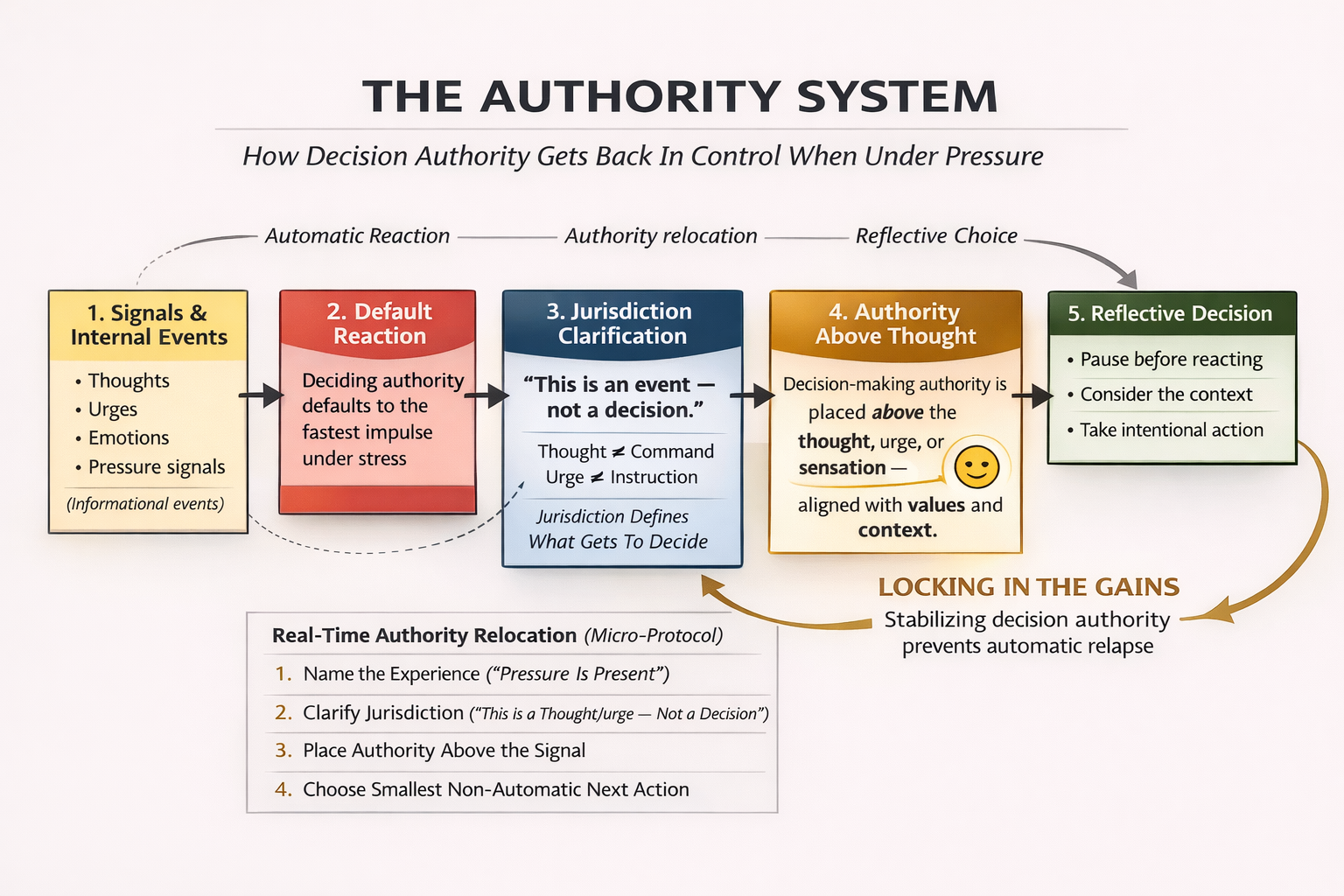
At this point, most explanations stall. The reader is left with:
- “Practice more”
- “Insight isn’t deep enough yet”
- “Conditioning remains”
Zen Tools introduces a different distinction.
On first use, it matters to be precise:
Decision-making authority refers to where the power to determine action is actually located in the moment.
Awareness shows what is happening. Decision-making authority determines what happens next.
When people struggle and when insight is not enough, it is rarely because they lack awareness. It is because authority has defaulted to urgency, habit, or relief.
Under pressure, authority silently defaults. It moves - often without notice - to whatever system is fastest, most urgent, or most relieving. Habit, threat response, emotional relief, and conditioned patterns take over jurisdiction.
This is not a moral failure. It is mechanical.
Zen Tools names the deliberate alternative "Authority Above Thought": a condition in which thoughts are allowed to arise freely, but decision-making authority is explicitly held at a higher, reflective level aligned with values and context.
This is not suppression. Not control. Not force. It is jurisdiction.
__________
Why insight alone cannot guarantee change
Insight alters perception. Authority governs action.
A person can:
- See a craving clearly
- Understand its origin
- Recognise its consequences
…and still act from it, because the authority to decide has already been handed over to urgency.
This explains a common and frustrating experience: insight feels real, but unreliable. It works when life is calm. It collapses when pressure rises.
In other words, the experience of being stuck when insight is not enough.
The issue is not that awareness is weak. The issue is that authority has not been made explicit.
What Zen Tools Adds When Insight Is Not Enough

Zen Tools does not reject awareness-based practice. It depends on it.
What it adds is a named, deliberate relocation of decision-making authority at the exact point where insight often stops being decisive.
This does three things:
- It explains why insight can coexist with automatic behaviour
- It removes self-blame (“I know better, why can’t I change?”)
- It introduces a lever that still functions under load
Authority Above Thought is not a belief, worldview, or identity. It is a functional placement of jurisdiction.
Different people may anchor that authority differently - in values, conscience, faith, or secular reasoning.
Zen Tools remains agnostic to the source.
What matters is that authority is not left inside the thought stream itself.
Worksheet: Action Steps For Relocating Decision Making Authority Above Thought
__________
Simple illustration
A person notices irritation while driving. They clearly see the thought: “This traffic is unbearable.” They even recognise the pattern.
And yet, seconds later, they are tailgating, tense, and reactive.
Insight was present. Authority was not.
When authority is relocated, the same thought can arise: “This traffic is unbearable” - without determining behaviour. The decision point is held elsewhere. A pause appears. Action changes.
Nothing mysterious occurred. Jurisdiction shifted.
__________
A single supporting protocol
Zen Tools operationalises this through a protocol referred to as "Locking In The Gains".
Locking In The Gains is a stabilisation protocol used when insight is present but behaviour is at risk of automatic reversion, reinforcing the relocation of decision-making authority so that thoughts and urges no longer dictate action under pressure.
In brief:
- The experience is named as an event
- Jurisdiction is clarified: “this is a thought — not a decision
- Decision-making authority is deliberately placed above thought
- The smallest non-automatic next action is chosen
This is not willpower. It does not require calm. It works because it addresses authority directly.
Worksheet: Action Steps For Authority Above Thought - Locking In The Gains
__________
Why this is not a worldview or doctrine
Authority Above Thought does not claim that:
- Thoughts are bad
- Emotions must be bypassed
- Awareness is insufficient in principle
It makes a narrower claim:
Under pressure, behaviour follows authority - not insight.
This keeps Zen Tools firmly within its intended operating layer: thought-awareness and authority allocation, not belief, meaning, or identity formation.
Closing Orientation - When Insight Is Not Enough

Insight reveals the signal. Authority determines the response. When
insight is not enough, it is rarely because clarity is missing. More
often, it is because decision-making authority has quietly collapsed
back into the very thoughts that insight can already see. Recognising that distinction changes where effort is applied - and why change becomes possible again.
Reflection prompts
- Where does decision-making authority sit for you under pressure?
- When insight fails to change behaviour, what system decides instead?
- How often do thoughts act as instructions rather than signals?
- What would it mean to hold authority above urgency, not against it?
- How might authority be supported rather than forced?
Action orientations
- Notice moments where insight is present but action is automatic
- Experiment with naming jurisdiction explicitly
- Reduce the cost of pausing rather than increasing effort
- Treat urgency as information, not instruction
- Anchor authority outside the thought stream itself
Academic References
- Arnsten, A. F. T. (2009). Stress signalling pathways that impair prefrontal cortex structure and function.
- LeDoux, J. (1996). The Emotional Brain.
- Kahneman, D. (2011). Thinking, Fast and Slow.
- Kegan, R., & Lahey, L. (2009). Immunity to Change.
- Evans, J. St. B. T. (2008). Dual-processing accounts of reasoning, judgment, and social cognition.
Recommended Further Reading
- Why Insight Alone Does Not Change Behavior - Core companion piece — establishes the original insight/authority distinction.
- Not Every Urge Is a Decision: The Gap Between Feeling & Action
- When the Brain Is Hijacked – Where Does Choice Go? - Explains authority collapse under threat and urgency.
- Living in Survival Mode Without Surrendering Mental Control - Shows how insight survives while authority degrades under load.
- Universal Awareness and the Machinery of Thought - Clarifies what awareness does well — and what it does not govern.
- How to Interrupt Emotional Spirals Using Thought Awareness - Practical example of awareness creating a pause — but not yet authority.
Return from: "When Insight Is Not Enough" to: Home Page or Inner Mastery For Outer Impact
Next Article: Why the Brain Replays Threat at Night - and What It’s Responding To

LATEST ARTICLES


Belief and Thought: What Zen Tools Works With - What It Leaves Alone
 A Clarification Of Scope Within Zen Tools - Not A Position On Belief As soon as people begin to notice their own thinking more clearly, questions about belief and thought naturally follow: - If though…
How Thought Becomes Identity - The Hidden Mechanism Behind Overthinking, Self-Worth, and Inner Conflict
 Thought Is an Event, Not a Self Most people believe identity is something they have - a stable sense of who they are. In reality, identity is something the mind is continuously producing. It is not fo…
When the Brain Is Hijacked - Where Does Choice Sit?"
 Pressure, the Hijacked Brain, and the Question of Authority
When the brain is hijacked, people are often told they have “lost control”.That language is understandable - and misleading. In reality, man…
Pressure, the Hijacked Brain, and the Question of Authority
When the brain is hijacked, people are often told they have “lost control”.That language is understandable - and misleading. In reality, man…Reduce Digital Overthinking To Lower Your Constant Inner Noise
 Why Constant Micro-Stimulation Increases Your Internal Noise. Modern digital life generates a level of mental activity that previous generations never had to deal with, and this is fundamentally why w…
Pausing Before You Act - Make It a Meta-Habit
 How A Tiny Moment Unlocks Clarity, Choice, And Self-Leadership. There is a moment in life so subtle you barely register it. A colleague questions your idea. A notification flashes. A moment of uncerta…
How to Interrupt Emotional Spirals Using Thought-Awareness
 The spiral is fueled by your mind believing the story your thoughts tell. No one sets out to be swept away by a surge of emotion. One second you’re handling life, and the next, your mind has broken in…
Universal Awareness and the Machinery of Thought
 You Can’t Control Thoughts - But You Can Learn To See Them. Why do our thoughts have so much power over us - and how do we reclaim clarity? The foundation of thought-awareness is the ability to see yo…
Rewiring Your Autopilot – How To Harness Your Subconscious Mind
 How to harness your subconscious mind and move from passenger to pilot. The case for rewiring your autopilot is that most of what drives your thoughts, reactions, and decisions happens below your cons…
Why You Need To Be Intimate With Your Own Thinking
 How self-awareness and insight transforms delusion into wisdom. We live inside an invisible weather system - one made not of clouds and wind, but of thoughts - and this invisibilty is why you need to…
The Illusion of Closeness in Always-On Relationships
 Closeness that cannot survive absence was never intimacy - only constant stimulation mistaken for connection. We live inside an unprecedented experiment in human connection. For the first time in hist…
Why Approval Feels Like Safety And Distance Feels Like Danger
 Safety is not found in being approved - it appears when approval is no longer required. When approval feels like safety, connection stops being something we enjoy and quietly becomes something we rely…
You Do Not Need Better Boundaries - You Need Clearer Thought
 What no longer feels like your responsibility no longer crosses your boundaries. This article explains why you don’t need better boundaries - you need clearer thought - how modern life systematically…