How to See Your Thoughts Without Becoming the Story
A Practical Guide to Thought-Awareness

How To See Your Thoughts - Setting the Scene
You can spend your life inside the stories of your mind without ever learning how to see your thoughts clearly and objectively.
A comment from someone you care about sparks worry. Suddenly the mind races:
"What did they mean by that? Did I do something wrong?"
A project hits a snag and the story becomes:
"I always screw things up."
In each of these situations a temporary experience becomes a permanent identity.
But, most of the stuff we tell ourselves is, at best, a guess at the truth, and at worst, complete rubbish.
Learning how to drop the story and deal with that voice in your head can be a game changer.
Thoughts constantly arise: judgments, predictions, fears, opinions - and most people take them as truth the moment they appear.
This article shows how suffering begins not with thoughts themselves, but with identification: believing “this is me,” or “this is real.”
You’ll learn how thoughts are mental events - not identity, not commands, not reality.
By noticing the moment a thought forms, you create space between awareness and mental narrative. This separation enables emotional stability, clearer decisions, and a calmer internal world.
Practical methods include mental labeling, observing tone, and returning to direct sensory awareness.
This is a foundational skill of Zen Tools: when thought is seen as thought, its power dissolves.
The Invisible Habit of Identification
Thoughts come and go constantly, yet we relate to them as if they are who we are.
We think:
- “I am anxious”
- “I am inadequate”
- “I am not enough”
Instead of:
- “A thought about anxiety is appearing”
- “A self-doubt story is happening”
- “An old belief is resurfacing”
Identification is when we lose sight of how to see your thoughts as thoughts and not as reality.
When you fuse with a thought, it becomes your world.
You Are the One Who Notices
Here's the shift:
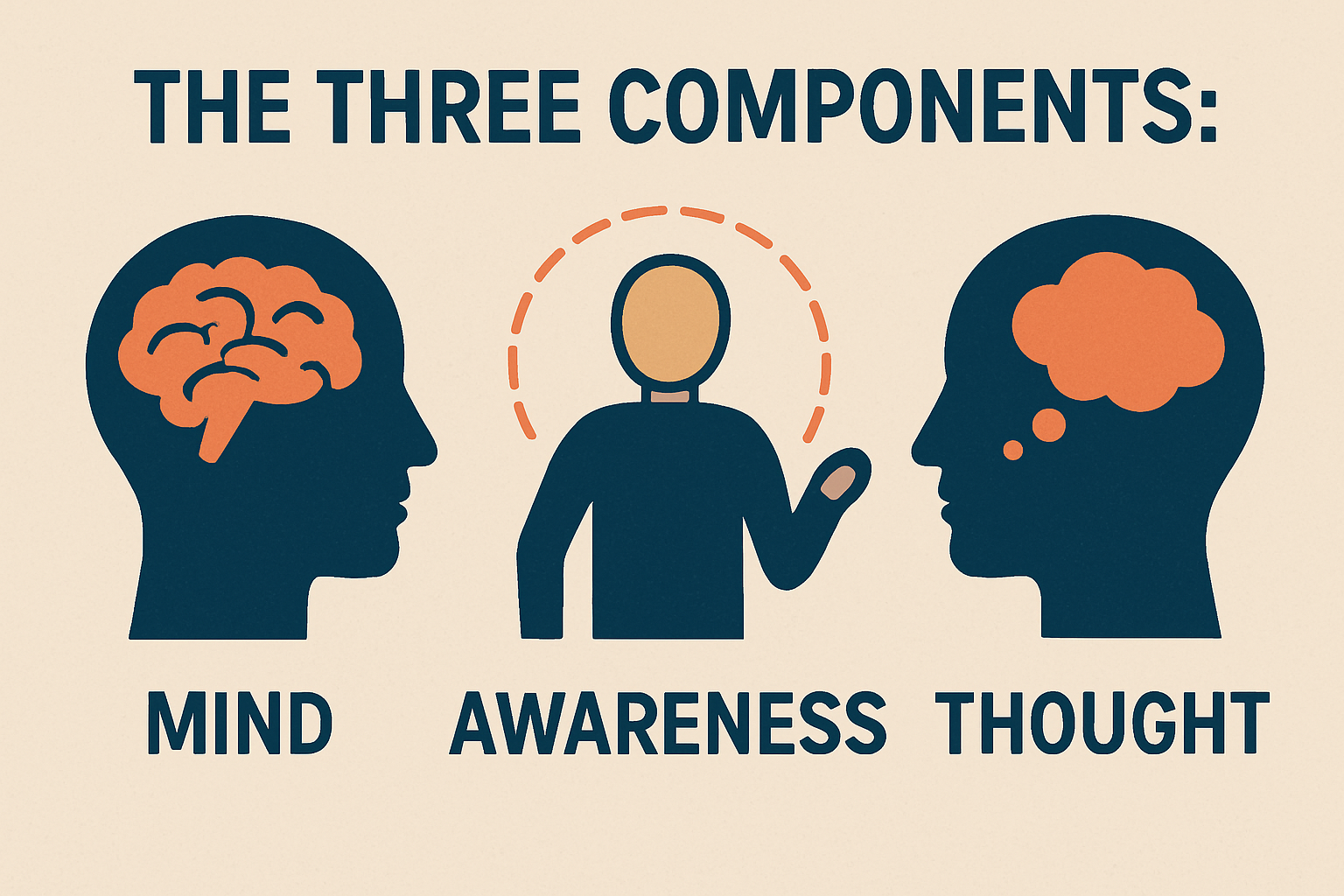
There is the thought, and there is the observer of the thought.
These are not the same.
You can learn how to see your thoughts arise and fade like clouds in the sky - while the sky (awareness) remains clear and unchanged.
This leads to the core recognition of applied Zen Tools:
Why the Mind Loves a Good Story

Your mind is trying to protect you, it:
- Forecasts danger
- Tries to control uncertainty
- Creates meaning - often too quickly
When you don’t know how to see your thoughts as mental guesses, you believe:
- Predictions = Facts
- Interpretations = Truth
- Fears = Warnings
- Doubts = Identity
And so unnecessary suffering begins.
The moment you step back and see the thought as a mental event, the spell breaks.
The Structure of a Stressful Story
Every painful narrative has four parts:
- A trigger
- Interpretation
- Personal identification
- Catastrophic projection
Only the trigger is real.
The rest is imagination.
When you know how to see your thoughts as mental construction, these layers reveal themselves.
Are You Inside the Thought or Seeing It?
Try this:
Think of a recent worry.
Notice how it feels.
If it feels urgent, heavy, or personal, you’re inside Position A:
Position A - Inside the Thought
- You are the character in the story.
But if you can notice the thought as a thought, you’re in Position B:
Position B - Seeing the Thought
- You are the observer of the story.
Knowing how to see your thoughts is how you move from A → B.
Suffering is what happens when we live inside Position A.
Freedom is Position B.
Three Practical Techniques to Step Out of the Story

These micro-skills show you how to see your thoughts with distance and clarity:
[1] Naming the Thought
Say:
“I’m having the thought that….”
You turn the thought into an object of awareness.
[2] Labeling the Category
Instead of believing the specific story, identify the pattern:
- “Fear story.”
- “Control narrative.”
- “Self-judgment.”
This makes thoughts predictable - not powerful.
[3] Return to Sensation, Not Narrative
Where do you feel the thought in the body?
- Tight chest
- Knot in stomach
- Heat in the face
- Tension in the jaw
Instead of fueling the story, shift attention to sensation:
“Tightness. Pressure. Buzzing.”
Physical noticing grounds you in the present, where the story cannot survive.
The Story Doesn’t Stop - But You Stop Believing It
This is what mental freedom looks like:
- The narration continues
- But you no longer play the starring role
- You watch from awareness
When you know how to see your thoughts, they lose the power to define you.
The movie keeps playing - but you are no longer on the screen.
A 60-Second Practice: “Thoughtwatch”
Try this once today:
- Sit. Breathe.
- Notice the next thought that appears.
- Say silently: “There is a thought.”
- Watch it fade naturally.
This tiny shift builds the neural habit of seeing thoughts - not becoming them.
Let this become your direct, daily training in how to see your thoughts clearly.
A Metaphor: The Observer in the Stands

Imagine a running track.
Thoughts are runners - sprinting past all day.
When you don’t know how to see your thoughts, you chase every runner and exhaust yourself.
Thought-awareness is sitting in the stands, watching the parade go by.
- Some runners look dramatic.
- Some look terrifying.
- Some look foolish.
But none of them require your participation.
Freedom is staying seated.
What Changes When You Stop Becoming Every Thought
Several benefits unfold naturally:
- Less anxiety — because you don’t believe catastrophic predictions
- Better decisions — because clarity replaces panic
- More emotional resilience — because reactions soften
- Deeper presence — because attention returns to reality
- A lighter inner life — because stories lose gravity
When you know how to see your thoughts, life becomes simpler and truer.
Thoughts Are Not the Problem

The goal isn’t silence.
The goal is perspective.
Recommended Further Reading
- Universal Awareness and the Machinery of Thought
- You Are Not Your Thoughts
- Rewiring Your Autopilot – How To Harness Your Subconscious Mind
- The Battle for Your Mind
- Why You Need to Be Intimate with Your Own Thinking
Return from: "How To See Your Thoughts" to: You Are Not Your Thoughts or Inner Mastery For Outer Impact
Next Article: Universal Awareness and the Machinery of Thought

LATEST ARTICLES


Belief and Thought: What Zen Tools Works With - What It Leaves Alone
 A Clarification Of Scope Within Zen Tools - Not A Position On Belief As soon as people begin to notice their own thinking more clearly, questions about belief and thought naturally follow: - If though…
How Thought Becomes Identity - The Hidden Mechanism Behind Overthinking, Self-Worth, and Inner Conflict
 Thought Is an Event, Not a Self Most people believe identity is something they have - a stable sense of who they are. In reality, identity is something the mind is continuously producing. It is not fo…
When the Brain Is Hijacked - Where Does Choice Sit?"
 Pressure, the Hijacked Brain, and the Question of Authority
When the brain is hijacked, people are often told they have “lost control”.That language is understandable - and misleading. In reality, man…
Pressure, the Hijacked Brain, and the Question of Authority
When the brain is hijacked, people are often told they have “lost control”.That language is understandable - and misleading. In reality, man…Reduce Digital Overthinking To Lower Your Constant Inner Noise
 Why Constant Micro-Stimulation Increases Your Internal Noise. Modern digital life generates a level of mental activity that previous generations never had to deal with, and this is fundamentally why w…
Pausing Before You Act - Make It a Meta-Habit
 How A Tiny Moment Unlocks Clarity, Choice, And Self-Leadership. There is a moment in life so subtle you barely register it. A colleague questions your idea. A notification flashes. A moment of uncerta…
How to Interrupt Emotional Spirals Using Thought-Awareness
 The spiral is fueled by your mind believing the story your thoughts tell. No one sets out to be swept away by a surge of emotion. One second you’re handling life, and the next, your mind has broken in…
Universal Awareness and the Machinery of Thought
 You Can’t Control Thoughts - But You Can Learn To See Them. Why do our thoughts have so much power over us - and how do we reclaim clarity? The foundation of thought-awareness is the ability to see yo…
Rewiring Your Autopilot – How To Harness Your Subconscious Mind
 How to harness your subconscious mind and move from passenger to pilot. The case for rewiring your autopilot is that most of what drives your thoughts, reactions, and decisions happens below your cons…
Why You Need To Be Intimate With Your Own Thinking
 How self-awareness and insight transforms delusion into wisdom. We live inside an invisible weather system - one made not of clouds and wind, but of thoughts - and this invisibilty is why you need to…
The Illusion of Closeness in Always-On Relationships
 Closeness that cannot survive absence was never intimacy - only constant stimulation mistaken for connection. We live inside an unprecedented experiment in human connection. For the first time in hist…
Why Approval Feels Like Safety And Distance Feels Like Danger
 Safety is not found in being approved - it appears when approval is no longer required. When approval feels like safety, connection stops being something we enjoy and quietly becomes something we rely…
You Do Not Need Better Boundaries - You Need Clearer Thought
 What no longer feels like your responsibility no longer crosses your boundaries. This article explains why you don’t need better boundaries - you need clearer thought - how modern life systematically…