Not Every Urge Is a Decision
The Missing Gap Between Feeling & Action
Seeing the Urge Without Obeying It

Setting The Scene
An urge can feel immediate, compelling, and persuasive. It arrives with emotional charge and a sense of necessity. Yet not every urge is a decision.
An urge is an internal signal, but the decision-making authority over what happens next does not automatically belong to that signal.
This distinction is subtle but mechanically decisive.
Understanding this gap helps explain the well-documented gap between insight and behaviour. You may fully understand your patterns, recognise your triggers, and even anticipate your reactions, yet still act automatically when the urge appears.
This is the core distinction: not every urge is a decision, even when it feels urgent or emotionally persuasive.
The issue is not ignorance. The issue is jurisdiction.
__________
The Speed of Internal Signals
Urges rarely present themselves as optional suggestions. They present as pressure:
- Pressure to relieve discomfort.
- Pressure to resolve tension.
- Pressure to act quickly.
From a cognitive perspective, internal signals [thoughts, emotions, bodily sensations] are processed rapidly by subcortical and limbic systems before reflective evaluation by the prefrontal cortex is fully engaged [LeDoux, 1996; Arnsten, 2009].
This creates a perceptual illusion: urgency feels like necessity.
When an urge is emotionally charged, the mind often compresses the decision window. The internal narrative shifts from:
“An urge is present” to “I should act.”
That shift is not conscious reasoning. It is automatic interpretation.
__________
Urge Misclassification: The Hidden Mechanism
The core problem is not the presence of urges.
Urges are normal signals generated by the brain in response to stress, boredom, discomfort, reward anticipation, or emotional load.
The problem is misclassification.
When this misclassification occurs, the mind behaves as if action is required, even though not every urge is a decision.
When an urge is misclassified as an instruction, decision-making authority is handed over automatically. The internal experience is no longer observed as an event; it is treated as a directive.
This explains why behaviour often follows even when insight exists. As explored in why insight alone does not change behaviour, awareness without a shift in authority does not reliably alter action.
Typically:
- Awareness identifies the urge.
- Misclassification gives the urge power.
- Behaviour follows the perceived instruction.
Insight may identify the pattern, but urgency still dictates the response if decision makin authority collapses under emotional pressure.
Why Not Every Urge Is A Decision

Feeling Does Not Equal Instruction
- Emotions are signals.
- Thoughts are interpretations.
- Urges are impulses toward relief or resolution.
None of these inherently contain decision authority.
However, under cognitive load or emotional strain, the brain prioritises speed over evaluation [Kahneman, 2011].
Fast processing systems favour immediate resolution of discomfort. This makes reactive behaviour feel rational in the moment, even when it contradicts long-term intentions.
The internal logic becomes:
- “I feel tense” → relieve tension
- “I feel restless” → seek stimulation
- “I feel uncomfortable” → escape discomfort
The feeling itself does not logically determine the action. The interpretation does.
__________
Simple Illustration
Imagine a moment of stress late in the day. Fatigue is present. Pressure is present. An urge arises to disengage from a task and seek immediate relief.
At a mechanical level, three events occur:
- An internal signal [stress and fatigue]
- An urge toward relief
- A rapid interpretation: “I need a break now”
If the urge is treated as an instruction, behaviour becomes automatic. But, if the urge is observed as an internal event, a decision space remains open.
The difference is not willpower. It is classification.
__________
The Decision Threshold Moment
Behaviour is rarely decided at the point of action. It is decided earlier, at the threshold where an urge is either:
- Granted authority, or
- Observed without automatic compliance.
This threshold is often only a few seconds long.
During this brief window, the mind can either fuse with the urge or maintain a reflective stance.
At this threshold, recognising that not every urge is a decision preserves decision-making authority before behaviour becomes automatic.
Research on cognitive control suggests that the prefrontal cortex supports inhibitory regulation when there is even a short pause between impulse and action [Miller & Cohen, 2001]. When reaction is immediate, this regulatory process is bypassed.
Thus, the gap between feeling and action is not philosophical. It is neurological and functional.
Seeing the Urge Without Obeying It
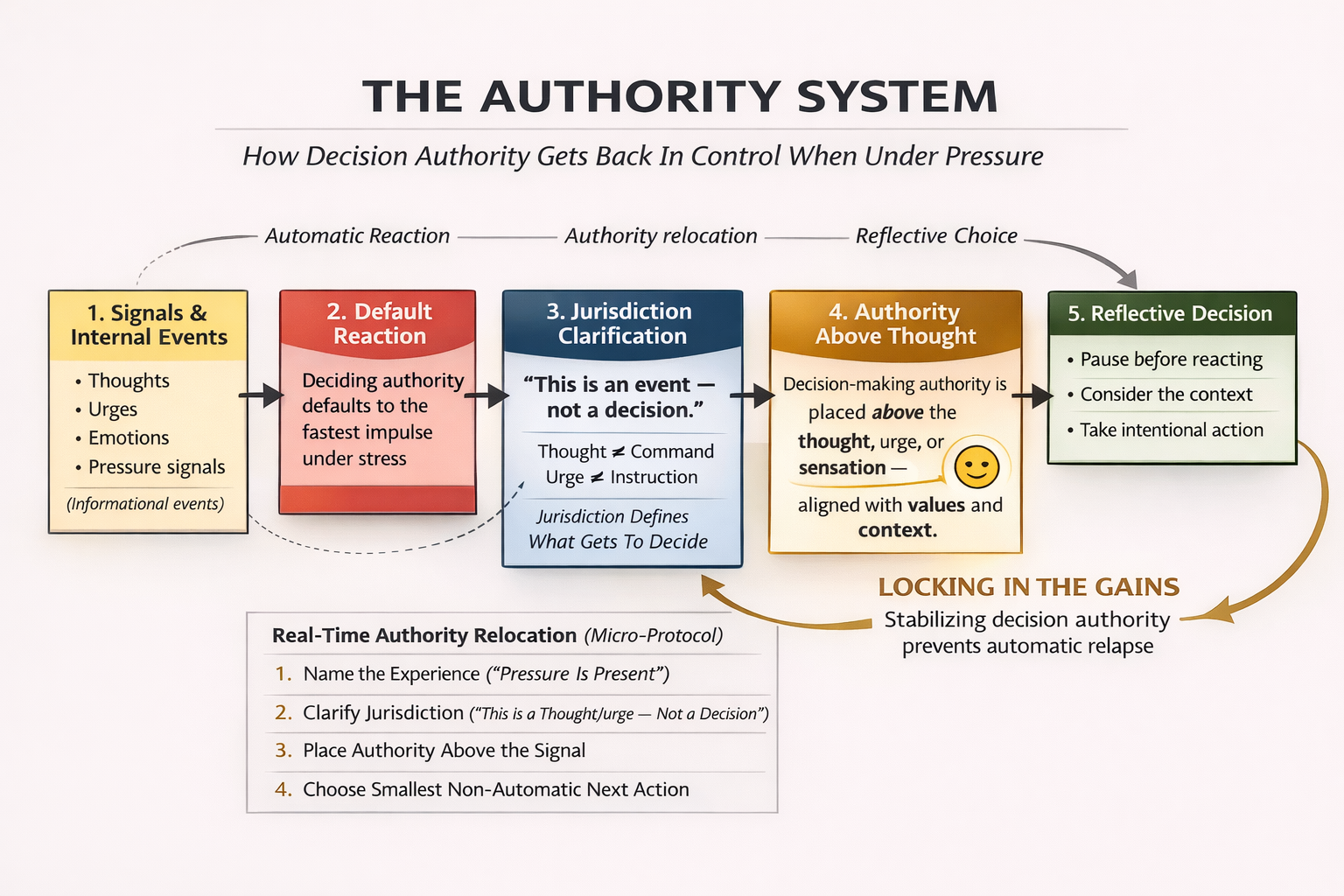
Thought-awareness involves recognising internal experiences as events rather than commands.
This includes urges, which can be observed in the same way as thoughts and emotions.
The ability to observe an internal signal without automatic identification is closely related to the process of seeing thoughts without automatically identifying with them. The same mechanism applies to urges: they arise, they carry emotional weight, but they do not inherently decide behaviour.
This stance does not suppress the urge. It repositions decision making authority relative to the urge.
__________
Why Urges Feel Decisive Under Pressure
Under emotional load, the brain seeks efficiency.
Stress signalling pathways can impair reflective cognitive function, increasing reliance on habitual responses [Arnsten, 2009].
This makes urges feel stronger and more urgent, not because they are more valid, but because reflective processing is reduced.
The subjective experience is: “I have to act.”
Objectively, the situation is: “An urge is present during a state of reduced cognitive capacity.”
This distinction is rarely noticed in real time, yet it has significant behavioural consequences.
__________
The Cost of Automatic Urge Compliance
When urges are consistently treated as decisions, behaviour becomes reactive and patterned.
Over time, this reinforces neural pathways associated with habitual relief-seeking [Brewer, 2017]. The brain learns that urgency leads to action, and action leads to short-term relief.
This loop increases behavioural rigidity:
- Urge arises faster
- Reaction occurs sooner
- Reflective choice diminishes
Breaking this loop does not require eliminating urges. It requires interrupting the automatic classification process.
Awareness Without Authority vs Authority Above Thought

Awareness alone allows recognition of internal signals. You may clearly recognise:
- “This is stress.”
- “This is an urge.”
- “This reaction is habitual.”
Yet you still act automatically.
This is awareness without authority: the experience is seen, but decision-making authority is still implicitly granted to urgency, discomfort, or emotional relief.
"Authority Above Thought" refers to the deliberate relocation of decision-making authority to a reflective stance aligned with values and context, rather than to the immediate emotional signal.
This is awareness with authority. It does not eliminate urges. It alters their jurisdiction.
In practical terms, this relocation does not begin with suppression or resistance. It begins with classification:
[1] The urge is first recognised as an internal event rather than an instruction.
- The aim here is not to resist the urge forcefully, but to prevent automatic handover of decision-making authority to urgency.
- For example, the experience is mentally named: “an urge is present” or “pressure is present.”
- This naming clarifies jurisdiction - the signal exists, but it does not automatically decide behaviour.
- It also clarifies that the signal is informational, not instructional.
- This small act introduces a pause that allows reflective evaluation before behaviour occurs.
[2] Once the experience is recognised as an event, jurisdiction becomes explicit: this is a thought, sensation, or urge, not a command.
- At this point, decision-making authority can be deliberately held above the urgency of the signal rather than handed over to it.
- This is the functional shift described in the gap between insight and behaviour, where awareness alone does not determine action unless authority is consciously retained at the decision point.
[3] The next step is not forceful control, but the selection of a small non-automatic response aligned with context and values.
- This may involve pausing briefly, delaying the reaction, changing the environment, or reducing exposure to the triggering stimulus.
- The key mechanism is that behaviour is no longer dictated by the speed or intensity of the urge, but by reflective evaluation.
- This process is consistent with why insight alone does not change behaviour, as insight can recognise a pattern while urgency still drives action if decision-making authority collapses under emotional pressure.
- By contrast, relocating authority above the urge interrupts the automatic handover of control without requiring the urge itself to disappear.
[4] Over time, this shift strengthens the capacity to observe internal signals without immediate compliance.
- Much like seeing thoughts without automatically identifying with them, urges can be experienced as persuasive internal events that signal information, rather than directives that determine behaviour.
- The urge may remain present, emotionally charged, and convincing, but its influence on action is moderated because jurisdiction has changed.
In this sense, Authority Above Thought is not the removal of internal experiences, but the reorganisation of decision-making authority.
- Thoughts can suggest.
- Emotions can signal.
- Urges can press for relief.
Yet the deciding stance remains positioned above these signals, allowing response rather than automatic reaction.
__________
Treating Internal Signals as Information, Not Commands
Urges can signal:
- Fatigue
- Stress
- Emotional discomfort
- Unmet needs
- Environmental overload
Treating them as information allows proportional response. Treating them as commands produces automatic behaviour.
The distinction is subtle but operationally powerful.
Information invites evaluation. Commands bypass evaluation.
Closing Perspective on Not Every Urge Is A Decision

Urges can be persuasive, emotionally charged, and rapid, but they do not inherently determine behaviour.
Not every urge is a decision.
The critical moment lies in the brief gap between feeling and action, where decision-making authority can either be handed to urgency or held at a reflective level aligned with context and values.
- Thoughts can suggest.
- Emotions can signal.
- Urges can press for relief.
- But they do not have to decide.
__________
Reflection Points
Reflecting on the idea that not every urge is a decision can reveal how quickly internal signals are mistaken for behavioural instructions.
- When an urge appears, do I experience it as a signal or as an instruction?
- How quickly do I move from feeling to action without recognising the gap?
- In what contexts do urges feel most urgent or compelling?
- What internal narratives accompany strong urges?
- Where does my decision-making authority sit during emotionally charged moments?
__________
Action Points
- Recognise urges as internal events rather than behavioural directives.
- Pause briefly to maintain decision-making authority above immediate emotional signals.
- Evaluate context and values before responding to internal pressure.
- Reduce environmental and cognitive load where urgency repeatedly escalates.
- Choose the smallest non-automatic response when pressure is high.
Free Worksheets:
- Action Steps For Relocating Decision Making Authority Above Thought
- Action Steps For Authority Above Thought - Locking In The Gains
Academic References
- Arnsten, A. F. T. [2009]. Stress signalling pathways that impair prefrontal cortex function. Nature Reviews Neuroscience.
- Brewer, J. A. [2017]. The Craving Mind. Yale University Press.
- Kahneman, D. (2011). Thinking, Fast and Slow.
- LeDoux, J. (1996). The Emotional Brain. Simon & Schuster.
- Miller, E. K., & Cohen, J. D. (2001). An integrative theory of prefrontal cortex function. Annual Review of Neuroscience.
Recommended Further Reading
- Why Insight Alone Does Not Change Behaviour
- How to See Your Thoughts Without Becoming Them
- You Are Not Your Thoughts
- How to Interrupt Emotional Spirals Using Thought Awareness
Return from: "Not Every Urge Is A Decision" to: Home Page or Inner Mastery For Outer Impact
Next Article: When Insight Is Not Enough - The Missing Piece in Behaviour Change

LATEST ARTICLES


Belief and Thought: What Zen Tools Works With - What It Leaves Alone
 A Clarification Of Scope Within Zen Tools - Not A Position On Belief As soon as people begin to notice their own thinking more clearly, questions about belief and thought naturally follow: - If though…
How Thought Becomes Identity - The Hidden Mechanism Behind Overthinking, Self-Worth, and Inner Conflict
 Thought Is an Event, Not a Self Most people believe identity is something they have - a stable sense of who they are. In reality, identity is something the mind is continuously producing. It is not fo…
When the Brain Is Hijacked - Where Does Choice Sit?"
 Pressure, the Hijacked Brain, and the Question of Authority
When the brain is hijacked, people are often told they have “lost control”.That language is understandable - and misleading. In reality, man…
Pressure, the Hijacked Brain, and the Question of Authority
When the brain is hijacked, people are often told they have “lost control”.That language is understandable - and misleading. In reality, man…Reduce Digital Overthinking To Lower Your Constant Inner Noise
 Why Constant Micro-Stimulation Increases Your Internal Noise. Modern digital life generates a level of mental activity that previous generations never had to deal with, and this is fundamentally why w…
Pausing Before You Act - Make It a Meta-Habit
 How A Tiny Moment Unlocks Clarity, Choice, And Self-Leadership. There is a moment in life so subtle you barely register it. A colleague questions your idea. A notification flashes. A moment of uncerta…
How to Interrupt Emotional Spirals Using Thought-Awareness
 The spiral is fueled by your mind believing the story your thoughts tell. No one sets out to be swept away by a surge of emotion. One second you’re handling life, and the next, your mind has broken in…
Universal Awareness and the Machinery of Thought
 You Can’t Control Thoughts - But You Can Learn To See Them. Why do our thoughts have so much power over us - and how do we reclaim clarity? The foundation of thought-awareness is the ability to see yo…
Rewiring Your Autopilot – How To Harness Your Subconscious Mind
 How to harness your subconscious mind and move from passenger to pilot. The case for rewiring your autopilot is that most of what drives your thoughts, reactions, and decisions happens below your cons…
Why You Need To Be Intimate With Your Own Thinking
 How self-awareness and insight transforms delusion into wisdom. We live inside an invisible weather system - one made not of clouds and wind, but of thoughts - and this invisibilty is why you need to…
The Illusion of Closeness in Always-On Relationships
 Closeness that cannot survive absence was never intimacy - only constant stimulation mistaken for connection. We live inside an unprecedented experiment in human connection. For the first time in hist…
Why Approval Feels Like Safety And Distance Feels Like Danger
 Safety is not found in being approved - it appears when approval is no longer required. When approval feels like safety, connection stops being something we enjoy and quietly becomes something we rely…
You Do Not Need Better Boundaries - You Need Clearer Thought
 What no longer feels like your responsibility no longer crosses your boundaries. This article explains why you don’t need better boundaries - you need clearer thought - how modern life systematically…