How Individuals Change Systems By Acting As Reflective Agents
The Hidden Power of Reflective Agents in Human Systems

Introduction - How Individuals Change Systems
Where System Change Actually Begins
Most discussions about how individuals change systems focus on leaders, reforms, or structural interventions.
These can matter. But complex human systems rarely change because someone announces a new rule.
They change because patterns of behaviour shift over time, for example:
- Imagine a meeting where a mistake has just been discovered.
- The room becomes tense.
- Someone is likely to be blamed.
- One person immediately begins criticising the colleague responsible.
- Others join in.
- The atmosphere tightens.
Now imagine a different response. One person pauses and says calmly:
- "Let’s slow down and understand what happened before we start assigning blame."
The problem being discussed is exactly the same in both situations. But the behaviour entering the room is different.
And that difference matters.
When people observe behaviour, they draw conclusions about how the system operates.
They learn what behaviour is acceptable, what behaviour is risky, and how they themselves should respond.
Over time these signals shape the patterns we recognise as an organisations's culture.
Understanding how individuals change systems begins with recognising how these small behavioural moments influence the wider environment around them.
So in practice this means that every day inside organisations, communities, and institutions, people observe each other:
- How others respond under pressure
- What behaviour is tolerated
- What behaviour spreads
- What behaviour is punished
From these signals people infer the real operating rules of the system.
This is how the culture of an organisationa formed. And by culture we mean: "how things are done round here".
Understanding how individuals change systems therefore begins with recognising that behaviour functions as information inside a system.
What is a Reflective Agent?
In systems thinking, an agent simply means a participant whose behaviour influences what happens in the system.
In everyday terms, an agent is simply a person whose actions affect the environment around them.
Inside organisations, teams, or societies, every individual contributes signals through what they do - how they respond to problems, how they speak to others, and how they behave under pressure.
Most behaviour in systems happens quickly and automatically. People react to incentives, emotions, expectations, or habits without pausing to think about alternative responses.
However, there are moments when a person becomes aware that more than one response is possible.
For example deciding whether or not to:
- Speak up in a meeting
- Respond defensively to criticism
- Follow pressure to cut corners
- Repeat a rumour or stay silent
These moments are points where behaviour could follow different paths. Zen Tools refers to these points as "decision moments".
At such moments a person can either react automatically or pause briefly and choose their response deliberately.
When someone takes that pause and considers the situation before acting, they are reflecting on their response rather than reacting immediately.
Zen Tools calls individuals who consistently operate in this way "Reflective Agents". For a more detailed explanation see:
The Decision Point Inside the System
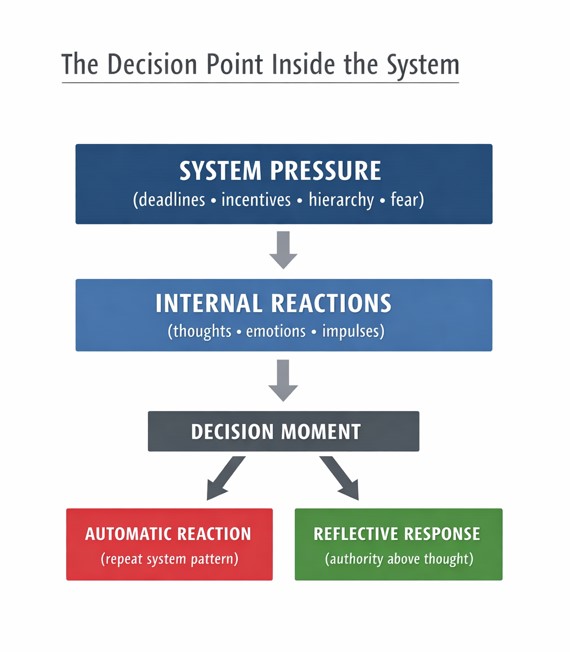
[Click on all graphics to expand]
Human systems continuously generate pressure. Deadlines, incentives, hierarchy, and social expectations all push individuals toward immediate reactions.
Most responses are automatic. However Zen Tools highlights a crucial mechanism.
Decision-making authority - the power that determines behaviour - does not have to be automatically handed over to thoughts or emotions.
Zen Tools calls the deliberate relocation of decision-making authority above these reactions:
Authority Above Thought
When decision-making authority sits above thoughts and impulses, a brief reflective pause becomes possible.
The individual can choose a response aligned with context and values rather than reacting automatically. For a fuller explanation please see:
A person operating in this way becomes what we have described as a "Reflective Agent".
At first this may appear to be purely an internal mental process. But inside a complex system it has much wider consequences, because every behavioural choice becomes a signal.
Behaviour Is More Than Action
Inside human systems, behaviour does more than produce outcomes. It also communicates information.
When people observe others acting, they are not only noticing what was done. They are also noticing how the person behaved while doing it.
- Was the response calm or reactive?
- Was responsibility accepted or avoided?
- Was the person open or defensive?
- Was the behaviour cooperative or competitive?
These signals shape how others interpret the situation and decide how they themselves should behave. So in this sense:
How you are while behaving becomes as important as what you do.
- A manager who solves a problem through blame sends one signal to the system.
- A manager who solves the same problem calmly and constructively sends a very different signal.
The technical outcome may be identical - the problem gets solved - but the behavioural signal entering the system is completely different.
Others observe that signal and adjust their behaviour accordingly.
- This is why every behavioural choice contributes information to the system.
- Each response becomes a small signal that others notice, interpret, and respond to.
- Over time these signals accumulate and influence the patterns that people recognise as culture.
For a fuller explanation of group culture why individual behaviour can influence the dynamics of the wider system please see:
Behaviour Is a Signal and What That Means
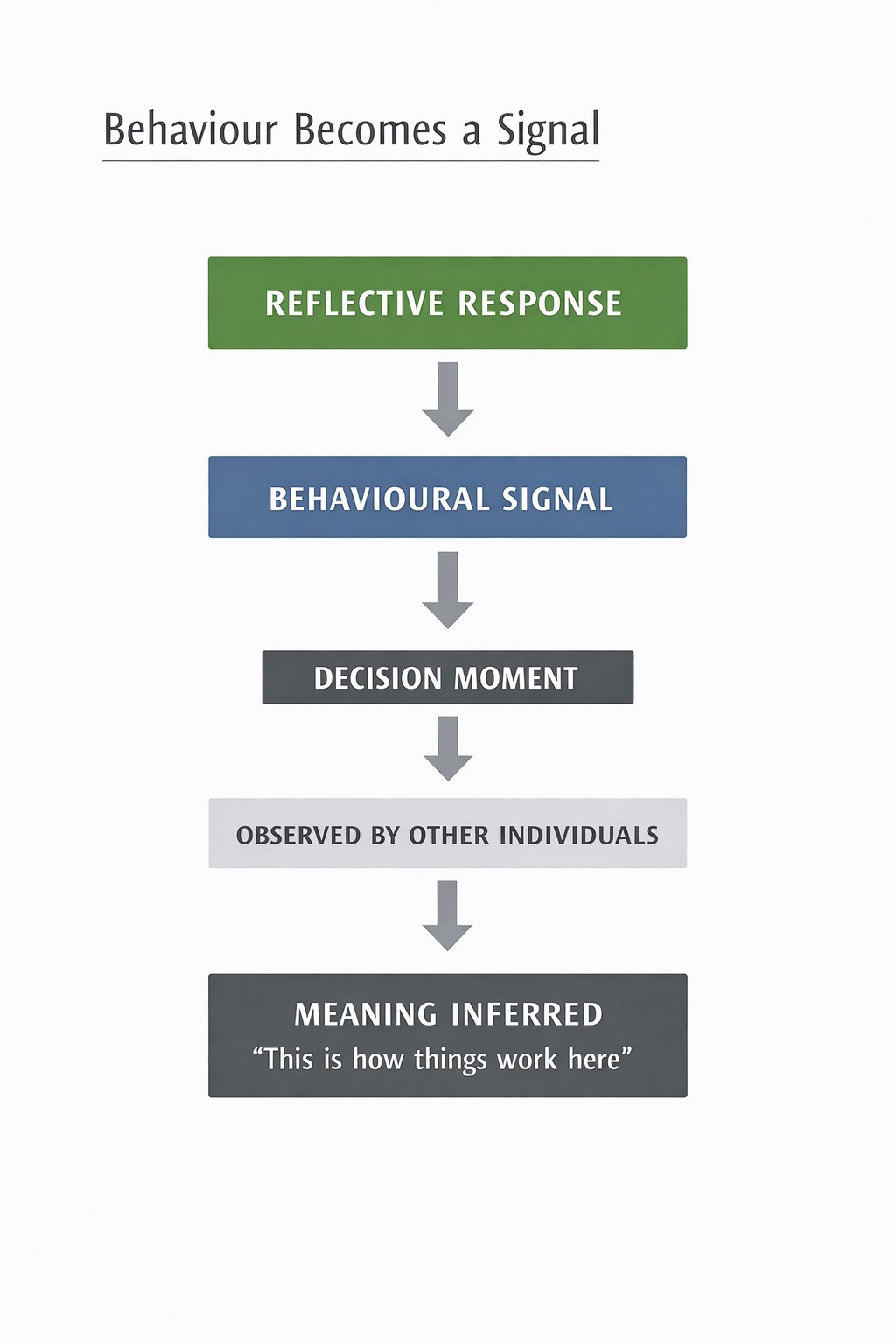
Human systems operate through continuous behavioural signalling. People constantly interpret what they observe. They notice who:
- Speaks honestly
- Remains silent
- Accepts responsibility
- Shifts blame
From these observations they infer what behaviour is safe, rewarded, or expected.
These signals accumulate into what we call culture.
- Culture is not primarily written policy.
- Culture is the pattern of behaviour repeatedly observed and reinforced.
Understanding how individuals change systems therefore requires understanding how behaviour becomes a signal that enters system feedback loops.
__________
Real-Life Example - Culture Signals
Imagine a hospital team dealing with a medical error. Two possible responses create two very different system signals.
Response 1 — Blame
A senior doctor immediately criticises the person involved.
Observed signal:
- Mistakes must be hidden
- Speaking up is dangerous
- Protect yourself
The feedback loop reinforces silence and defensiveness.
__________
Response 2 — Reflective Response
A senior doctor says:
“Let’s understand what happened so we can prevent it.”
Observed signal:
- Problems can be discussed
- Learning is valued
- Transparency is safe
The feedback loop reinforces learning behaviour.
Both behaviours influence the system.
________
The Behavioural Signal Pathway
The mechanism explaining how individuals change systems can be visualised clearly.
Reflective Behaviour Pathway System Pressure ↓ Decision Moment ↓ Reflective Response ↓ Behavioural Signal ↓ Feedback Loop ↓ Culture Formation
- The critical moment is the decision point.
- Automatic reactions reproduce existing patterns.
- Reflective responses introduce new behavioural signals.
Feedback Loops Drive System Behaviour
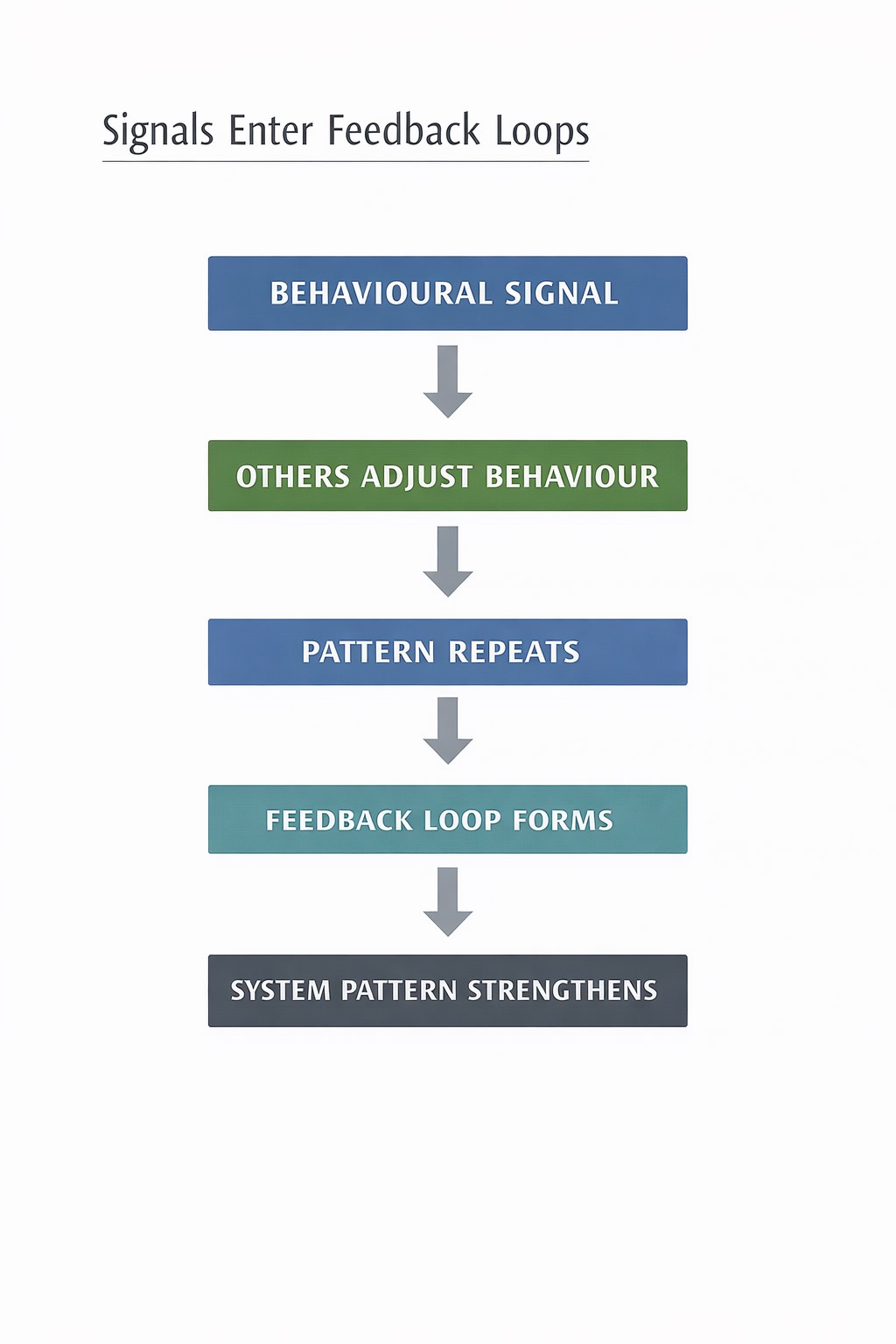
Complex systems evolve through feedback loops which occur when behaviour influences future behaviour. Two forms are especially important:
[1] Reinforcing Feedback Loops
Reinforcing loops amplify behaviour.
Example:
- A manager openly acknowledges uncertainty in a difficult project.
- Team members observe this honesty.
- They feel safer raising concerns.
- Open discussion spreads.
- The behaviour reinforces itself.
[2] Balancing Feedback Loops
Balancing loops stabilise or interrupt behaviour.
Example:
- During a crisis meeting people begin blaming each other.
- One participant calmly redirects the discussion toward solutions.
- The blame cycle weakens.
- The system stabilises.
__________
Example — Behaviour Spreading Through a System
Consider a technology company where meetings are dominated by senior voices. Junior employees rarely contribute ideas.
A single team leader begins explicitly inviting junior input. Over time:
- Junior staff speak more
- New ideas appear
- Participation increases
The system gradually shifts toward more distributed participation. A small behavioural signal influenced the system’s feedback loops.
__________
Automatic Behaviour Replicates Systems
Most behavioural signals are automatic. People tend to mirror what they observe around them. Examples include:
- Stress spreading through teams
- Blame spreading after failure
- Cynicism spreading in organisations
This automatic mirroring means systems often reproduce their existing patterns. Even when many individuals privately disagree with the culture, the behaviour persists.
__________
Reflective Agents Introduce New Signals
Reflective Agents behave differently. Because they operate with decision-making authority above thought, they can interrupt automatic reactions.
Instead of reproducing the dominant signal they introduce alternative behavioural signals. Examples include:
- Calm instead of panic
- Responsibility instead of blame
- Constructive challenge instead of silence
These signals alter the information environment of the system. Others observe them. Some adjust their behaviour. The signal begins circulating.
__________
Example — System Change Through Behaviour
Consider an airline safety culture. Historically many aviation accidents occurred because junior crew members did not challenge captains.
After aviation training began encouraging open challenge behaviour, a new signal entered the system: “Safety concerns should always be voiced.” Over time:
- Crew members spoke up more
- Safety discussions improved
- Accident rates declined
The behavioural signal reshaped the system’s feedback loops.
__________
Small Signals, Large Effects
Complex systems are highly sensitive to repeated behaviour. Change rarely occurs instantly. Instead culture evolves gradually through signal accumulation.
- Repeated behaviours → shape expectations
- Expectations → shape norms
- Norms → shape culture
This mechanism explains much of how individuals change systems.
Bringing It All Together
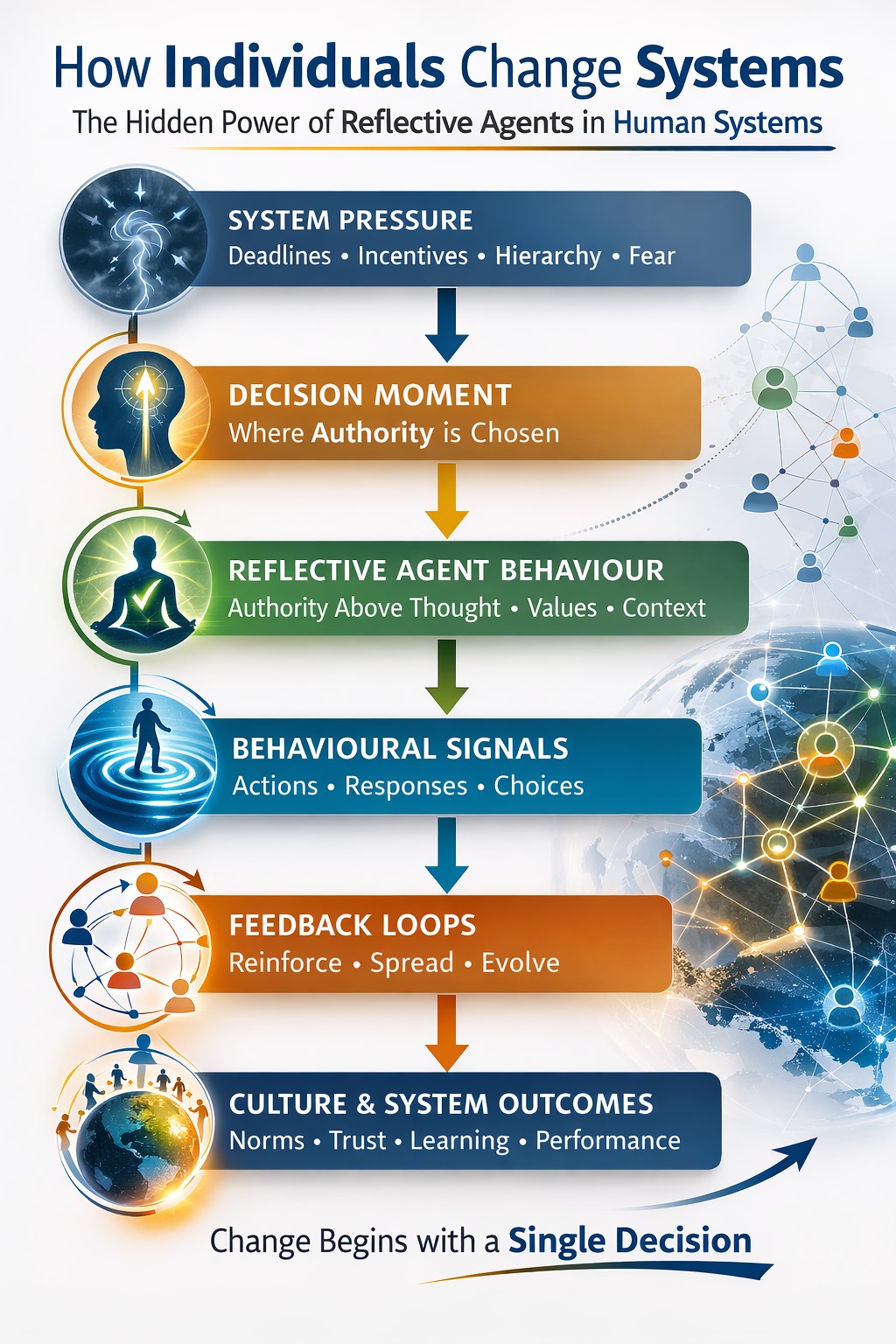
Understanding how individuals change systems begins with recognising where influence actually enters a human system.
- Systems apply pressure through incentives, expectations, uncertainty, and social cues.
- In most situations behaviour follows automatically.
But when decision-making authority is deliberately placed above immediate thoughts and reactions, a different pathway becomes possible.
- A reflective response produces behaviour that is not merely reactive but chosen.
- That behaviour becomes a signal inside the system.
- Others observe it, interpret it, and adjust their own behaviour accordingly.
- As similar responses repeat across interactions, those signals accumulate into feedback loops.
- Over time these loops shape the patterns that people recognise as culture, norms, and “how things are done here.”
Seen this way, systems do not change only through policies or structural interventions. They evolve through the steady accumulation of behavioural signals produced by individuals operating within them.
- The significance of the Reflective Agent therefore becomes clear.
- Each reflective decision contributes a small but meaningful signal to the wider system.
When such signals recur consistently, they gradually influence feedback loops and alter the patterns from which system outcomes emerge.
Reflection Points
- What behavioural signals dominate the systems you operate within?
- Which behaviours appear to spread quickly through your environment?
- Where might a reflective response interrupt an unhelpful feedback loop?
- What signals might strengthen constructive system behaviour?
- How might repeated behaviour gradually reshape expectations?
Action Orientations
- Notice moments when system pressure pushes toward automatic reaction.
- Pause briefly before responding.
- Identify the behavioural signal currently dominating the system.
- Consider what signal would improve the situation.
- Choose the smallest reflective response aligned with values and context.
Academic References
- Meadows, D. (2008). Thinking in Systems: A Primer.
- Senge, P. (2006). The Fifth Discipline.
- Axelrod, R. & Cohen, M. (2000). Harnessing Complexity.
- Sterman, J. (2000). Business Dynamics.
Recommended Further Reading
- Understanding Complex Systems Thinking — It's Not What You Think
- Applying Systems Thinking to Personal Behaviour
- The Illusion of Inevitability in Complex Decisions
- You Are Part of the System — The Reflective Agent Model
Return from: "How Individuals Change Systems" to: Home Page or Inner Mastery For Outer Impact
Next Article: You Are Part of the System: The Reflective Agent Model

LATEST ARTICLES


Belief and Thought: What Zen Tools Works With - What It Leaves Alone
 A Clarification Of Scope Within Zen Tools - Not A Position On Belief As soon as people begin to notice their own thinking more clearly, questions about belief and thought naturally follow: - If though…
How Thought Becomes Identity - The Hidden Mechanism Behind Overthinking, Self-Worth, and Inner Conflict
 Thought Is an Event, Not a Self Most people believe identity is something they have - a stable sense of who they are. In reality, identity is something the mind is continuously producing. It is not fo…
When the Brain Is Hijacked - Where Does Choice Sit?"
 Pressure, the Hijacked Brain, and the Question of Authority
When the brain is hijacked, people are often told they have “lost control”.That language is understandable - and misleading. In reality, man…
Pressure, the Hijacked Brain, and the Question of Authority
When the brain is hijacked, people are often told they have “lost control”.That language is understandable - and misleading. In reality, man…Reduce Digital Overthinking To Lower Your Constant Inner Noise
 Why Constant Micro-Stimulation Increases Your Internal Noise. Modern digital life generates a level of mental activity that previous generations never had to deal with, and this is fundamentally why w…
Pausing Before You Act - Make It a Meta-Habit
 How A Tiny Moment Unlocks Clarity, Choice, And Self-Leadership. There is a moment in life so subtle you barely register it. A colleague questions your idea. A notification flashes. A moment of uncerta…
How to Interrupt Emotional Spirals Using Thought-Awareness
 The spiral is fueled by your mind believing the story your thoughts tell. No one sets out to be swept away by a surge of emotion. One second you’re handling life, and the next, your mind has broken in…
Universal Awareness and the Machinery of Thought
 You Can’t Control Thoughts - But You Can Learn To See Them. Why do our thoughts have so much power over us - and how do we reclaim clarity? The foundation of thought-awareness is the ability to see yo…
Rewiring Your Autopilot – How To Harness Your Subconscious Mind
 How to harness your subconscious mind and move from passenger to pilot. The case for rewiring your autopilot is that most of what drives your thoughts, reactions, and decisions happens below your cons…
Why You Need To Be Intimate With Your Own Thinking
 How self-awareness and insight transforms delusion into wisdom. We live inside an invisible weather system - one made not of clouds and wind, but of thoughts - and this invisibilty is why you need to…
The Illusion of Closeness in Always-On Relationships
 Closeness that cannot survive absence was never intimacy - only constant stimulation mistaken for connection. We live inside an unprecedented experiment in human connection. For the first time in hist…
Why Approval Feels Like Safety And Distance Feels Like Danger
 Safety is not found in being approved - it appears when approval is no longer required. When approval feels like safety, connection stops being something we enjoy and quietly becomes something we rely…
You Do Not Need Better Boundaries - You Need Clearer Thought
 What no longer feels like your responsibility no longer crosses your boundaries. This article explains why you don’t need better boundaries - you need clearer thought - how modern life systematically…