You Are Part of the System: The Reflective Agent Model
Where Systems Thinking Meets Mindfulness

You Are Part Of The System - You Cannot Escape
Most people think of themselves as separate from the systems around them - workplaces, organisations, families, communities, and societies. We often experience these systems as external forces that shape our opportunities, expectations, and behaviour.
Yet the reality is different. You are part of the system, whether you realise it or not.
In complex human systems behaviour does not move in a straight line from cause to effect. It circulates through feedback loops. One response triggers another, which then influences the next interaction. Over time these signals accumulate and shape the culture, tone, and expectations of the system itself.
This means something subtle but powerful:
You are part of the system, and the signals you contribute inevitably influence the environment you experience.
Once this becomes visible, an important question appears.
If individuals contribute signals to the systems they inhabit, what happens when those signals are chosen deliberately rather than automatically?
The Reflective Agent model explores that question.
The Behaviour Loop Inside Human Systems
The first step is simply recognising how human systems operate.
- Complex systems are shaped by continuous feedback loops.
- Pressures emerge within the system - expectations, incentives, cultural norms, emotional reactions.
- Individuals respond to those pressures, and their responses generate new signals that influence the next cycle of behaviour.
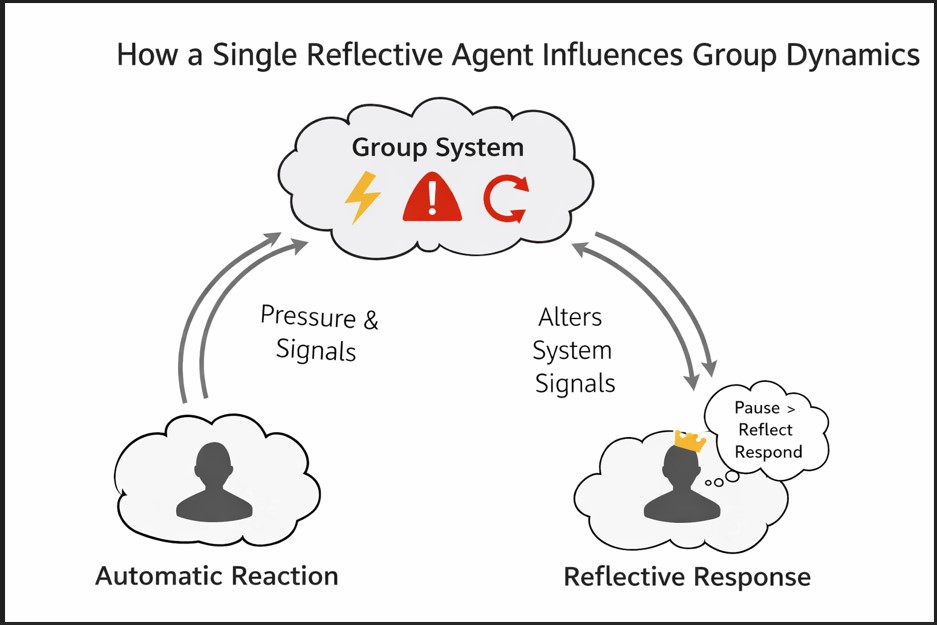
[Click on all graphics to expand]
In many situations these responses occur automatically.
- Urgency triggers haste.
- Criticism triggers defensiveness.
- Anxiety triggers control.
Each reaction feeds the system with new signals that reinforce existing dynamics.
- Over time the system stabilises around these patterns.
- Teams become known for their tension or cooperation. organisations develop reputations for trust or blame.
- Families settle into familiar cycles of escalation or avoidance.
At this level most attempts to change behaviour focus on the surface: correcting mistakes, enforcing rules, or responding to problems as they arise.
But systems thinking suggests something deeper.
Behaviour is not only a response to the system. It is also a signal shaping the system itself.
The Hidden Decision Point
If behaviour shapes system signals, an important question emerges: where does behaviour actually originate?
At first glance the process appears simple. Pressure leads to reaction.
Yet between pressure and response there is often a brief moment of awareness.
In that moment an individual may notice the urge to react before the reaction occurs.
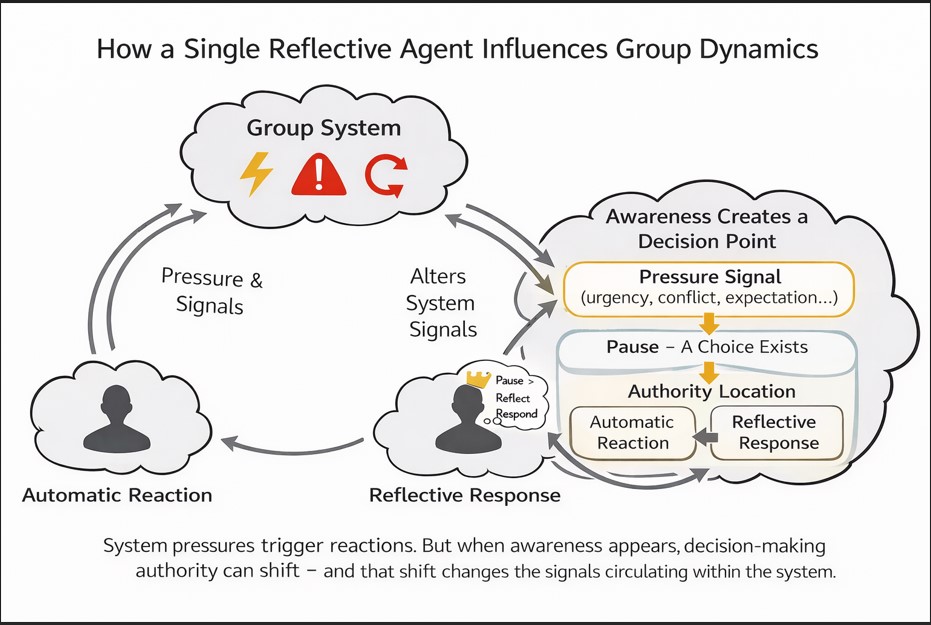
This moment reveals something important: behaviour is not always inevitable. There exists a small but significant decision point between stimulus and response.
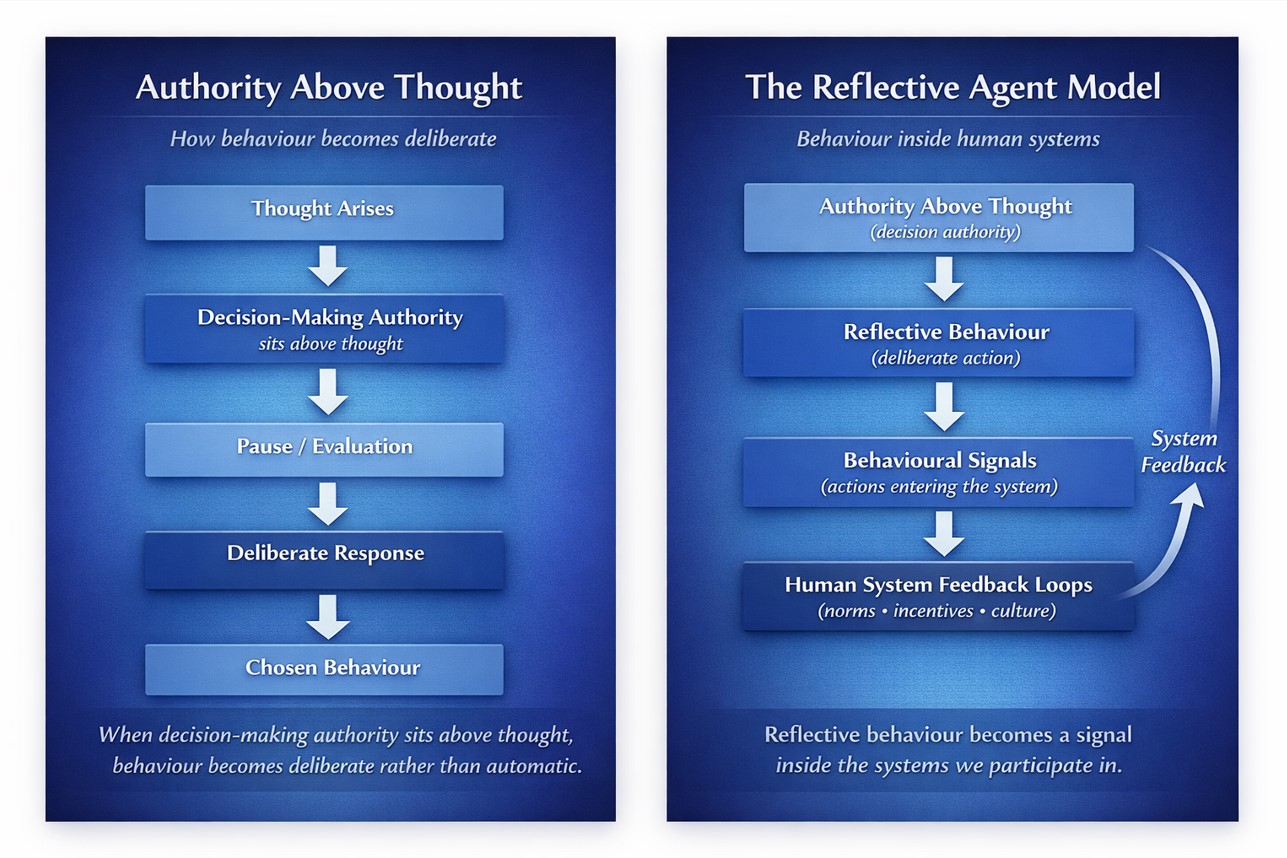
Zen Tools describes the relocation of decision-making authority above immediate reaction as Authority Above Thought. Thoughts and emotions may arise automatically, but they do not necessarily determine what happens next.
When awareness reveals the decision point, behaviour becomes a matter of choice rather than impulse.
This shift introduces the possibility of reflective action within the system.
Behaviour as a Signal
Once behaviour is recognised as a choice rather than an inevitability, another insight follows.
Every response sends signals back into the system.
- Tone influences tone.
- Calmness interrupts escalation.
- A deliberate pause slows urgency.
Over time these signals propagate through interactions and contribute to what groups often describe as “how things are done around here”.
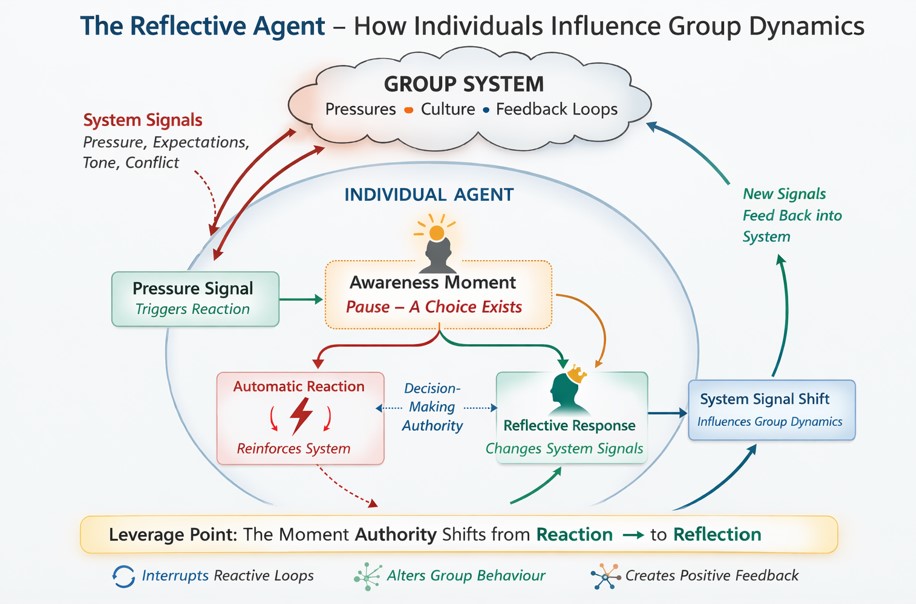
This is where systems thinking meets group culture.
Behaviour is not simply personal; it is communicative. Each action broadcasts information about expectations, norms, and emotional climate.
- When individuals respond automatically, they reinforce the signals already circulating within the system.
- When responses become reflective, they introduce new signals that may gradually influence group dynamics.
At this point a deeper realisation becomes possible. If behaviour circulates through the system in this way, then individual responses are not merely reactions to the environment. They are also contributions to the environment.
In other words, you are part of the system.
And once that becomes clear, the question changes. The issue is no longer simply how the system influences you, but how your behaviour influences the system you inhabit.
This observation leads to the core insight of the Reflective Agent model.
Pivot Point 1 — The Moment of Personal Alignment
At some point the individual recognises something fundamental: you are part of the system.
This realisation marks a shift from observing the system to recognising one’s role within it.
- The individual is no longer separate from the environment they inhabit.
- They are one of the many moving parts contributing to its behaviour.
- The implication is both simple and profound.
How you are is as important as what you do.
- In complex systems small behavioural signals can propagate widely.
- Tone influences tone.
- Composure stabilises interaction.
- Fairness encourages trust.
These intangible signals shape how people experience the system around them. This leads to a practical question:
Why should you care about influencing the system at all? The answer is straightforward: This is where the "what's in it for me" motivation becomes clear. If your behaviour contributes signals to the system, those signals eventually shape the environment you must live within. In other words: If you cannot escape the system, it makes sense to contribute signals that make that system function better.
This recognition is: The Moment of Personal Alignment.
__________
Pivot Point 2 — Establishing the Point of Focus
After alignment comes a practical question.
If individuals influence systems, where should they focus their effort?
- Complex systems make outcomes unpredictable.
- Attempts to control results often produce frustration or unintended consequences.
- The behaviour of many interacting components cannot be managed directly.
Yet there is something the individual can control.
You can control the quality of the process through which you act. How you are is as important as what you do.
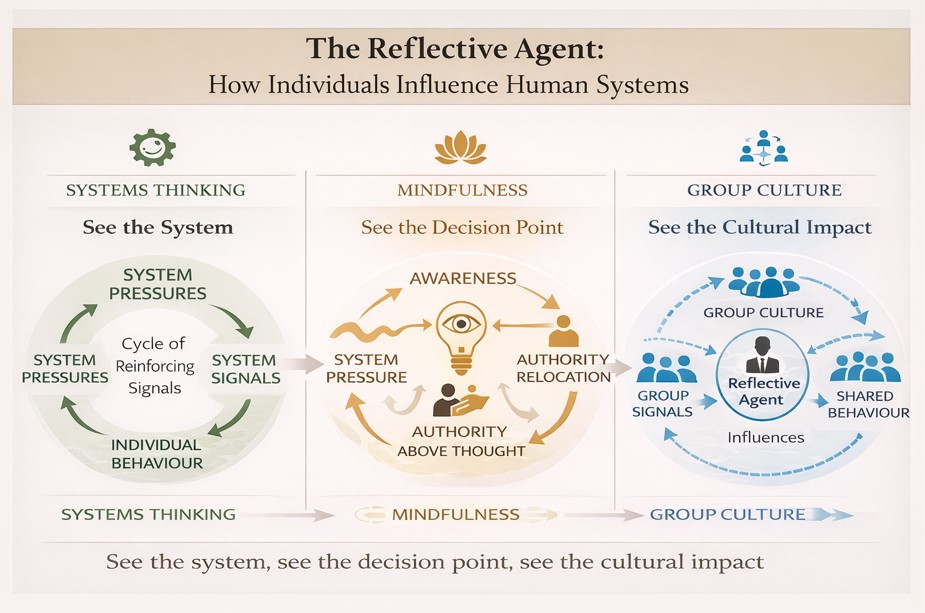
This second pivot point establishes a practical orientation: focus on the quality of your response.
- Qualities such as clarity, patience, composure, fairness, and restraint may appear intangible, yet these signals often have powerful effects within human systems.
- They shape tone, influence trust, and alter the feedback loops that govern behaviour.
The Reflective Agent

A person who recognises these dynamics and deliberately chooses their responses within them can be described as a Reflective Agent.
In systems terminology:
- An agent is simply an individual acting within a system.
- A reflective agent is someone who recognises that their behaviour influences the system they inhabit and therefore chooses their responses deliberately rather than reacting automatically.
The Reflective Agent model therefore brings together two insights: You do not control the system. But by altering the signals you contribute, you can influence how the system evolves over time.
Conclusion — The System You Help Create

Human systems can feel overwhelming. Organisations develop rigid cultures, teams fall into unhelpful patterns, and relationships repeat the same cycles. From inside these dynamics it is easy to feel that individuals have little real influence.
But complex systems are not controlled by a single force. They are shaped by the accumulated signals of the people within them — how people communicate, respond, and behave under pressure. Every response you contribute becomes part of the environment others respond to next.
This is what the Reflective Agent model makes practical. You may not control the system. But by choosing your responses more deliberately, you change the conditions you and everyone else must work within.
__________
Reflection Points
- In what situations do you experience strong system pressures such as urgency, authority, or expectation?
- Can you identify moments where your reaction felt automatic rather than deliberate?
- What signals does your behaviour tend to send into the system around you?
- How might reflective responses alter the tone or direction of those interactions?
- Where might focusing on the quality of your process improve the system you inhabit?
Action Points
- Notice system pressures before reacting
- Recognise the decision point between stimulus and response
- Place decision-making authority above immediate reaction
- Focus on the quality of the signal your behaviour contributes
- Observe how different responses influence system dynamics
Reflective Agent Practice Worksheets
The following worksheets help translate the Reflective Agent model into practical observation and action.
- Worksheet 1 — Seeing the System
- Worksheet 2 — Recognising the Decision Point
- Worksheet 3 — Focusing on the Quality of Process
- Worksheet 4 — Observing System Signals
Download: Zen Tools - Reflective Agent Practice Worksheets
Academic References
- Meadows, D. [2008] Thinking in Systems: A Primer.
- Sterman, J. [2000)] Business Dynamics: Systems Thinking and Modeling for a Complex World.
- Senge, P. (2006). The Fifth Discipline.
Recommended Further Reading
Explains the core principles of complex systems, feedback loops, and why behaviour inside systems often produces unintended outcomes. This article provides the conceptual foundation for understanding why you are part of the system and how systems evolve through interaction.
Shows how systems thinking applies directly to everyday behaviour in organisations, teams, and relationships. It introduces the idea that behavioural signals can reinforce or shift system dynamics.
The pillar article for the Mindfulness domain explaining how awareness reveals the decision point between stimulus and response. This provides the foundation for Authority Above Thought, the mechanism behind reflective behaviour.
Explores how behavioural signals propagate through groups and create shared expectations, norms, and patterns of interaction. This article explains why individual behaviour can influence the dynamics of the wider system.
Introduces the principle of focusing on process rather than outcome in complex systems. This insight supports the second pivot point in the Reflective Agent model: focusing on the quality of the signal you contribute rather than attempting to control the system itself.
Return from: "You Are Part Of The System" to: Home Page or Inner Mastery For Outer Impact
Next Article: Applying Systems Thinking to Personal Behaviour, Teams & Relationships

LATEST ARTICLES


Belief and Thought: What Zen Tools Works With - What It Leaves Alone
 A Clarification Of Scope Within Zen Tools - Not A Position On Belief As soon as people begin to notice their own thinking more clearly, questions about belief and thought naturally follow: - If though…
How Thought Becomes Identity - The Hidden Mechanism Behind Overthinking, Self-Worth, and Inner Conflict
 Thought Is an Event, Not a Self Most people believe identity is something they have - a stable sense of who they are. In reality, identity is something the mind is continuously producing. It is not fo…
When the Brain Is Hijacked - Where Does Choice Sit?"
 Pressure, the Hijacked Brain, and the Question of Authority
When the brain is hijacked, people are often told they have “lost control”.That language is understandable - and misleading. In reality, man…
Pressure, the Hijacked Brain, and the Question of Authority
When the brain is hijacked, people are often told they have “lost control”.That language is understandable - and misleading. In reality, man…Reduce Digital Overthinking To Lower Your Constant Inner Noise
 Why Constant Micro-Stimulation Increases Your Internal Noise. Modern digital life generates a level of mental activity that previous generations never had to deal with, and this is fundamentally why w…
Pausing Before You Act - Make It a Meta-Habit
 How A Tiny Moment Unlocks Clarity, Choice, And Self-Leadership. There is a moment in life so subtle you barely register it. A colleague questions your idea. A notification flashes. A moment of uncerta…
How to Interrupt Emotional Spirals Using Thought-Awareness
 The spiral is fueled by your mind believing the story your thoughts tell. No one sets out to be swept away by a surge of emotion. One second you’re handling life, and the next, your mind has broken in…
Universal Awareness and the Machinery of Thought
 You Can’t Control Thoughts - But You Can Learn To See Them. Why do our thoughts have so much power over us - and how do we reclaim clarity? The foundation of thought-awareness is the ability to see yo…
Rewiring Your Autopilot – How To Harness Your Subconscious Mind
 How to harness your subconscious mind and move from passenger to pilot. The case for rewiring your autopilot is that most of what drives your thoughts, reactions, and decisions happens below your cons…
Why You Need To Be Intimate With Your Own Thinking
 How self-awareness and insight transforms delusion into wisdom. We live inside an invisible weather system - one made not of clouds and wind, but of thoughts - and this invisibilty is why you need to…
The Illusion of Closeness in Always-On Relationships
 Closeness that cannot survive absence was never intimacy - only constant stimulation mistaken for connection. We live inside an unprecedented experiment in human connection. For the first time in hist…
Why Approval Feels Like Safety And Distance Feels Like Danger
 Safety is not found in being approved - it appears when approval is no longer required. When approval feels like safety, connection stops being something we enjoy and quietly becomes something we rely…
You Do Not Need Better Boundaries - You Need Clearer Thought
 What no longer feels like your responsibility no longer crosses your boundaries. This article explains why you don’t need better boundaries - you need clearer thought - how modern life systematically…