Thought Awareness and Mindfulness
How to Develop Cognitive Clarity
The Foundation of Clear Thinking and Reflective Action

Setting The Scene for Thought Awareness and Mindfulness
At the heart of thought awareness and mindfulness lies a practical shift: learning to recognise thoughts as events rather than commands.
Most people do not lack intelligence.
- They struggle with unexamined mental activity.
- Thoughts arise rapidly, often carrying urgency, emotion or certainty.
- Without awareness, those thoughts are experienced as reality itself.
The result is automatic reaction.
This skill underpins clear thinking, creative insight, complex systems reasoning and behavioural stability under pressure. Without it, higher-level mechanisms such as Authority Above Thought cannot operate reliably.
__________
What Mindfulness Means in Zen Tools
Within this framework, thought awareness and mindfulness involve:
- Recognising thoughts as thoughts
- Distinguishing signal from story
- Noticing emotional activation as it arises
- Interrupting automatic identification with mental content
- Directing attention deliberately
This is not about suppressing thought or eliminating emotion. It is about seeing clearly.
Cognitive science describes related processes as decentring or cognitive defusion — the ability to observe thoughts without fusing with them [Fresco et al., 2007; Hayes et al., 2011].
Research also links meta-awareness and attentional regulation with increased prefrontal activation associated with reflective control [Tang, Hölzel & Posner, 2015].
The Four Layers Of The Thought Awareness & Mindfulness Framework

Layer 1 — Foundational Thought Awareness
The first layer of the Mindfulness framework develops the core capacity to notice mental activity without immediate reaction.
You strengthen the ability to:
- Notice a thought as it appears
- Detect emotional signals early
- Recognise recurring cognitive patterns
- Observe mental noise without acting from it
This is the ground from which reflective choice becomes possible.
Foundational Practice Downloads To develop thought awareness and mindfulness in a structured way, use the following practice tools: These worksheets build the awareness foundation before progressing to authority relocation or stabilisation protocols.
A structured protocol for recognising thoughts as events rather than facts.
A guided exercise for separating emotional signals from the narratives that follow them.
A short mechanical process for restoring clarity when attention becomes fragmented.
__________
Simple Illustration
You receive a critical email.
Without awareness:
- “This is unfair.”
- “I’m being attacked.”
- Immediate defensive reply.
With awareness:
- “A thought of unfairness is present.”
- “Tension is present.”
- Pause.
Nothing external has changed. The difference lies in recognition. Awareness creates space.
__________
Why Awareness Alone Is Not Always Enough
Awareness does not automatically change behaviour.
You can see a thought and still obey it. You can recognise anger and still act from it.
This is why Zen Tools distinguishes between foundational thought awareness and mindfulness and the mechanism known as Authority Above Thought.
For a deeper exploration of how this gap operates, see:
- How to See Your Thoughts Without Becoming the Story
- Not Every Urge Is a Decision: The Missing Gap Between Feeling & Action
Layer 2 — Authority Above Thought
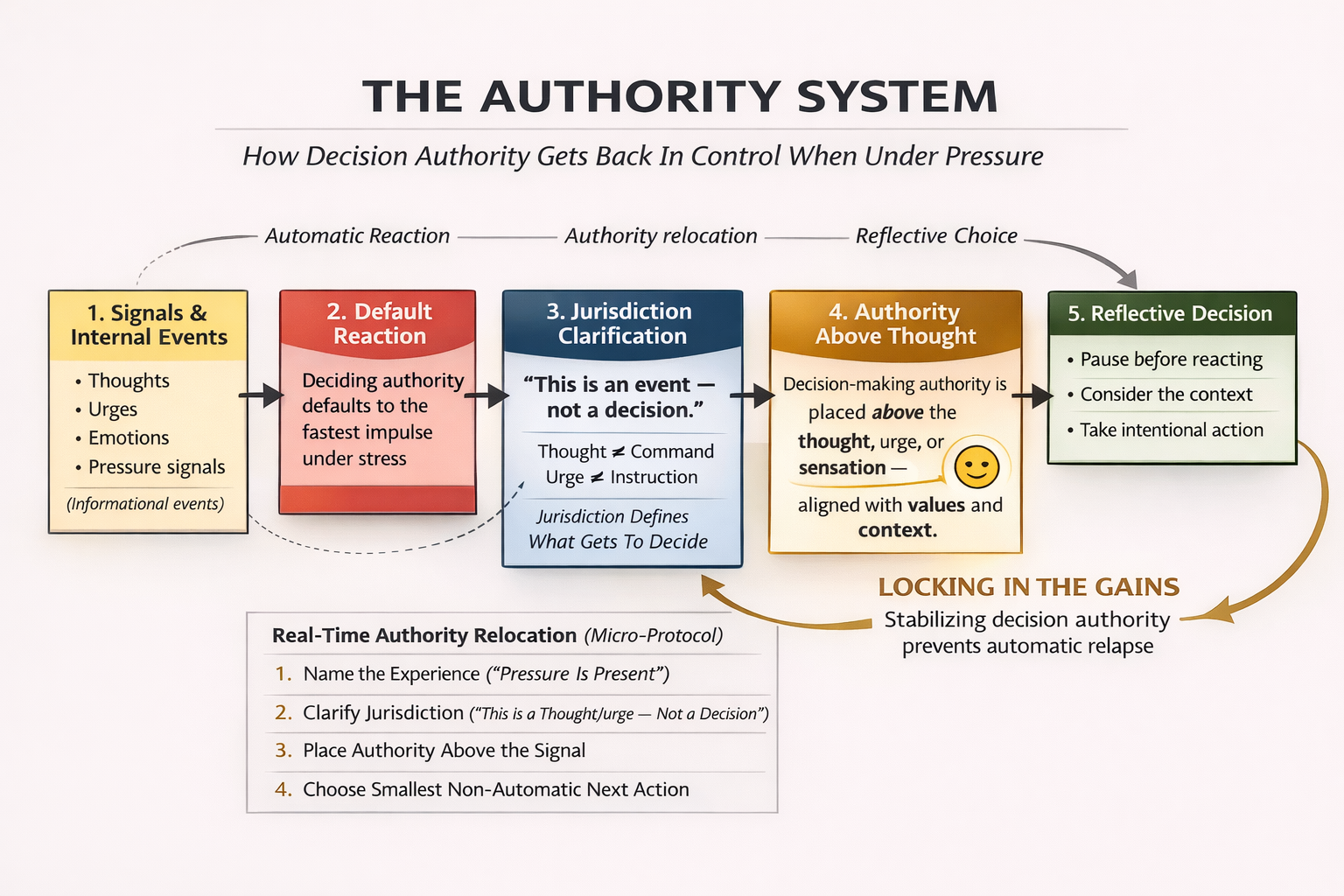
Authority Above Thought addresses a different question: where is decision-making authority currently sitting?
Decision-making authority refers to the system that determines what action follows a thought or urge.
It may sit with automatic habit and emotional urgency, or with reflective choice aligned to values and context.
Operationally, Authority Above Thought involves:
- Naming the experience [“an urge is present”].
- Clarifying jurisdiction [“this is a thought, not a decision”].
- Relocating decision-making authority above the thought.
- Choosing the smallest non-automatic next action.
Authority depends upon awareness.
Without foundational thought awareness and mindfulness, there is nothing to relocate authority from.
Further reading:
- Why Insight Alone Does Not Change Behavior – Locking In The Gains
- When Insight Is Not Enough – The Missing Piece in Behaviour Change
Layer 3 — When Clarity Is Impaired

Under emotional overload, clarity can collapse.
In such cases, the Deep Acceptance Process provides a structured, mechanical method for clearing destabilising internal interference so calm clarity can return.
This supports the effective application of Authority Above Thought.
Explore this further in:
Layer 4 — Stabilising Under Pressure

Even when awareness and authority are present, behaviour may regress under stress.
Locking In The Gains reinforces relocated decision-making authority so automatic patterns do not regain control.
Explore this further in:
__________
How This Strengthens Thinking, Creativity and Decision-Making
The disciplined development of thought awareness and mindfulness strengthens:
- Reflective brain activation
- Creative cognition
- Complex systems thinking
- Communication clarity
- Emotional regulation
- Cognitive load management
Creative insight often emerges when mental noise subsides and attention stabilises. Research on attentional flexibility suggests that regulated awareness enhances creative problem solving [Tang et al., 2015].
Complex systems thinking likewise depends on the ability to observe assumptions without immediately identifying with them.
Mindfulness, in this sense, functions as cognitive infrastructure.
For applied practice see:
Closing Reflections on Thought Awareness and Mindfulness

A Simple Practice You Can Try Now
Pause.
Ask internally:
- “What thought is present right now?”
Name it plainly. Do not analyse. Do not argue.
Repeat twice.
This is not meditation. It is cognitive signal recognition.
___________
Reflection Points
- When do I most easily fuse with my thoughts?
- What signals tell me I have lost awareness?
- In what contexts does urgency override clarity?
- How does mental noise affect my decision quality?
- Where might awareness alone be insufficient?
Action Orientations
- Notice one recurring thought pattern today.
- Label it explicitly as a thought, not a fact.
- Pause before acting on emotionally charged signals.
- Practise distinguishing signal from story.
- Identify one situation where decision-making authority collapses under pressure.
Academic References (Minimal Authority List)
- Fresco, D.M. et al. (2007) ‘Initial psychometric properties of the Experiences Questionnaire’
- Hayes, S.C., Strosahl, K.D. & Wilson, K.G. (2011) Acceptance and Commitment Therapy: The Process and Practice of Mindful Change.
- Tang, Y.Y., Hölzel, B.K. & Posner, M.I. (2015) ‘The neuroscience of mindfulness meditation’
Recommended Further Reading
- How to See Your Thoughts Without Becoming the Story
- Not Every Urge Is a Decision: The Missing Gap Between Feeling & Action
- Why Insight Alone Does Not Change Behavior – Locking In The Gains
- When Insight Is Not Enough – The Missing Piece in Behaviour Change
- The Transformative Power of Acceptance
- Mindful Listening
- Practising Mindfulness In Daily Life
- Mindfulness Meditation Technique – The Basics
Return from: "Thought Awareness And Mindfulness" to: Home Page or Inner Mastery For Outer Impact
Next Article: The Illusion of Inevitability in Complex Decisions

LATEST ARTICLES


Belief and Thought: What Zen Tools Works With - What It Leaves Alone
 A Clarification Of Scope Within Zen Tools - Not A Position On Belief As soon as people begin to notice their own thinking more clearly, questions about belief and thought naturally follow: - If though…
How Thought Becomes Identity - The Hidden Mechanism Behind Overthinking, Self-Worth, and Inner Conflict
 Thought Is an Event, Not a Self Most people believe identity is something they have - a stable sense of who they are. In reality, identity is something the mind is continuously producing. It is not fo…
When the Brain Is Hijacked - Where Does Choice Sit?"
 Pressure, the Hijacked Brain, and the Question of Authority
When the brain is hijacked, people are often told they have “lost control”.That language is understandable - and misleading. In reality, man…
Pressure, the Hijacked Brain, and the Question of Authority
When the brain is hijacked, people are often told they have “lost control”.That language is understandable - and misleading. In reality, man…Reduce Digital Overthinking To Lower Your Constant Inner Noise
 Why Constant Micro-Stimulation Increases Your Internal Noise. Modern digital life generates a level of mental activity that previous generations never had to deal with, and this is fundamentally why w…
Pausing Before You Act - Make It a Meta-Habit
 How A Tiny Moment Unlocks Clarity, Choice, And Self-Leadership. There is a moment in life so subtle you barely register it. A colleague questions your idea. A notification flashes. A moment of uncerta…
How to Interrupt Emotional Spirals Using Thought-Awareness
 The spiral is fueled by your mind believing the story your thoughts tell. No one sets out to be swept away by a surge of emotion. One second you’re handling life, and the next, your mind has broken in…
Universal Awareness and the Machinery of Thought
 You Can’t Control Thoughts - But You Can Learn To See Them. Why do our thoughts have so much power over us - and how do we reclaim clarity? The foundation of thought-awareness is the ability to see yo…
Rewiring Your Autopilot – How To Harness Your Subconscious Mind
 How to harness your subconscious mind and move from passenger to pilot. The case for rewiring your autopilot is that most of what drives your thoughts, reactions, and decisions happens below your cons…
Why You Need To Be Intimate With Your Own Thinking
 How self-awareness and insight transforms delusion into wisdom. We live inside an invisible weather system - one made not of clouds and wind, but of thoughts - and this invisibilty is why you need to…
The Illusion of Closeness in Always-On Relationships
 Closeness that cannot survive absence was never intimacy - only constant stimulation mistaken for connection. We live inside an unprecedented experiment in human connection. For the first time in hist…
Why Approval Feels Like Safety And Distance Feels Like Danger
 Safety is not found in being approved - it appears when approval is no longer required. When approval feels like safety, connection stops being something we enjoy and quietly becomes something we rely…
You Do Not Need Better Boundaries - You Need Clearer Thought
 What no longer feels like your responsibility no longer crosses your boundaries. This article explains why you don’t need better boundaries - you need clearer thought - how modern life systematically…