When External Narratives Become Identity
When identity is unclear, the mind will accept ready-made answers — and those answers can start making decisions immediately
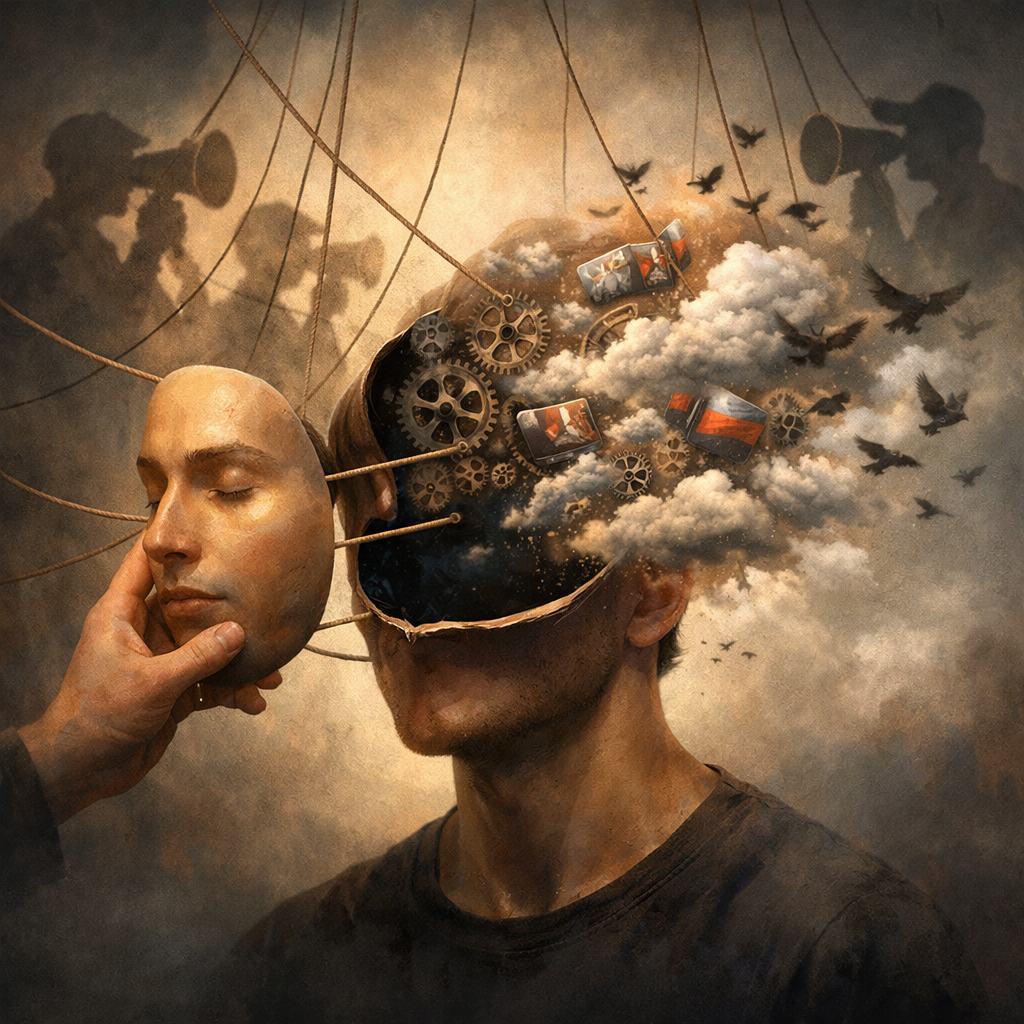
Why External Narratives Become Identity
When external narratives become identity, what begins as something you hear or read can quickly become something you feel is “you”.
- This shift is rarely deliberate. It does not happen because people are weak or easily influenced.
- It happens because the mind is designed to resolve uncertainty quickly, especially around identity.
- When there is no clear internal answer to the question of who you are and how you should act, the mind looks for structure.
- It looks for something that reduces ambiguity and provides direction.
If that structure is not internally formed, it is often supplied from the outside - and this is where external narratives become identity without being noticed.
__________
Why This Happens
Human beings are naturally responsive to modelling, authority, and belonging. We look for people to learn from, voices to trust, and groups to fit into.
These are not flaws - they are part of how we orient ourselves in the world.
But they also create a point of vulnerability:
- When identity feels unclear, strong external narratives can step in and fill that gap.
- These narratives are typically simple, confident, and emotionally charged.
- They present themselves as explanations of how the world works and how you should behave within it.
- They reduce uncertainty quickly, and at the same time they offer something that feels like identity.
That combination - clarity plus identity - is what makes them powerful, and explains how external narratives become identity so effectively.
How External Narratives Become Identity

At first, a narrative is just something you encounter - an idea, a message, a way of interpreting the world.
But when it begins to answer questions about who you are, what matters, and how you should respond, it starts to move from external input into internal identity.
This transition is rarely obvious in the moment.
What changes is not just what you think, but how you experience situations:
- A comment may feel like disrespect.
- A challenge may feel like something that must be confronted.
- An interaction may feel like something to win or lose.
This is the point at which external narratives become identity, because the narrative is no longer something you are considering. It becomes something you are operating from.
__________
How Behaviour Gets Locked In
Once a belief becomes tied to identity, it begins to shape behaviour in advance.
The response is often already implied:
- If respect is something that must always be asserted, then any perceived slight can trigger an immediate reaction.
- If value is something that must be proven, effort increases without question.
- If showing weakness is seen as a risk, withdrawal or suppression can happen automatically.
In each case, the behaviour can feel obvious and necessary. It can feel as though there is no real decision being made.
But what is happening is simple.
The belief is no longer just guiding interpretation - it is shaping action before you are aware of it.
This is how external narratives become identity at a behavioural level, not just a conceptual one.
__________
Recognising the Shift
The transition from influence to identity is easy to miss because it does not feel like influence.
It feels like clarity.
It feels like:
- “This is just how things are”
- “This is obvious”
- “This is just who I am”
That sense of certainty is often the signal.
When a belief feels unquestionable, or tightly linked to who you are, it is more likely that it has moved from something you are using to something that is using you.
This does not mean the belief is wrong. It means it is no longer being examined.
How To Work With The Influence Of External Narratives - Before They Become Identity

The task here is not to reject the narrative or the belief on which it is based, it is to create enough distance to see what it is doing.
This begins by noticing how the belief is shaping your interpretation of situations, and how it is influencing your responses.
You look at what it helps you do, but also what it may be limiting.
At the same time, you can examine the narrative itself:
- What it highlights, and what it leaves out.
- What feels valid about it, and where it may be simplifying something more complex.
The aim here:
- Is not to decide whether the narrative is right or wrong.
- It is to see it clearly enough so that it does not operate automatically.
If you want to work through this more systematically, use the Belief Review & Update Worksheet, which helps you examine both the beliefs you already hold and the narratives you are being drawn towards, and decide whether to keep, adapt, or replace them.
___________
The Key Point
Beliefs are there to guide you - not to decide for you.
A belief shapes how you see a situation. It influences what stands out and what feels important. But a real-world action still has to be taken.
There is always a moment where a response becomes behaviour.
In everyday situations, this can be seen in small but important decisions - whether to react or pause, whether to prove something or step back, whether to follow the pattern or choose differently.
When a belief feels true, these responses often happen automatically. It can feel as though there is no separation between the thought and the action.
This is how external narratives become identity in practice - they begin to make decisions for you.
But that link can be loosened. Rather than accepting the narrative, you can examine the belief behind it.
The belief can still inform how you see the situation, but without automatically determining what you do next.
Worksheet: How To Review & Update Your Beliefs
__________
What This Changes
Once you begin to see this process clearly, identity becomes less fixed and more flexible.
You are no longer required to accept a belief simply because it feels true, or because it is widely reinforced.
You can examine it, test it, and decide how much influence it should have.
This does not remove influence, but it changes your relationship to it.
Instead of being shaped automatically, you become more deliberate in how you respond.
Closing Reflections On The Influence Of External Narratives

When identity is unclear, the mind moves quickly to resolve that uncertainty. It accepts answers that feel certain, structured, and widely reinforced.
That does not make those answers accurate. It makes them compelling.
Understanding how external narratives become identity allows you to recognise this process as it happens, rather than after the fact.
External narratives will always exist. But they do not have to become identity.
Points for Reflection
- Consider where your reactions feel strongest or most automatic. These are often the places where a belief is operating without being examined.
- Notice where that belief may have come from. Was it built gradually through experience, or adopted more recently from something you have seen or heard?
- Then consider what that belief is doing for you now, and what it may be costing.
- Specifically, notice where it feels tied to identity — where questioning it feels unnecessary or uncomfortable.
Points for Action
- Identify one situation where your response feels predictable or automatic. Instead of trying to change everything at once, focus on noticing the pattern as it happens.
- Create a small pause before acting. This may be brief, but it is enough to interrupt the automatic link between belief and behaviour.
- From there, experiment with a slightly different response. Not to prove anything, but to explore whether the belief is the only possible guide to action.
Academic References
- Bandura, A. (1977). Social Learning Theory.
- Tajfel, H., & Turner, J. C. (1979). An integrative theory of intergroup conflict.
- Kunda, Z. (1990). The case for motivated reasoning.
Recommended Further Reading
- Belief - A Terrible Tyrant Or An Empowering Servant
- Defining Belief
- Belief and Thought: What Zen Tools Works With
- What Is Truth - How To Tell A Partial Truth From The Whole Truth
- How Thought Becomes Identity - Overthinking & Identity Formation
Return from: "When External Narratives Become Identity" to: Home Page or Inner Mastery For Outer Impact
Next Article: How to Work With Beliefs — A Practical Framework for Better Decisions

LATEST ARTICLES


Belief and Thought: What Zen Tools Works With - What It Leaves Alone
 A Clarification Of Scope Within Zen Tools - Not A Position On Belief As soon as people begin to notice their own thinking more clearly, questions about belief and thought naturally follow: - If though…
How Thought Becomes Identity - The Hidden Mechanism Behind Overthinking, Self-Worth, and Inner Conflict
 Thought Is an Event, Not a Self Most people believe identity is something they have - a stable sense of who they are. In reality, identity is something the mind is continuously producing. It is not fo…
When the Brain Is Hijacked - Where Does Choice Sit?"
 Pressure, the Hijacked Brain, and the Question of Authority
When the brain is hijacked, people are often told they have “lost control”.That language is understandable - and misleading. In reality, man…
Pressure, the Hijacked Brain, and the Question of Authority
When the brain is hijacked, people are often told they have “lost control”.That language is understandable - and misleading. In reality, man…Reduce Digital Overthinking To Lower Your Constant Inner Noise
 Why Constant Micro-Stimulation Increases Your Internal Noise. Modern digital life generates a level of mental activity that previous generations never had to deal with, and this is fundamentally why w…
Pausing Before You Act - Make It a Meta-Habit
 How A Tiny Moment Unlocks Clarity, Choice, And Self-Leadership. There is a moment in life so subtle you barely register it. A colleague questions your idea. A notification flashes. A moment of uncerta…
How to Interrupt Emotional Spirals Using Thought-Awareness
 The spiral is fueled by your mind believing the story your thoughts tell. No one sets out to be swept away by a surge of emotion. One second you’re handling life, and the next, your mind has broken in…
Universal Awareness and the Machinery of Thought
 You Can’t Control Thoughts - But You Can Learn To See Them. Why do our thoughts have so much power over us - and how do we reclaim clarity? The foundation of thought-awareness is the ability to see yo…
Rewiring Your Autopilot – How To Harness Your Subconscious Mind
 How to harness your subconscious mind and move from passenger to pilot. The case for rewiring your autopilot is that most of what drives your thoughts, reactions, and decisions happens below your cons…
Why You Need To Be Intimate With Your Own Thinking
 How self-awareness and insight transforms delusion into wisdom. We live inside an invisible weather system - one made not of clouds and wind, but of thoughts - and this invisibilty is why you need to…
The Illusion of Closeness in Always-On Relationships
 Closeness that cannot survive absence was never intimacy - only constant stimulation mistaken for connection. We live inside an unprecedented experiment in human connection. For the first time in hist…
Why Approval Feels Like Safety And Distance Feels Like Danger
 Safety is not found in being approved - it appears when approval is no longer required. When approval feels like safety, connection stops being something we enjoy and quietly becomes something we rely…
You Do Not Need Better Boundaries - You Need Clearer Thought
 What no longer feels like your responsibility no longer crosses your boundaries. This article explains why you don’t need better boundaries - you need clearer thought - how modern life systematically…