How to Work With Beliefs
A Practical Framework for Better Decisions
Understand what beliefs do, how they shape behaviour, and how to update them so they work in real situations

Introducing How To Work With Beliefs
How to work with beliefs begins with understanding what beliefs actually do, rather than treating them as fixed truths.
Beliefs are a core part of how the mind operates.
A useful way to think about them is as part of your mental operating system - similar to the system software on a computer or mobile phone.
They help you interpret what is happening, decide what matters, and guide what actions feel appropriate.
Without beliefs, you would have to work everything out from scratch each time. Their purpose is practical: they simplify decisions and guide behaviour.
This is why learning how to work with beliefs directly affects how you think, what you notice, and what you do next in real situations.
Why Beliefs Need Reviewing
Beliefs are formed from past experience, environment, repeated messages, and influential sources.
Over time conditions change, but beliefs often do not update automatically.
A belief that was once useful can become outdated, narrow your options, increase pressure, or drive patterns that no longer make sense.
At the same time, new beliefs and narratives are constantly being encountered - many of which feel compelling but are incomplete.
Understanding how to work with beliefs means recognising that both old and new beliefs need to be examined, rather than accepted automatically.
The first task is to review and update them so they continue to serve a useful purpose.
A Simple Way To Review Your Beliefs

Your Current Belief
Start with the belief you are currently operating with.
Typical beliefs that often need reviewing include:
- “If I’m not respected, I’m nothing”
- “Nice guys always lose”
- “If I show weakness, I’ll be rejected”
- “I have to prove myself all the time”
And, just as commonly:
- “If I don’t do it, who will?”
- “I have to hold everything together”
- “I can’t afford to make mistakes”
- “I’ll deal with it later”
These beliefs often come from real experience and responsibility. They can be useful as they help you act, cope, and keep things moving.
But they can also: narrow your options, increase pressure and lock you into patterns that are hard to step out of.
Now take one belief you recognise and ask:
- What is this belief helping me do?
- What is it helping me avoid, explain, or protect?
- What is it now making more difficult, narrower, or costly?
This establishes the function of that belief.
__________
A New Belief Or Narrative
Then look at any new belief or narrative you are being drawn towards.
For example:
- “You need to be more dominant to succeed”
- “Everything is stacked against you”
- “I just need to push through this phase”
Ask:
- What seems valid or attractive about this?
- What might it leave out, oversimplify, or exaggerate?
__________
Make The Comparison
Finally, compare the this new belief or narrative with your current belief.
Which belief:
- Better fits the situation now
- Supports more effective behaviour
- Carries fewer hidden costs
Taking a good close look at the function of an existing belief and comparing it with a new belief is very important because a belief can be like having a terrible boss in your life or, a very good helper.
___________
A Third Option
Sometimes, neither an existing belief or a new potential belied is a good fit.
The belief you already hold may be outdated or too rigid. But, the new belief you are drawn towards may be oversimplified, exaggerated, or incomplete.
In that case, the task is not to choose between them, but to step outside both.
The Third Option
This means stepping back and asking:
- What belief would actually serve the purpose required here?
- What would help me act more effectively in this situation?
- What reduces unnecessary pressure or limitation?
You may:
- Adjust an existing belief
- Combine elements of both
- Or, create a clearer, more useful way of thinking
The aim is not to adopt a belief because it feels right.
The Key Point About How To Work With Beliefs
Beliefs are there to guide you — not to decide for you.
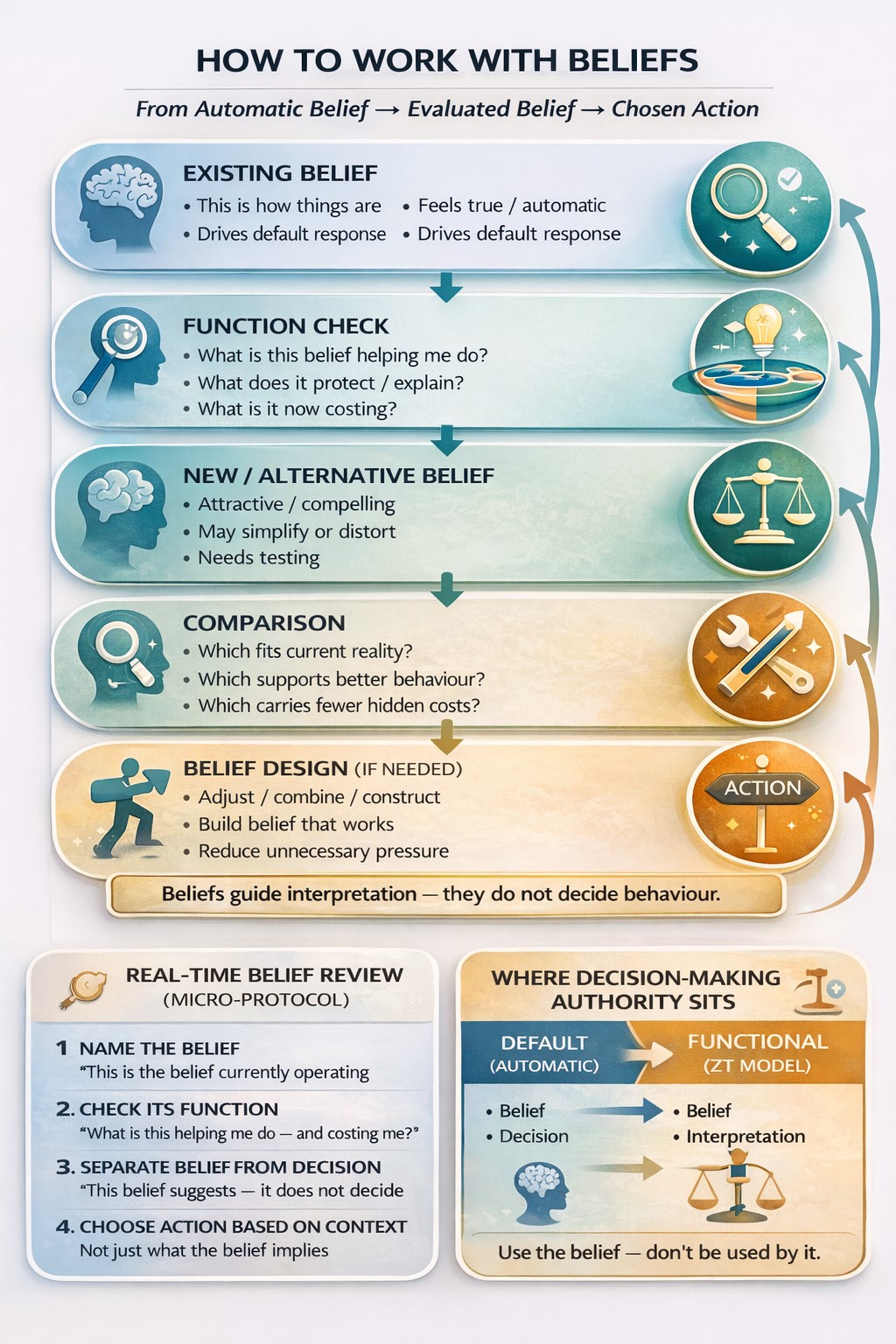
[Click on all graphics to expand]
A belief shapes how you interpret a situation. It influences what you notice, what you expect, and what feels like the right thing to do.
But at some point, a real-world action still has to be taken - the decision to act. For example:
- Do you speak or stay silent?
- Do you push harder or step back?
- Do you trust or stay guarded?
- Do you respond calmly or react immediately?
These are actual behavioural choices — and they always have to be made in real time.
What Usually Happens
When a belief feels true, the decision to act often happens automatically.
It can feel like:
- “Of course I have to do this”
- “There’s no other option”
- “This is just how it is”
In that moment, the belief is not just guiding you - it is driving the action without being questioned.
So, in a sense, the decision to act sits “inside” the belief. The belief already contains the conclusion about what to do, so no separate decision to act is made.
This is your impulsive brain at work.
What This Framework Changes
You can separate the two things. You can separate the belief from the decision to act on it.
The belief is still there - it presents a view
of the situation.
But the decision to act on that belief becomes a separate step — you consciously decide choose whether or not to act on that belief.
For example:
- Belief: “If I don’t do it, who will?”
- Decision to act: "Do I take this on, or do I step back and redistribute it?"
This is your reflective brain at work.
There are two systems in your brain which are constantly in conflict for control of your behaviour and actions, see: Thinking Fast And Slow
Worksheet: How To Review & Update Your Beliefs
Why The Decision To Act Matters
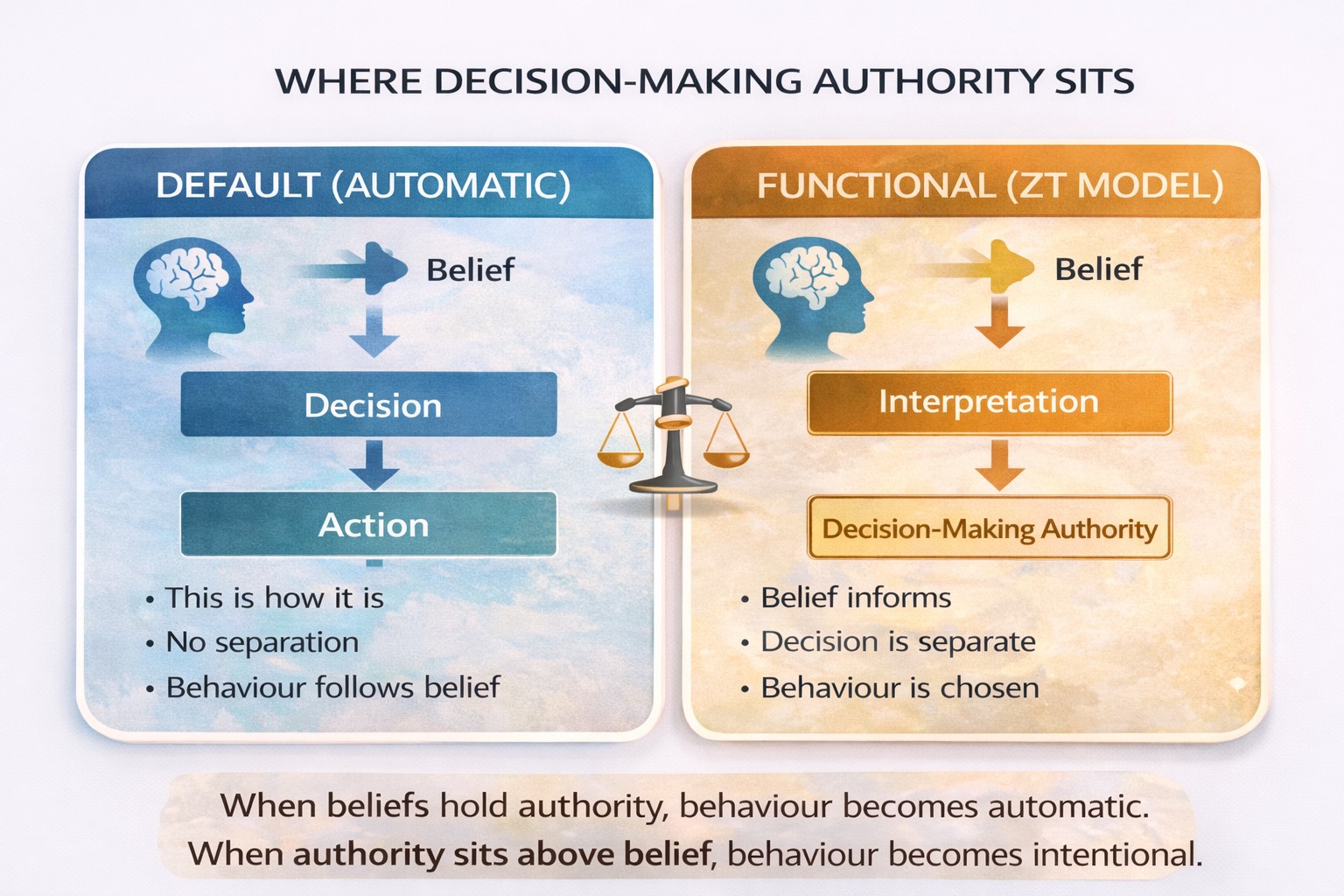
Once the decision to act is recognised as separate:
- More than one action becomes possible
- The response is no longer automatic
- Behaviour is no longer locked to the belief
You are no longer acting from inside the belief. You are acting with awareness of it and you are not controlled by it.
In Simple Terms
- The belief says: “This is what’s going on”
- The decision to act answers: “What am I going to do about it?”
Those are not the same thing.
The Shift
The belief can inform what you see - but you still decide what you do next.
What This Changes
Instead of holding beliefs as fixed truths, or replacing them automatically, you begin to:
- Treat beliefs as tools
- Update them when needed
- Choose how much influence they have
This keeps your thinking flexible, current, and aligned with the situation you are actually in rather the original situation the belief was originally built for.
Closing Reflections On How To Work With Beliefs

Beliefs help you navigate the world, but they are not fixed truths.
They are working tools that need to remain flexible and current.
When beliefs are left unexamined, they can quietly narrow behaviour and increase pressure without being noticed.
When they are reviewed and adjusted, they become more precise and more useful.
Learning how to work with beliefs is not about replacing one set of ideas with another. It is about ensuring that what guides your thinking continues to support effective action in the situations you face.
Points for Reflection
- Consider a belief you currently rely on in an important area of your life. Where did it come from, and what has it helped you handle or manage up to now?
- Look closely at how this belief is shaping your behaviour in real situations. Does it create pressure, narrow your options, or push you towards automatic responses?
- Reflect on whether this belief still fits your current circumstances, or whether it is carrying assumptions from a different context.
- Think about a new belief or narrative you have recently encountered. What makes it appealing, and what problem does it seem to solve?
- Examine that new belief more critically. What might it oversimplify, leave out, or exaggerate?
Points for Action
- Take one belief that is currently influencing your behaviour and write it out clearly.
- Describe how this belief affects what you do in specific situations.
- Identify one situation where it tends to drive an automatic response.
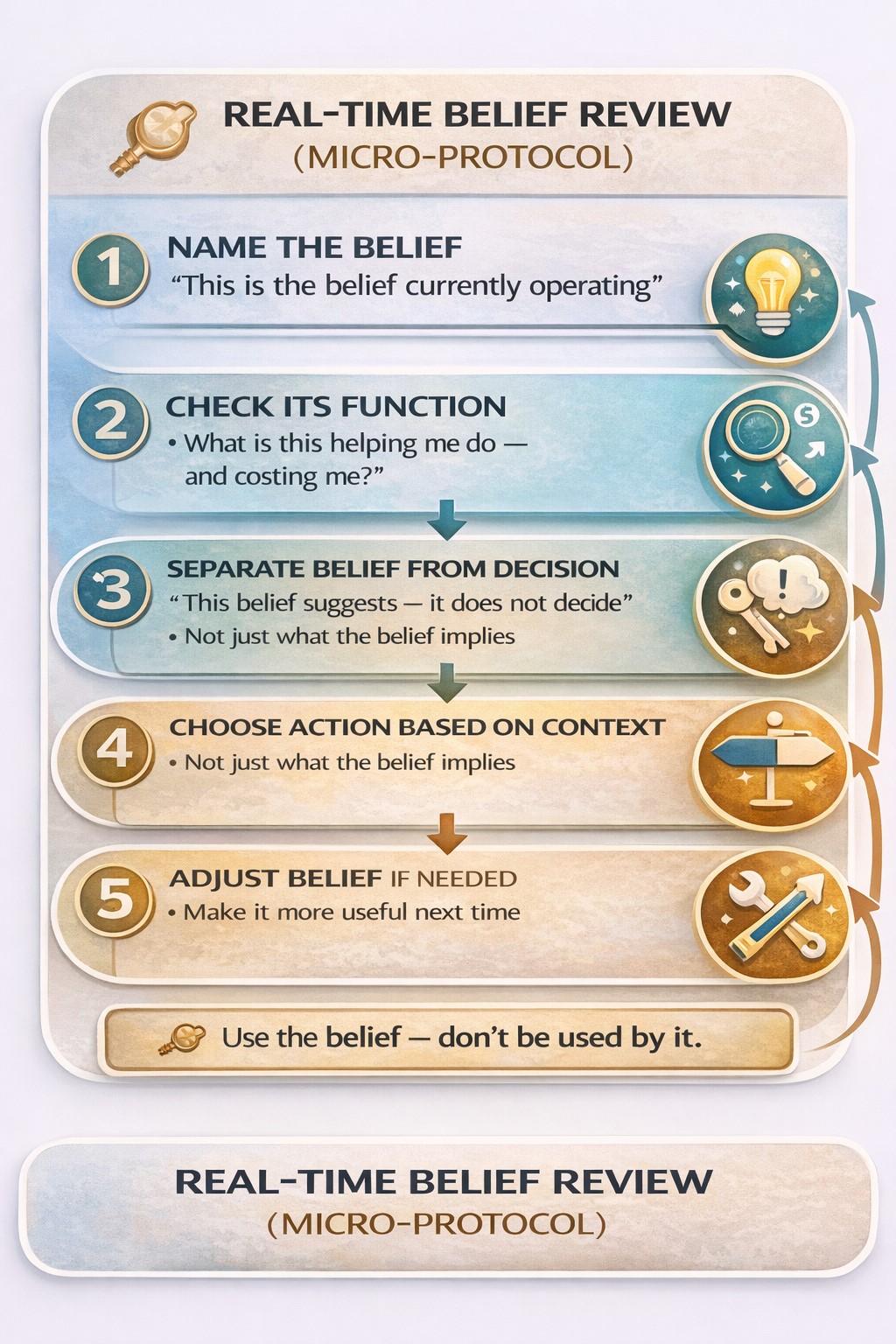
- In that moment, pause and separate the belief from the action.
- Choose what to do based on what is actually needed — not just what the belief suggests.
- If needed, adjust the belief into a more useful version and test it in practice.
Worksheet: How To Review & Update Your Beliefs
Academic References
- Beck, A. T. (1976). Cognitive Therapy and the Emotional Disorders
- Kahneman, D. (2011). Thinking, Fast and Slow
- Ross, L., & Nisbett, R. (1991). The Person and the Situation
- Nickerson, R. S. (1998). Confirmation bias
Recommended Further Reading
- Belief - A Terrible Tyrant Or An Empowering Servant
- Defining Belief
- Belief and Thought: What Zen Tools Works With
Return from: "How To Work With Beliefs" to: Home Page or Inner Mastery For Outer Impact
Next Article: Identity and Thoughts: Why Some Thoughts Stick

LATEST ARTICLES


Belief and Thought: What Zen Tools Works With - What It Leaves Alone
 A Clarification Of Scope Within Zen Tools - Not A Position On Belief As soon as people begin to notice their own thinking more clearly, questions about belief and thought naturally follow: - If though…
How Thought Becomes Identity - The Hidden Mechanism Behind Overthinking, Self-Worth, and Inner Conflict
 Thought Is an Event, Not a Self Most people believe identity is something they have - a stable sense of who they are. In reality, identity is something the mind is continuously producing. It is not fo…
When the Brain Is Hijacked - Where Does Choice Sit?"
 Pressure, the Hijacked Brain, and the Question of Authority
When the brain is hijacked, people are often told they have “lost control”.That language is understandable - and misleading. In reality, man…
Pressure, the Hijacked Brain, and the Question of Authority
When the brain is hijacked, people are often told they have “lost control”.That language is understandable - and misleading. In reality, man…Reduce Digital Overthinking To Lower Your Constant Inner Noise
 Why Constant Micro-Stimulation Increases Your Internal Noise. Modern digital life generates a level of mental activity that previous generations never had to deal with, and this is fundamentally why w…
Pausing Before You Act - Make It a Meta-Habit
 How A Tiny Moment Unlocks Clarity, Choice, And Self-Leadership. There is a moment in life so subtle you barely register it. A colleague questions your idea. A notification flashes. A moment of uncerta…
How to Interrupt Emotional Spirals Using Thought-Awareness
 The spiral is fueled by your mind believing the story your thoughts tell. No one sets out to be swept away by a surge of emotion. One second you’re handling life, and the next, your mind has broken in…
Universal Awareness and the Machinery of Thought
 You Can’t Control Thoughts - But You Can Learn To See Them. Why do our thoughts have so much power over us - and how do we reclaim clarity? The foundation of thought-awareness is the ability to see yo…
Rewiring Your Autopilot – How To Harness Your Subconscious Mind
 How to harness your subconscious mind and move from passenger to pilot. The case for rewiring your autopilot is that most of what drives your thoughts, reactions, and decisions happens below your cons…
Why You Need To Be Intimate With Your Own Thinking
 How self-awareness and insight transforms delusion into wisdom. We live inside an invisible weather system - one made not of clouds and wind, but of thoughts - and this invisibilty is why you need to…
The Illusion of Closeness in Always-On Relationships
 Closeness that cannot survive absence was never intimacy - only constant stimulation mistaken for connection. We live inside an unprecedented experiment in human connection. For the first time in hist…
Why Approval Feels Like Safety And Distance Feels Like Danger
 Safety is not found in being approved - it appears when approval is no longer required. When approval feels like safety, connection stops being something we enjoy and quietly becomes something we rely…
You Do Not Need Better Boundaries - You Need Clearer Thought
 What no longer feels like your responsibility no longer crosses your boundaries. This article explains why you don’t need better boundaries - you need clearer thought - how modern life systematically…