Identity and Thoughts
Why Some Thoughts Stick
Identity Adhesion: Why 'I know it’s just a thought' still feels real, and how thoughts attach to identity
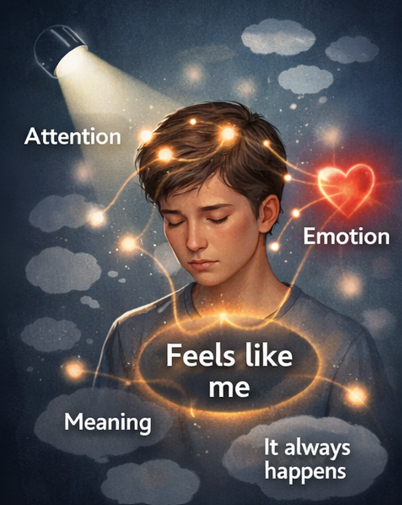
Introduction - Where Identity and Thoughts Become Entangled
Identity and thoughts become entangled in a very specific way, some thoughts don’t just pass through and drift away, they stick.
You may recognise a thought as “just a thought”, and yet still hesitate, withdraw, or change what you do next because of it. The thought remains present, but more importantly, it begins to influence behaviour.
This is the key shift.
Understanding this mechanism allows you to change what actually determines what you do next in that moment.
For example, a thought appears: “I’m not good enough.” Moments later, you hold back from speaking, delay taking action, or avoid a situation.
Nothing external forced that behaviour. The behaviour followed the thought.
Some thoughts are processed in a way that causes this shift to happen quickly and automatically. This is where identity and thoughts begin to fuse in real time.
__________
What This Looks Like in Real Life
A thought appears:
- “I’m not good enough”
- “This always happens to me”
- “I’m the kind of person who messes things up”
At first, it may register as a thought. But then:
- You hesitate
- You pull back
- You change your behaviour
Even if you recognise the thought as inaccurate, it still affects what you do. The thought is not just present, it begins to shape what you do next.
This is one of the clearest signs that identity and thoughts are no longer separate in that moment.
__________
Why Some Thoughts Stick
Some thoughts persist because they are processed as personally significant. They are not just noticed, they are treated as relevant to who you are.
Only after seeing this pattern clearly do we introduce the term "Identity Adhesion".
The Identity Adhesion Mechanism
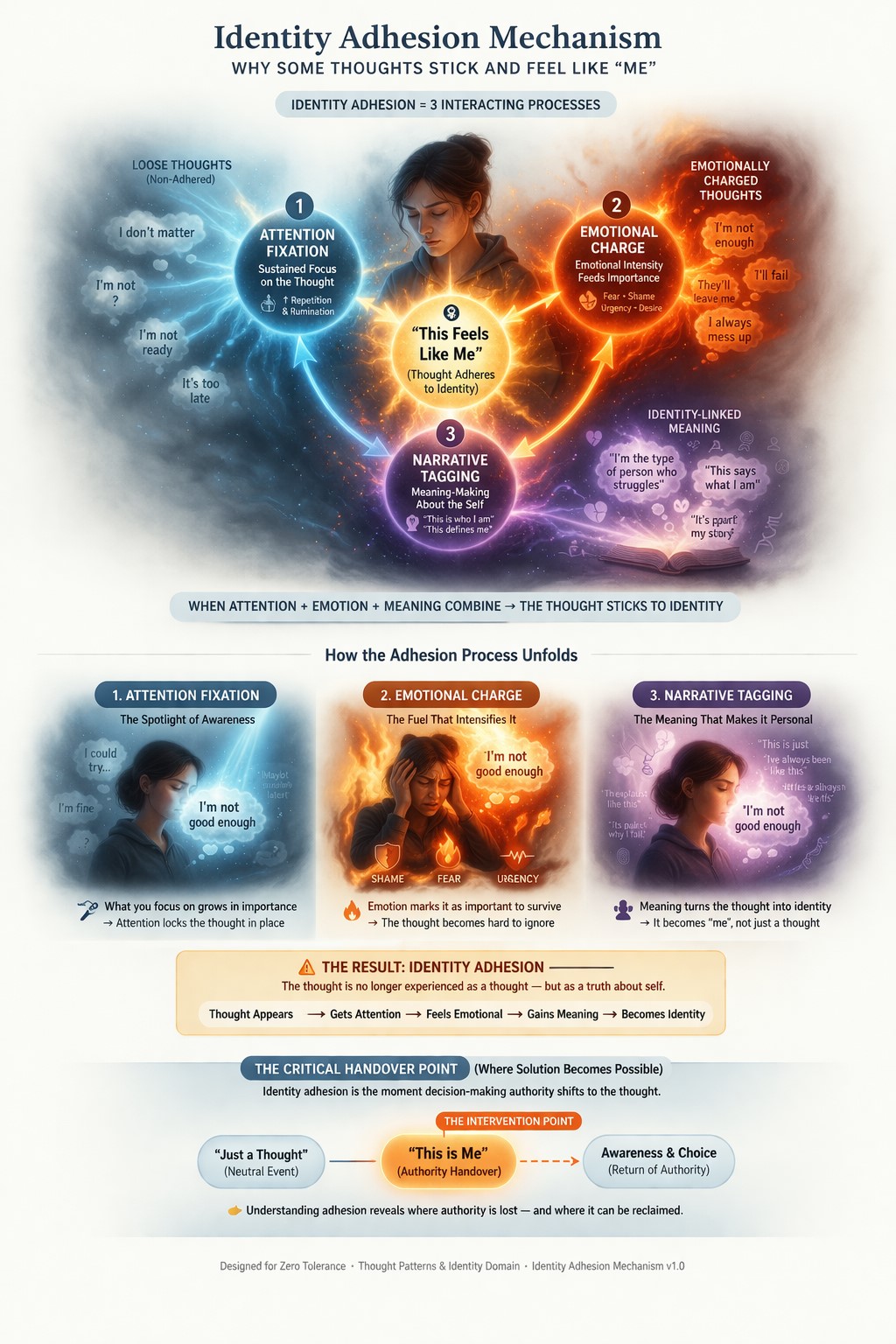
[Click on graphic to expand]
This process explains how identity and thoughts become tightly linked. It happens through three interacting elements:
1. Attention Fixation 2. Emotional Charge 3. Narrative Tagging
__________
__________
Simple Illustration
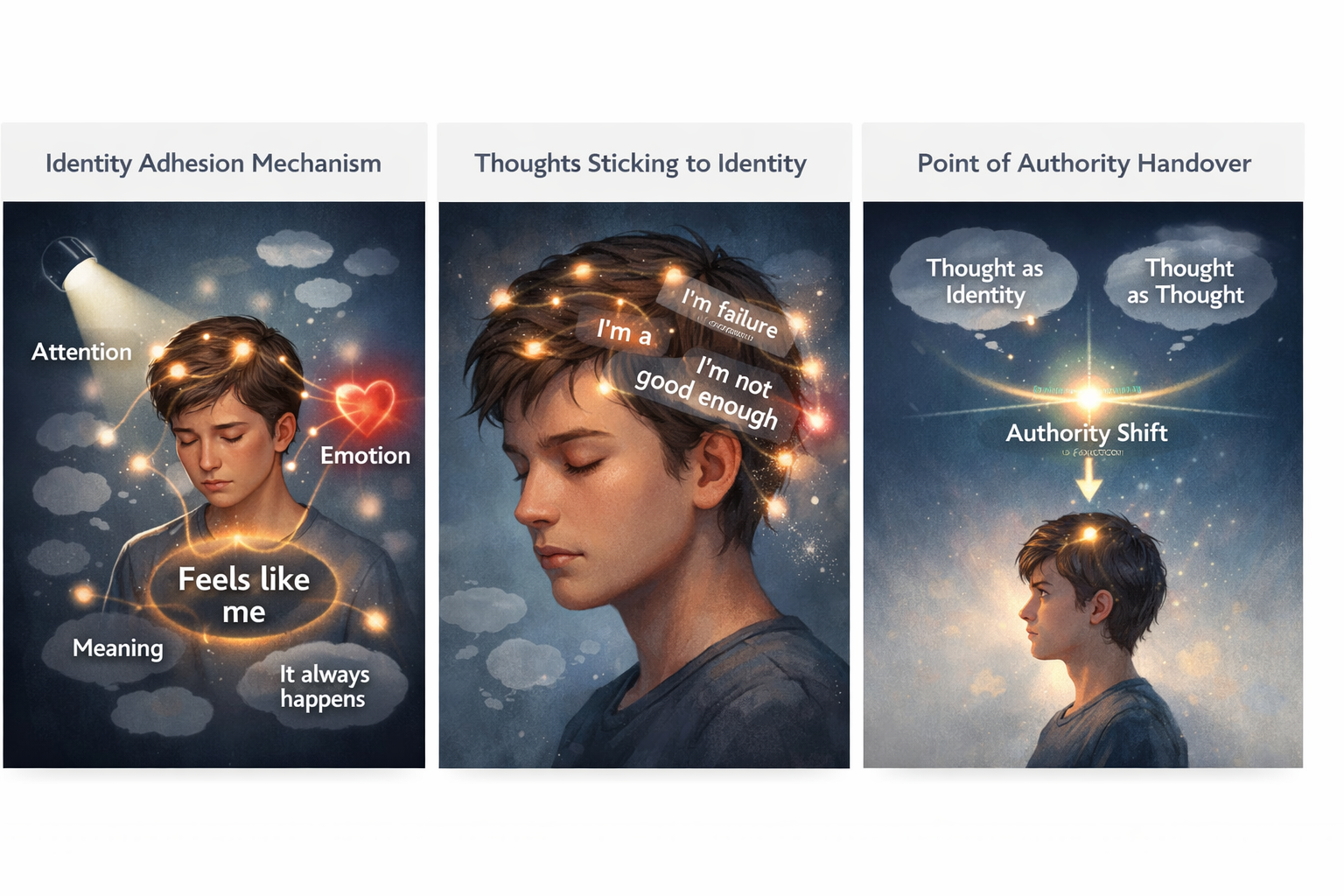
A person has the thought: “I’m not good enough.”
- They keep returning to it
- It carries emotional weight
- It is interpreted as meaningful
Result:
- They hesitate in a meeting.
- They avoid taking action.
The thought has moved from being present to shaping behaviour.
Why This Feels Personal
This process explains why thoughts feel real even when recognised as thoughts. Once a thought is treated as personally relevant:
- It is prioritised
- It captures attention more easily
- It feels more convincing
This is not a flaw. It is how the mind prioritises what it believes matters. This is also why identity and thoughts can feel inseparable in certain moments.
How Identity Forms Over Time
Each moment where a thought shapes behaviour reinforces a pattern. Repeated over time:
- Certain thoughts recur
- Behaviour aligns with them
- Patterns stabilise
This is explored further in: How Thought Becomes Identity
Why Insight Alone Does Not Change This
You may recognise: “This is just a thought.” But behaviour still follows, because:
- Recognition happens at one level
- Behaviour is being driven at another
The link between thought and action is still active, to understand how this happens see: Why Insight Alone Does Not Change Behaviour
Where Behaviour Starts to Follow the Thought
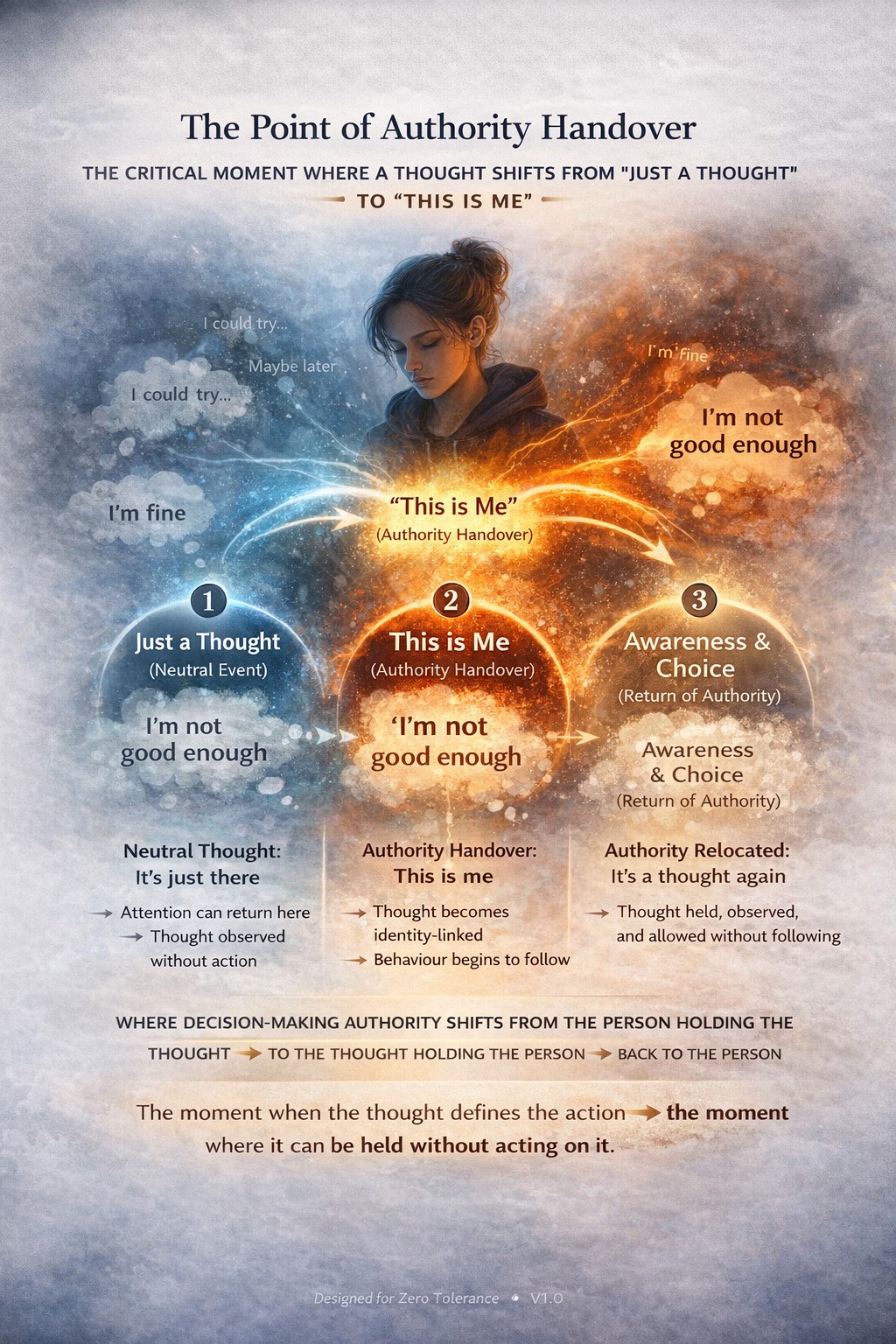
[Click on graphic to expand]
The critical moment is not when the thought appears. It is when your behaviour begins to follow it.
For example:
- You stop yourself from speaking
- You avoid a situation
- You delay taking action
This is the moment where the thought shifts from something you are noticing to something you are acting on.
This shift often happens quickly and without deliberate choice. It is also the moment where identity and thoughts feel fully merged.
Where the Intervention Actually Sits The same moment where behaviour begins to follow the thought is also
the moment where something different becomes possible. Instead of acting
immediately, there can be a pause. The thought can remain present:
The key change is
simple - the thought is there - but it is no longer automatically
driving behaviour.
This process is explained in detail in: Authority Above Thought.
Closing Reflections on Identity And Thought

Thoughts do not need to be true to influence behaviour. They only need to be processed in a way that links them to identity.
Identity adhesion explains why some thoughts persist, why they feel real, and why they shape behaviour even when recognised as thoughts.
This is not a failure of awareness. It is a mechanism.
And once understood, it becomes easier to see that identity and thoughts are not inherently the same - even when they feel like they are.
__________
Points for Reflection
- When does a thought begin to influence what you do next?
- What makes a thought feel important?
- How does emotion affect whether you act on a thought?
- When does a thought shift from “noticed” to “followed”?
- What changes when you see this as a process?
__________
Points for Action
- Notice when behaviour follows a thought automatically
- Identify emotional charge without interpreting it
- Separate the thought from the action it suggests
- Observe when meaning is being added
- Pause before acting on thoughts that feel personal
Academic References
- Hayes, S. C., Strosahl, K. D., & Wilson, K. G. (2011). Acceptance and Commitment Therapy
- Northoff, G., & Bermpohl, F. (2004). Cortical midline structures and the self
- LeDoux, J. (1996). The Emotional Brain
Recommended Further Reading
- How Thought Becomes Identity
- Why Insight Alone Does Not Change Behaviour
- Thought Awareness and Mindfulness
- When Insight Is Not Enough
Return from: "Identity And Thoughts" to: Home Page or Inner Mastery For Outer Impact
Next Article: How Individuals Change Systems By Acting As Reflective Agents

LATEST ARTICLES


Belief and Thought: What Zen Tools Works With - What It Leaves Alone
 A Clarification Of Scope Within Zen Tools - Not A Position On Belief As soon as people begin to notice their own thinking more clearly, questions about belief and thought naturally follow: - If though…
How Thought Becomes Identity - The Hidden Mechanism Behind Overthinking, Self-Worth, and Inner Conflict
 Thought Is an Event, Not a Self Most people believe identity is something they have - a stable sense of who they are. In reality, identity is something the mind is continuously producing. It is not fo…
When the Brain Is Hijacked - Where Does Choice Sit?"
 Pressure, the Hijacked Brain, and the Question of Authority
When the brain is hijacked, people are often told they have “lost control”.That language is understandable - and misleading. In reality, man…
Pressure, the Hijacked Brain, and the Question of Authority
When the brain is hijacked, people are often told they have “lost control”.That language is understandable - and misleading. In reality, man…Reduce Digital Overthinking To Lower Your Constant Inner Noise
 Why Constant Micro-Stimulation Increases Your Internal Noise. Modern digital life generates a level of mental activity that previous generations never had to deal with, and this is fundamentally why w…
Pausing Before You Act - Make It a Meta-Habit
 How A Tiny Moment Unlocks Clarity, Choice, And Self-Leadership. There is a moment in life so subtle you barely register it. A colleague questions your idea. A notification flashes. A moment of uncerta…
How to Interrupt Emotional Spirals Using Thought-Awareness
 The spiral is fueled by your mind believing the story your thoughts tell. No one sets out to be swept away by a surge of emotion. One second you’re handling life, and the next, your mind has broken in…
Universal Awareness and the Machinery of Thought
 You Can’t Control Thoughts - But You Can Learn To See Them. Why do our thoughts have so much power over us - and how do we reclaim clarity? The foundation of thought-awareness is the ability to see yo…
Rewiring Your Autopilot – How To Harness Your Subconscious Mind
 How to harness your subconscious mind and move from passenger to pilot. The case for rewiring your autopilot is that most of what drives your thoughts, reactions, and decisions happens below your cons…
Why You Need To Be Intimate With Your Own Thinking
 How self-awareness and insight transforms delusion into wisdom. We live inside an invisible weather system - one made not of clouds and wind, but of thoughts - and this invisibilty is why you need to…
The Illusion of Closeness in Always-On Relationships
 Closeness that cannot survive absence was never intimacy - only constant stimulation mistaken for connection. We live inside an unprecedented experiment in human connection. For the first time in hist…
Why Approval Feels Like Safety And Distance Feels Like Danger
 Safety is not found in being approved - it appears when approval is no longer required. When approval feels like safety, connection stops being something we enjoy and quietly becomes something we rely…
You Do Not Need Better Boundaries - You Need Clearer Thought
 What no longer feels like your responsibility no longer crosses your boundaries. This article explains why you don’t need better boundaries - you need clearer thought - how modern life systematically…