From React to Reflect
Conscious Participation in Complex Systems
How System Dynamics and Individual Reflective Awareness Interact Through an Ongoing Co-Adaptive Dialogue
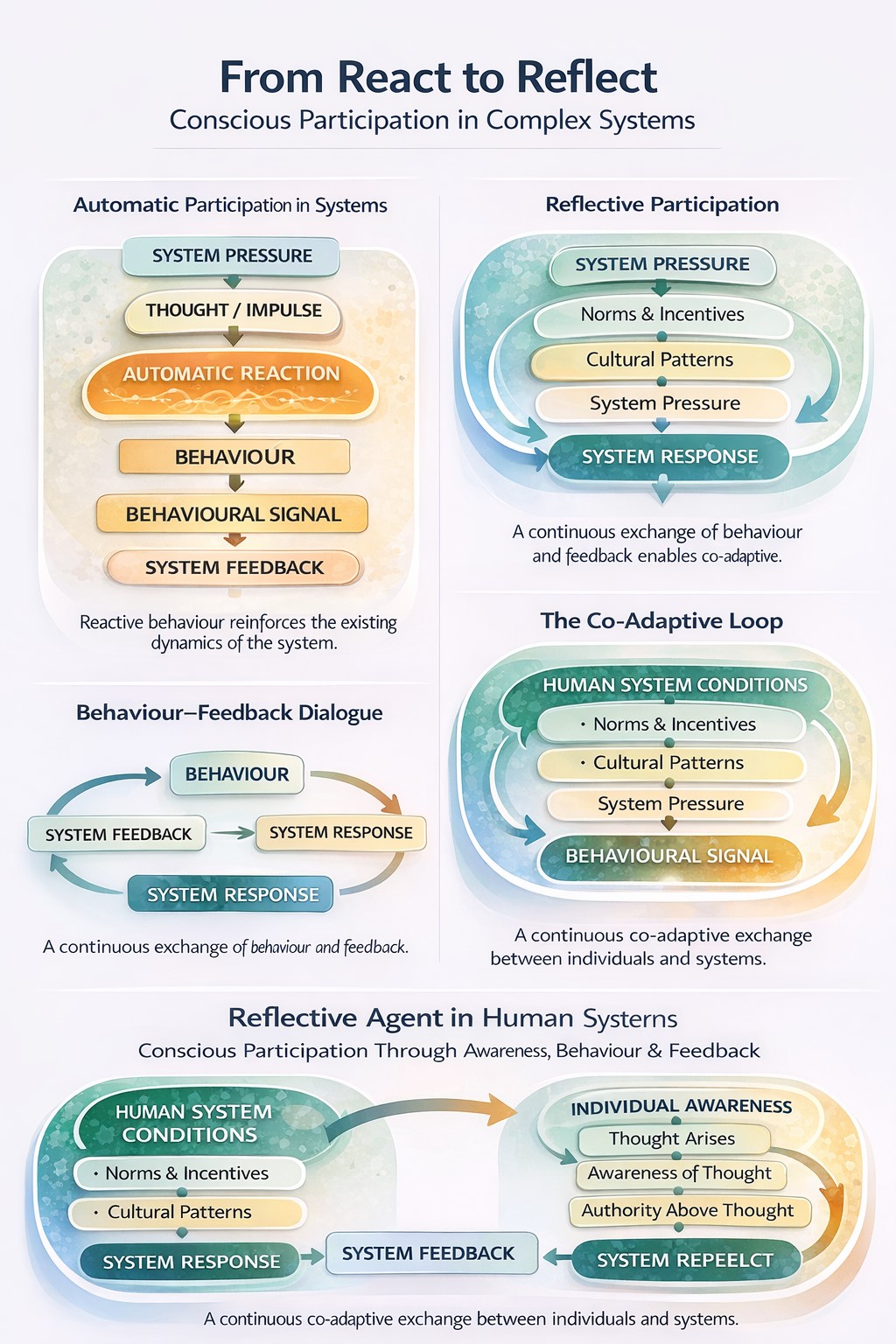
[Click on all graphics to expand]
From React to Reflect - What We Mean By Conscious Participation in Complex Systems
From react to reflect describes the shift that allows individuals to move from automatic reactions inside complex systems to conscious participation within them.
Most people assume that when they act in organisations, families, markets, communities, digital environments, or wider society they are simply making individual decisions.
Networks Of Overlapping Systems
In reality, everyday life unfolds within a network of overlapping systems.
Workplaces, social groups, institutions, economic systems, cultural norms, digital platforms, and physical environments all operate simultaneously around us. These systems interact with each other, and individuals participate within several of them at the same time.
This means that we are never outside systems. We are always participating within them.
Systems Within Systems
Most systems are also nested within larger systems and interacting with others simultaneously.
A workplace exists within an industry. Industries operate within economies. Economies interact with political and cultural environments.
At the same time, individuals are responding to pressures from family life, professional networks, digital platforms, and wider social expectations.
The result is that behaviour is shaped by multiple system influences operating at once.
Our Behaviour Responds To System Signals
In complex systems, behaviour is rarely an isolated act of individual choice. It is usually a response to signals transmitted by the systems we are participating in.
Inside complex systems we are not simply making decisions — we are participating in dynamics that are already shaping how we think, feel, and act.
Systems influence participants in several ways at the same time.
Some influences are structural. Rules, incentives, hierarchies, deadlines, and formal procedures guide behaviour directly.
Others are social and cultural. Norms, expectations, reputations, and shared beliefs shape how participants behave within groups and iThe
Subtle Influence By Intangible System Influences
But complex systems also transmit subtle patterns of influence that are sensed before they are fully articulated.
Changes in atmosphere, emerging tensions, shifts in confidence, or the emotional tone of a group can signal that the system is moving in a particular direction.
Participants often register these signals through intuition, pattern recognition, and emotional awareness before they are able to describe them analytically.
Systems also communicate through intangible signals and patterns of influence that participants often sense before they are consciously articulated.
Understanding how these signals influence behaviour is the starting point for understanding how individuals participate in complex systems.
How Systems Influence Our Behaviour Before We Realise It
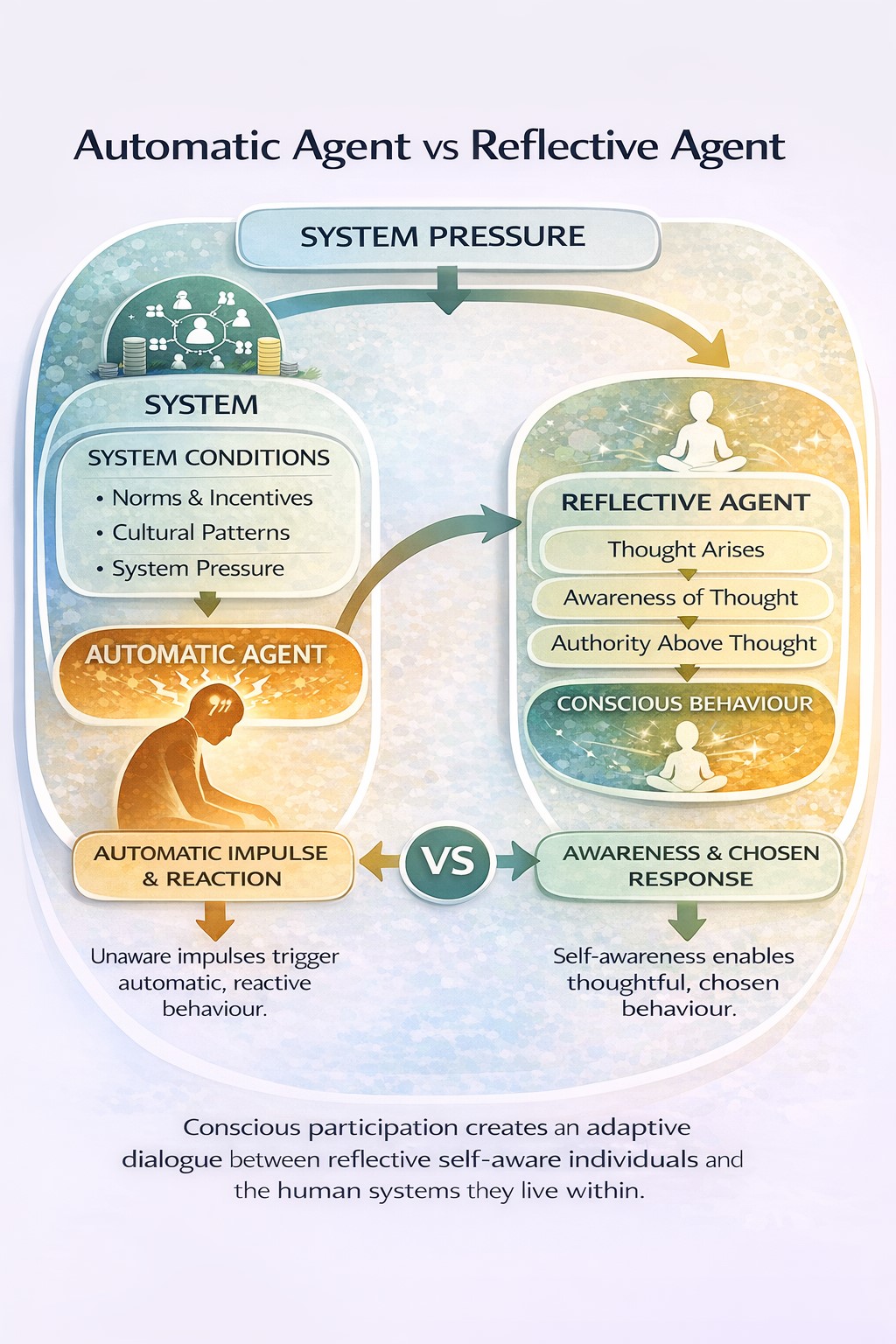
Once we recognise that we are participating inside multiple interacting systems, the next question becomes:
How do those multiple interactingsystems influence our behaviour in practice?
Complex systems are always in motion:
- Organisations evolve through incentives and constraints.
- Markets shift through patterns of supply and demand.
- Social groups develop expectations about acceptable behaviour.
These dynamics generate signals that participants respond to continuously.
Often these signals are recognised only after behaviour has already begun to form:
- A shift in tone in a meeting.
- A change in confidence in a market.
- An emerging tension within a team.
Participants sense these dynamics internally before they analyse them consciously.
When this happens, behaviour usually follows a familiar pattern:
- System pressure appears.
- A thought forms about what to do.
- An emotional response arises.
- Behaviour follows quickly.
The individual experiences this as a decision, but very often the behaviour is actually a reaction to system pressure.
This pattern explains why many systems reproduce their own dynamics. Participants react to system pressures automatically, and their behaviour feeds back into the system in ways that reinforce existing patterns.
Most people participate in systems this way without noticing it.
- The system shapes behaviour.
- Behaviour stabilises the system.
- The cycle continues.
__________
The Moment Where Participation Changes
Something different becomes possible when a participant notices their internal reaction before acting on it.
Often this moment of awareness occurs when a participant recognises the internal response that system signals have already triggered.
- A difficult message arrives.
- A meeting becomes tense.
- A decision produces pressure.
An internal reaction appears immediately:
- “I must respond quickly.”
- “This is a problem.”
- “I need to defend my position.”
Normally behaviour follows immediately.
But occasionally a different moment occurs: “I notice that I feel pressure to react.”
This small shift changes the level of cognition involved.
Instead of remaining inside the stream of thought, the individual becomes aware of the thought itself.
This is the beginning of reflection.
What Reflective Behaviour Actually Means
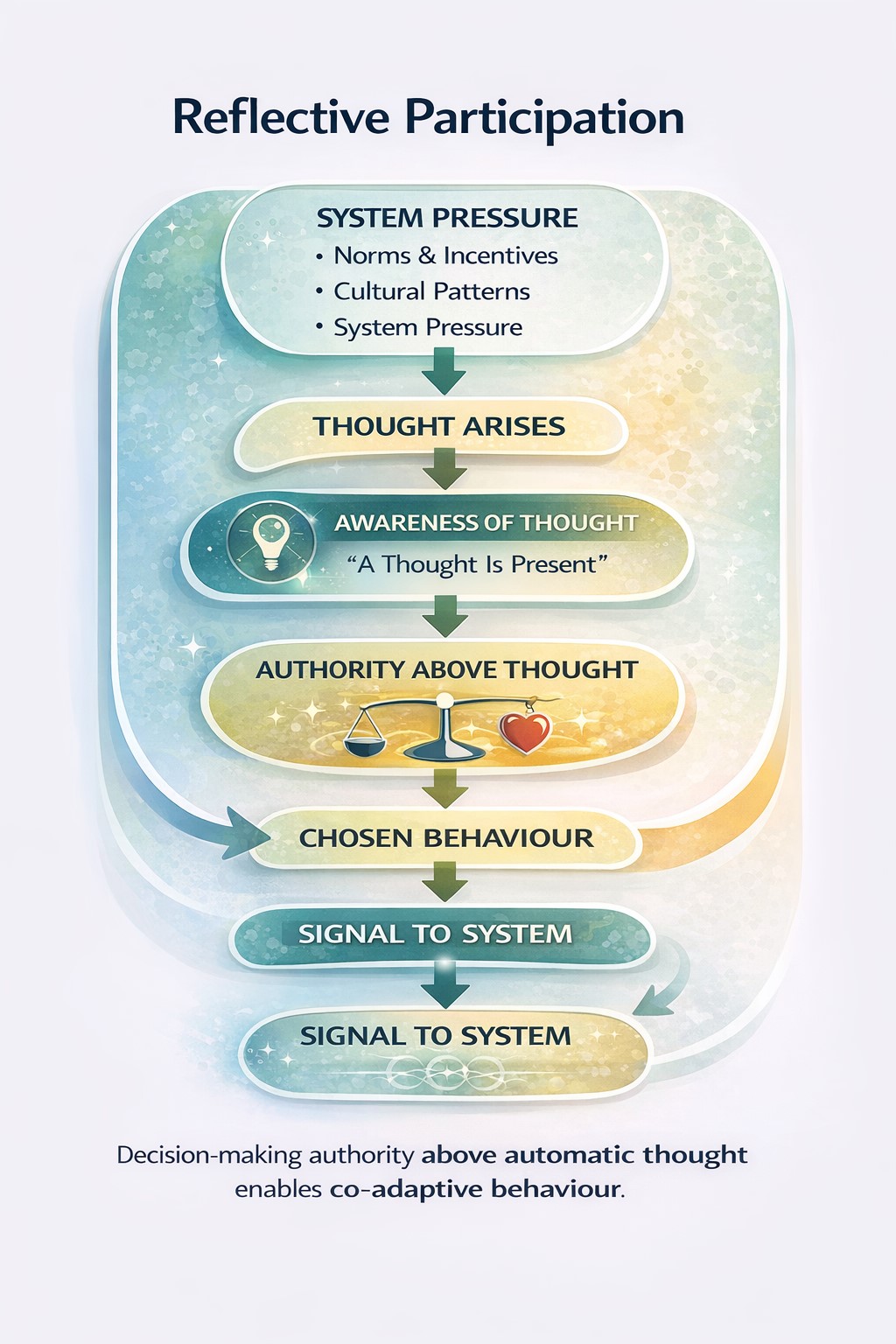
Reflection is often misunderstood as simply thinking carefully about a situation.
But the cognitive shift involved is more precise. Instead of thinking within a stream of thoughts, the individual becomes aware that thoughts are occurring.
For example: “I notice the thought that I must respond immediately.”
Reflection also allows individuals to notice subtle internal responses that arise before thoughts are fully formed. Emotional reactions, intuitive signals, and shifts in perception often appear before they are translated into language.
Metacognition - The Important Gap Between Thought And Decision
When these internal responses become visible, the individual gains a small but important separation between thought and decision.
In cognitive science this process is known as metacognition.
Metacognition refers to the ability to become aware of one's own thinking while it is happening.
This awareness changes the role that thoughts play:
- Thoughts are no longer treated automatically as instructions for action.
- They become signals that can be observed and evaluated.
At this point something important becomes possible.
Shifting The Decision About Your Response From React To Reflect
Decision-making authority can move above the thought itself.
Instead of reacting automatically, the participant can pause briefly and choose how to respond.
- When awareness appears, decision-making authority is no longer granted automatically to the thought itself.
- Authority shifts to a higher decision point aligned with context and values.
- Instead of reacting automatically, the participant can choose how to respond.
This shift - from reaction to reflection - is the foundation of conscious participation in complex systems.
For a fuller explanation of the dynamics of this process please see:
How Our Behaviour Adjusts To Signals From the System
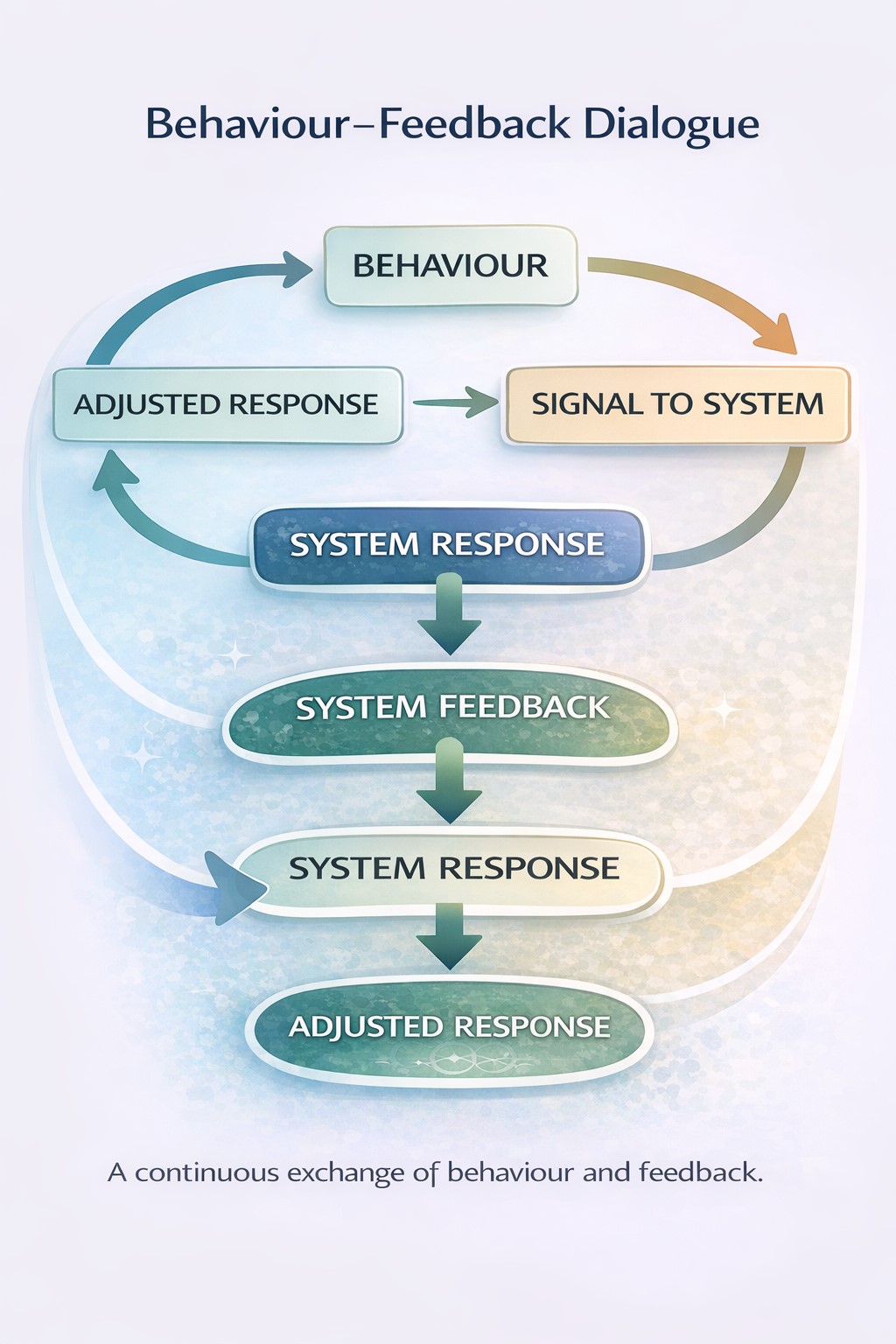
The Feedback Loop - We Respond To The System And The System Responds To Us
Once behaviour becomes deliberate rather than automatic, its role inside the system becomes clearer.
Behaviour does not simply express personal intention. Inside complex systems, behaviour functions as a signal. Every action communicates information:
- A pause signals caution.
- A question signals curiosity.
- A defensive reaction signals threat.
- A considered response signals stability.
These signals influence how other participants respond. Those responses alter the dynamics of the system. Through this process, systems continuously adapt to the behaviour of their participants.
Participants are also adapting to the signals they receive from the system. Participation therefore becomes an ongoing exchange.
__________
Participation as Dialogue
The nature of participation in systems becomes clearer at this point.
- The system sends signals.
- Participants perceive those signals.
- Participants respond through behaviour.
- The system responds again.
Participation therefore becomes a dialogue between system dynamics and individual awareness.
When individuals participate automatically, the dialogue remains largely invisible.
When reflection is present, the dialogue becomes visible:
- Both the system and the participant adjust continuously.
- The system shapes behaviour through signals and pressures.
- The participant interprets those signals through perception and awareness.
- Behaviour sends signals back into the system.
- The system evolves in response.
Participation therefore becomes a co-adaptive process.
What It Means To Be A Participant Inside the System
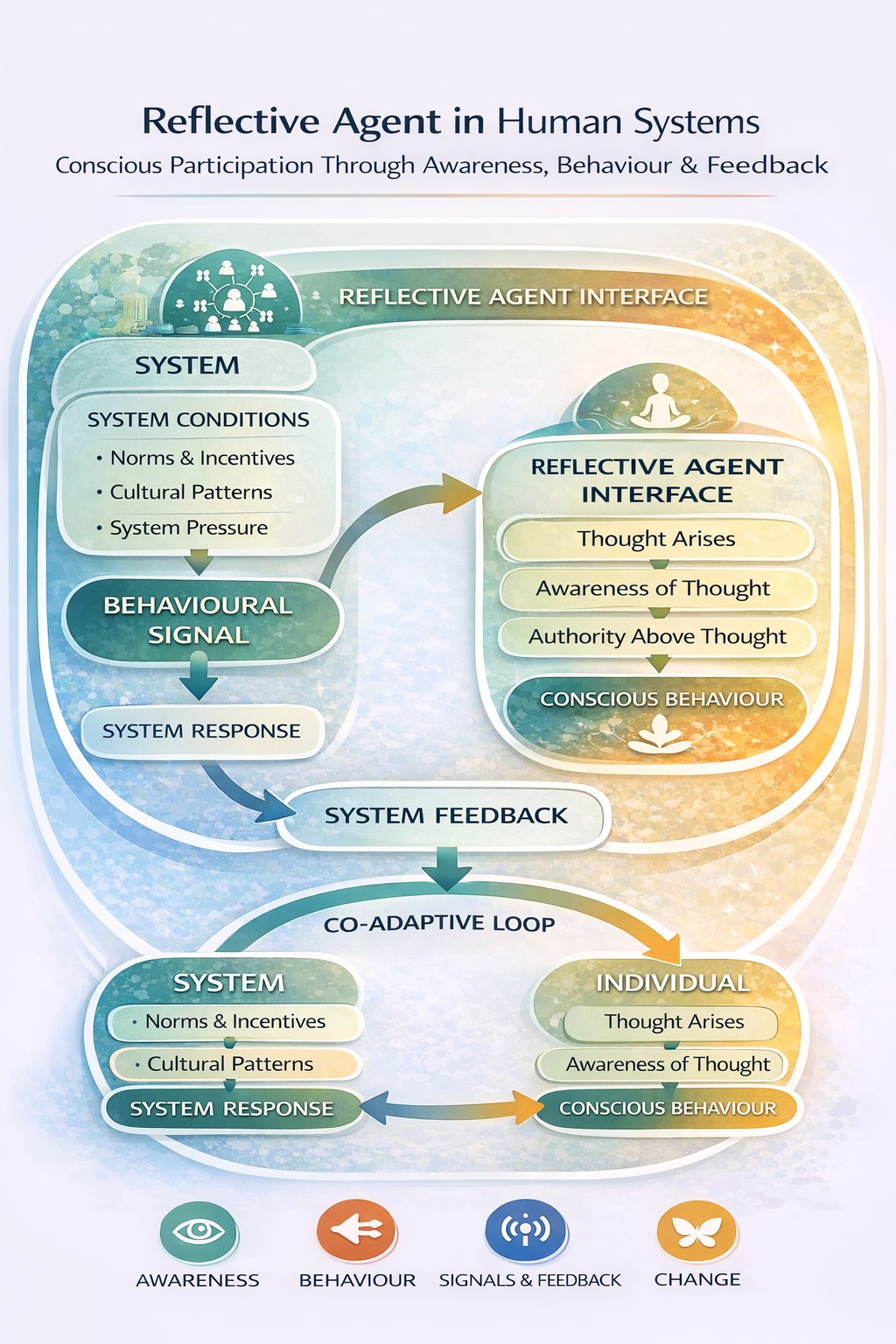
You Are A Participant Inside the System
This process reveals a different understanding of human participation in systems.
- Individuals are not outside observers attempting to control outcomes.
- They are participants inside systems that are already shaping their behaviour.
- The system is the larger dynamic.
But reflective awareness allows individuals to participate within that dynamic consciously.
- Instead of reacting automatically to system pressures, the participant becomes aware of how those pressures influence internal responses.
- Behaviour can then be chosen deliberately.
- Those choices become signals within the system.
- Over time, these signals influence how the system evolves.
Because individuals participate in multiple interacting systems simultaneously, this loop can operate across several system layers at once.
The Central Insight - You Are Inseparable From The System
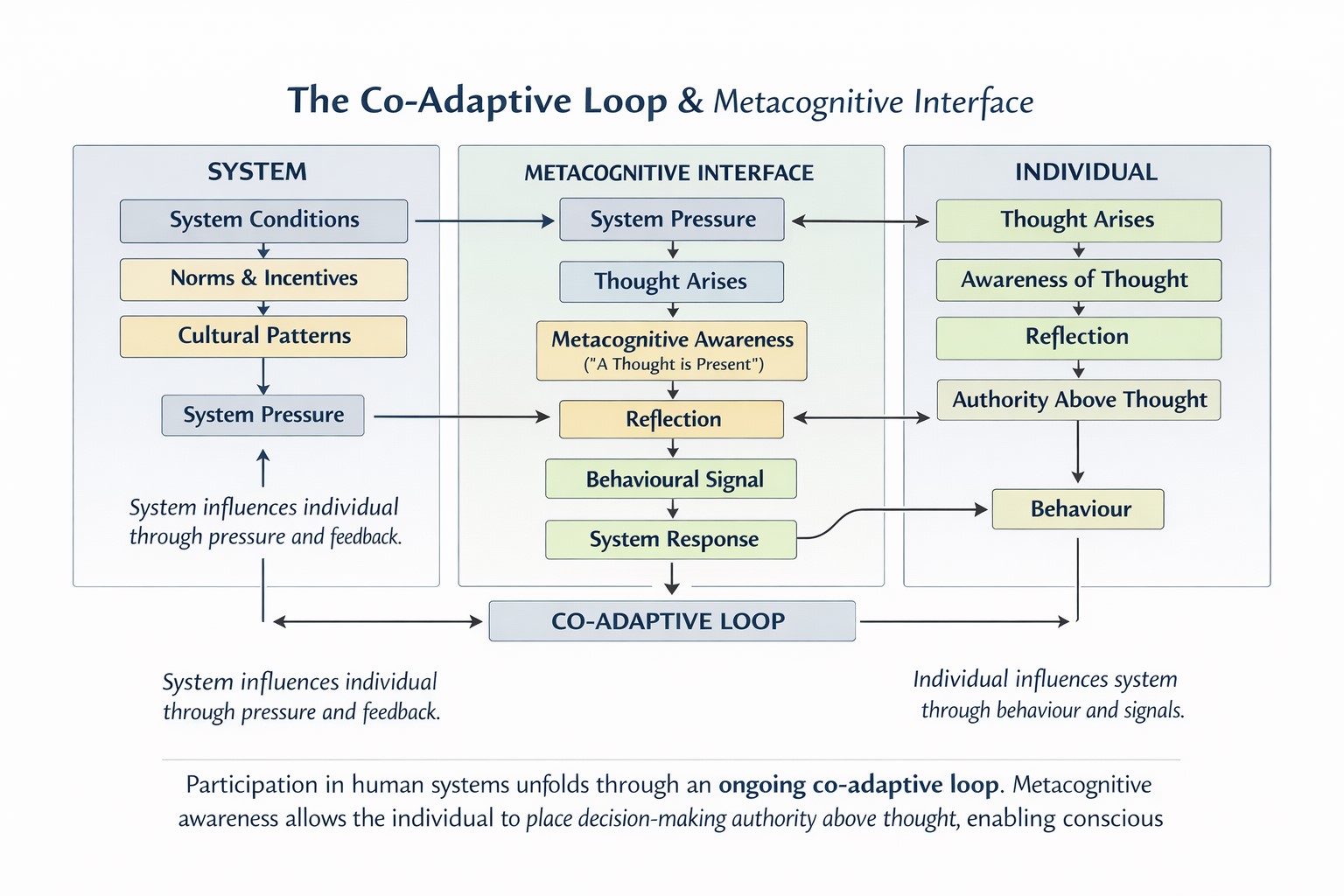
The Central Insight Participation in human systems is a continuous dialogue between system dynamics and individual awareness, unfolding through an ongoing co-adaptive loop. In simple terms: - The system influences the participant through signals. - The participant perceives those signals and reflects on their internal responses. - Behaviour becomes a deliberate signal sent back into the system. - The system responds. - The dialogue continues.
__________
Simple Illustration
Imagine a team meeting where tension is rising.
The system dynamics include time pressure, hierarchy, competing priorities, and subtle signals of disagreement.
- A participant senses these signals before fully articulating them.
- An automatic reaction might be defensive behaviour or rapid argument.
- But if reflection occurs, the participant may notice the internal pressure to react.
- Instead of responding impulsively, they pause and ask a clarifying question.
That behaviour changes the tone of the meeting.
- Others respond differently.
- The dynamics of the discussion shift.
- A small reflective act alters the trajectory of the system.
Closing Reflections - From React To Reflect

Complex systems continuously shape the behaviour of their participants through signals, expectations, pressures, and patterns of influence.
- Many of these signals are recognised only after they have already triggered internal responses.
- Reflection allows individuals to notice these responses before reacting automatically.
- When this awareness is present, behaviour becomes a deliberate contribution to the system rather than an automatic reaction to it.
- Participation therefore becomes something more than reaction.
- It becomes a dialogue between system dynamics and individual awareness.
Through this dialogue, both the system and its participants adapt continuously.
The shift from react to reflect does not place individuals above the systems they inhabit, but it allows them to participate within those systems with greater clarity and intention.
__________
Points for Reflection
- Where do you notice yourself reacting automatically to system pressures?
- What signals does the system you operate within transmit most strongly?
- Can you recognise moments where subtle or intangible signals influenced your behaviour before you articulated them?
- When have small reflective pauses changed how you responded within a system?
- How might your behaviour function as a signal that shapes the system around you?
___________
Points for Action
- Notice moments when system pressure triggers an immediate reaction.
- Pause briefly and observe the thoughts that arise before acting.
- Recognise these thoughts as signals rather than instructions.
- Reposition decision-making authority above the immediate thought.
- Choose the smallest deliberate action aligned with context and values.
Academic References
- Argyris, C., & Schön, D. (1978). Organizational Learning: A Theory of Action Perspective.
- Kahneman, D. (2011). Thinking, Fast and Slow.
- Meadows, D. (2008). Thinking in Systems: A Primer.
- Varela, F., Thompson, E., & Rosch, E. (1991). The Embodied Mind.
Recommended Further Reading
- You Are Part of the System — The Reflective Agent Model
- How Individuals Change Systems By Acting As Reflective Agents
- Understanding Complex Systems Thinking — It's Not What You Think
- Applying Systems Thinking to Personal Behaviour
- The Illusion of Inevitability in Complex Decisions
- Let Stillness Speak - Living Within a Complex System
Return from: "From React To Reflect" to: Home Page or Inner Mastery For Outer Impact
Next Article: How Individuals Participate in Human Systems

LATEST ARTICLES


Belief and Thought: What Zen Tools Works With - What It Leaves Alone
 A Clarification Of Scope Within Zen Tools - Not A Position On Belief As soon as people begin to notice their own thinking more clearly, questions about belief and thought naturally follow: - If though…
How Thought Becomes Identity - The Hidden Mechanism Behind Overthinking, Self-Worth, and Inner Conflict
 Thought Is an Event, Not a Self Most people believe identity is something they have - a stable sense of who they are. In reality, identity is something the mind is continuously producing. It is not fo…
When the Brain Is Hijacked - Where Does Choice Sit?"
 Pressure, the Hijacked Brain, and the Question of Authority
When the brain is hijacked, people are often told they have “lost control”.That language is understandable - and misleading. In reality, man…
Pressure, the Hijacked Brain, and the Question of Authority
When the brain is hijacked, people are often told they have “lost control”.That language is understandable - and misleading. In reality, man…Reduce Digital Overthinking To Lower Your Constant Inner Noise
 Why Constant Micro-Stimulation Increases Your Internal Noise. Modern digital life generates a level of mental activity that previous generations never had to deal with, and this is fundamentally why w…
Pausing Before You Act - Make It a Meta-Habit
 How A Tiny Moment Unlocks Clarity, Choice, And Self-Leadership. There is a moment in life so subtle you barely register it. A colleague questions your idea. A notification flashes. A moment of uncerta…
How to Interrupt Emotional Spirals Using Thought-Awareness
 The spiral is fueled by your mind believing the story your thoughts tell. No one sets out to be swept away by a surge of emotion. One second you’re handling life, and the next, your mind has broken in…
Universal Awareness and the Machinery of Thought
 You Can’t Control Thoughts - But You Can Learn To See Them. Why do our thoughts have so much power over us - and how do we reclaim clarity? The foundation of thought-awareness is the ability to see yo…
Rewiring Your Autopilot – How To Harness Your Subconscious Mind
 How to harness your subconscious mind and move from passenger to pilot. The case for rewiring your autopilot is that most of what drives your thoughts, reactions, and decisions happens below your cons…
Why You Need To Be Intimate With Your Own Thinking
 How self-awareness and insight transforms delusion into wisdom. We live inside an invisible weather system - one made not of clouds and wind, but of thoughts - and this invisibilty is why you need to…
The Illusion of Closeness in Always-On Relationships
 Closeness that cannot survive absence was never intimacy - only constant stimulation mistaken for connection. We live inside an unprecedented experiment in human connection. For the first time in hist…
Why Approval Feels Like Safety And Distance Feels Like Danger
 Safety is not found in being approved - it appears when approval is no longer required. When approval feels like safety, connection stops being something we enjoy and quietly becomes something we rely…
You Do Not Need Better Boundaries - You Need Clearer Thought
 What no longer feels like your responsibility no longer crosses your boundaries. This article explains why you don’t need better boundaries - you need clearer thought - how modern life systematically…