Inner Conflict Explained - Why Your Thoughts Compete
Why you feel pulled in different direction, and what drives it

How You Experience Inner Conflict
Inner conflict is the experience of being pulled in two directions at the same time. It shows up in ordinary situations: when you know what you should do, but hesitate; when one thought pushes you forward and another thought pulls you away from it; when you find yourself delaying something that, on reflection, clearly matters.
From the inside, it can feel like a struggle within you. People often describe it as if there are different sides or even different versions of themselves competing for control:
- One part wants to act; another part resists.
- One part is sensible; another part is not.
That description feels natural because it matches the intensity of the experience. But it quietly introduces a misunderstanding.
It suggests that the conflict is between different selves, rather than between different thoughts about what to do, but:
The underlying mechanism that helps you understand this is thought awareness and mindfulness where you learn how to see your thoughts as events rather than instructions.
__________
What Inner Conflict Looks Like in Practice
Take a familiar situation. There is something you need to do - perhaps a conversation you have been avoiding, a piece of work you have delayed, or a decision that carries some uncertainty.
A thought appears: you should deal with this properly. It is clear enough, and when you consider it, it makes sense.
Almost immediately, another thought follows: leave it for now; it will be easier.
Now you are in inner conflict. Both thoughts feel like they come from you. Both have some logic behind them. But they point in different directions, and you cannot follow both.
At this point, it is easy to slip into the language of “two sides of me”, but:
How Thoughts Arise in the First Place

To make sense of this, it helps to start with something basic but often overlooked: thoughts are not chosen in advance, they appear.
- Your mind is constantly processing what is happening around you and within you.
- It draws on memory, habit, past experience, and current conditions to generate possible responses.
- This process is continuous and largely automatic.
Impulsive Thoughts
Some of these responses appear quickly, almost instantly.
These thoughts are shaped by what has worked before, by what avoids discomfort, or by what reduces effort. They do not require deliberate thinking. They simply show up. These are impulsive thoughts.
Reflective Thoughts
Other responses take a little longer. They depend on a brief pause, even if that pause is only a few seconds.
In that space, you are able to consider the situation more fully - what the consequences might be, what matters in this context, and what would make sense beyond the immediate moment.
These are not two different selves. They are two different ways your mind produces thoughts.
__________
Why the Experience Feels Like “Conflicting Selves”

When these two types of thoughts point in different directions, the contrast between them can feel stark.
- One thought is quick, direct, and often emotionally charged.
- The other is quieter, less urgent, and requires a moment of attention to fully register.
It's Personal
Because of this difference in intensity, the mind tends to interpret the situation in personal terms.
It feels as though there is a struggle between different parts of you - one pushing, one resisting.
Variations In Thought & Identity
But this interpretation adds something that is not actually there. It turns variation in thought into variation in identity.
In reality, nothing about your identity has split. What you are experiencing is variation in how strongly different thoughts are pushing for action.
The sense of “conflicting selves” is an impression created by the contrast in tone, urgency, and emotional weight between those thoughts.
The Choice
Once you see that clearly, the experience changes:
- The conflict is no longer about who you are.
- It is about which suggestion you will follow.
__________
Thinking Fast & Thinking Slow

In most cases of inner conflict, the two directions follow a familiar pattern.
One direction is immediate. It aims to reduce discomfort, avoid effort, or move away from something uncertain. It is quick, persuasive, and often feels like the obvious thing to do in the moment.
The other direction is more considered. It takes into account what happens next, what matters beyond the present moment, and what the longer-term consequences might be. It is not as forceful, and it usually requires a brief pause to come into view properly.
- Immediate, relief-seeking thoughts often arise automatically and quickly.
- More considered thoughts are possible, but they usually require enough space, attention, or pause to emerge clearly.
The Root Cause of The Conflict
Though you may not be aware of it, there are two systems in your brain which are constantly in conflict for control of your behaviour and actions.
- One direction appears by default.
- The other often has to be accessed.
- These two directions do not have equal influence unless you allow them to.
In "Thinking Fast and Slow", Daniel Kahneman, winner of the Nobel Memorial Prize in Economics, presents decades of research to help us understand what really goes on inside our heads when we are making decisions.
Kahneman sets out the many ways the result of this conflict leads to mistakes and errors in your memory, your assessment of situations and your decision making processes and offers practical solutions as to what you can do about it.
The Key To Resolving Your Inner Conflict

Making The Choice
At the point of inner conflict the outcome is decided by which thought is followed.
Most of the time, the faster, easier option wins. It arrives first, carries more urgency, and offers immediate relief. Without a pause, behaviour tends to follow that path.
This is why avoidance, delay, and short-term decisions are so common. It is not because of weakness or lack of understanding. It is because the decision is effectively made before there is time to consider alternatives.
Why Inner Conflict Intensifies Under Pressure
Another factor is the pressure that you feel when you are tired or stressed. In these conditions, the faster, more automatic thoughts become stronger and more dominant. The space required for more considered thinking becomes harder to access.
As a result, the experience of inner conflict feels sharper, and the outcome is more likely to be driven by whatever offers the quickest relief.
In prolonged periods of overload, this can become a broader operating state, when it feels like you are constantly living in survival mode.
The First Step Is To Pause
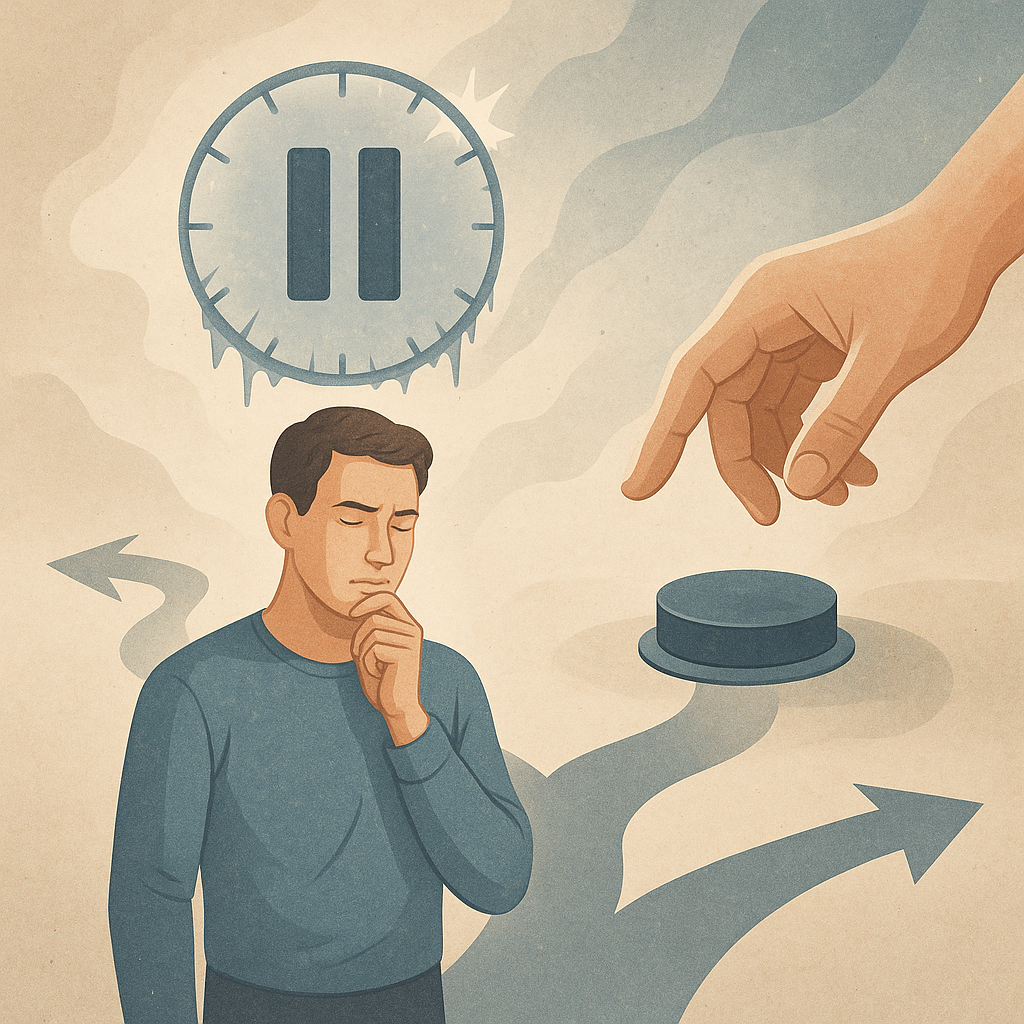
The first step to making the choice as to which thought to follow is to pause, and take an inner step back from the immediacy and urgency of your impulsive thoughts.
The fastest way to take that pause is to just focus all of your attention on your breathing for a few seconds - notice and feel the sensation of your in-breath and out-breath for 3 breaths.
Then pay attention to what you are feeling in that moment. For example if you notice you are feeling stressed, just say to yourself: "I accept that I am feeling stressed."
As you do this you are giving your brain a break and giving it a moment of silence. This has been referred to as a beneficial neurological delay which in that moment allows space for your reflective brain to engage.
- When you pause, you give the more considered thought enough space to be recognised.
- You are no longer limited to reacting to what appears first.
- You can look at the situation more fully and decide which direction makes sense.
If you would like to explore how this practical shift takes place, please see: "Authority Above Thought" which explains how decision-making about your thoughts is no longer handed automatically to the most urgent thought, and how a concious choice is made.
Your Guiding Principles
To summarise, the key to resolving your inner conflict
- A thought can suggest an action, but it does not require you to act on it.
- The presence of a thought is not the same as a decision.
- If you allow even a brief pause, you create enough space to consider the situation more clearly.
- In that space, you can ask a straightforward question: what makes sense here when I think about it properly?
- The answer does not need to be perfect.
- It only needs to be sufficient to guide the next step.
Acting on that answer, rather than on the easiest or most immediate thought, changes the outcome.
This worksheet trains you to recognise thoughts as events occurring in awareness rather than as facts, commands, or identity statements:
Where This Leaves the Idea of “Conflicting Selves"?

Seen clearly, the idea of “conflicting selves” is unnecessary. It describes the experience, but not what is actually happening.
You are not divided - you are presented with options in the form of thoughts, differing in speed and strength. The sense of conflict comes from that difference, not from any split in identity.
Once this is clear, the focus shifts to something more practical: deciding which thought to follow.
__________
A Simple Illustration
Imagine you sit down to start a piece of work.
A thought appears suggesting that you begin. It is straightforward and, on reflection, reasonable.
Another thought follows almost immediately, suggesting that you check something first - just briefly. That thought feels easier. It carries less resistance and offers a small amount of immediate relief.
If you act on it, you check something. That turns into more checking, then delay, and eventually a reason to justify why you did not start.
Nothing complex has happened. There were not two versions of you competing for control. There were two thoughts suggesting different actions, and you followed the one that felt easiest in the moment.
This is how inner conflict often resolves itself when there is no pause between thought and action: the quickest or easiest suggestion is acted on first.
When this pattern repeats across days and weeks and months, small decisions compound into much larger, and less beneficial, outcomes.
Put bluntly, constantly following the line of least resistance can come at very large cost over the long term.
Closing Reflections On Inner Conflict

Inner conflict often feels dramatic because it is experienced from the inside. It can seem as though different parts of you are locked in struggle, each trying to take control.
But much of the time, the reality is simpler and more useful to understand. Different thoughts arise with different levels of urgency, comfort, fear, effort, or long-term sense. The tension comes from their competing directions, not from a divided identity.
This matters because identity-based explanations often create unnecessary weight.
- If you believe you are fundamentally conflicted, you may spend energy trying to repair yourself.
- If you see that you are encountering competing thoughts, the task becomes more practical.
- You do not need to become someone else.
- You need to notice what is present, pause where possible, and choose what deserves to guide action.
That shift can be small, but it changes everything.
Points for Reflection
- In what situations do you most often experience inner conflict?
- Which thoughts tend to arrive first: relief-seeking thoughts or considered thoughts?
- Do you sometimes interpret conflicting thoughts as meaning something is wrong with you?
- What changes when you view thoughts as suggestions rather than commands?
- Where in your life would a small pause create better decisions?
Action Points
- The next time conflict appears, name it simply: two thoughts are present.
- Delay immediate reaction by a few seconds before acting.
- Ask: Which option still makes sense in ten minutes, tomorrow, or next week?
- Choose one small useful action rather than waiting for certainty.
- Review recurring conflict patterns so you recognise them earlier next time.
Academic References
- Evans, J. St. B. T., & Stanovich, K. E. (2013). Dual-process theories of higher cognition: Advancing the debate.
- Kahneman, D. (2011). Thinking, Fast and Slow.
- Baumeister, R. F., & Vohs, K. D. (2007). Self-regulation, ego depletion, and motivation.
- Botvinick, M. M., Braver, T. S., Barch, D. M., Carter, C. S., & Cohen, J. D. (2001). Conflict monitoring and cognitive control.
- Hofmann, W., Friese, M., & Strack, F. (2009). Impulse and self-control from a dual-systems perspective.
Recommended Further Reading
- The Mechanics Of Inner Conflict - Not Confusing Signals As Instructions
- Thought Awareness and Mindfulness - How to Develop Cognitive Clarity
- Why Insight Alone Does Not Change Behaviour
- Mental Models and Decision-Making — How We Really Think Under Pressure
- When External Narratives Become Identity
Return from: "Inner Conflict" to: Home Page or Inner Mastery For Outer Impact
Next Article: Role Status and Self-Image - When Who You Are Influences What You Do

LATEST ARTICLES


Belief and Thought: What Zen Tools Works With - What It Leaves Alone
 A Clarification Of Scope Within Zen Tools - Not A Position On Belief As soon as people begin to notice their own thinking more clearly, questions about belief and thought naturally follow: - If though…
How Thought Becomes Identity - The Hidden Mechanism Behind Overthinking, Self-Worth, and Inner Conflict
 Thought Is an Event, Not a Self Most people believe identity is something they have - a stable sense of who they are. In reality, identity is something the mind is continuously producing. It is not fo…
When the Brain Is Hijacked - Where Does Choice Sit?"
 Pressure, the Hijacked Brain, and the Question of Authority
When the brain is hijacked, people are often told they have “lost control”.That language is understandable - and misleading. In reality, man…
Pressure, the Hijacked Brain, and the Question of Authority
When the brain is hijacked, people are often told they have “lost control”.That language is understandable - and misleading. In reality, man…Reduce Digital Overthinking To Lower Your Constant Inner Noise
 Why Constant Micro-Stimulation Increases Your Internal Noise. Modern digital life generates a level of mental activity that previous generations never had to deal with, and this is fundamentally why w…
Pausing Before You Act - Make It a Meta-Habit
 How A Tiny Moment Unlocks Clarity, Choice, And Self-Leadership. There is a moment in life so subtle you barely register it. A colleague questions your idea. A notification flashes. A moment of uncerta…
How to Interrupt Emotional Spirals Using Thought-Awareness
 The spiral is fueled by your mind believing the story your thoughts tell. No one sets out to be swept away by a surge of emotion. One second you’re handling life, and the next, your mind has broken in…
Universal Awareness and the Machinery of Thought
 You Can’t Control Thoughts - But You Can Learn To See Them. Why do our thoughts have so much power over us - and how do we reclaim clarity? The foundation of thought-awareness is the ability to see yo…
Rewiring Your Autopilot – How To Harness Your Subconscious Mind
 How to harness your subconscious mind and move from passenger to pilot. The case for rewiring your autopilot is that most of what drives your thoughts, reactions, and decisions happens below your cons…
Why You Need To Be Intimate With Your Own Thinking
 How self-awareness and insight transforms delusion into wisdom. We live inside an invisible weather system - one made not of clouds and wind, but of thoughts - and this invisibilty is why you need to…
The Illusion of Closeness in Always-On Relationships
 Closeness that cannot survive absence was never intimacy - only constant stimulation mistaken for connection. We live inside an unprecedented experiment in human connection. For the first time in hist…
Why Approval Feels Like Safety And Distance Feels Like Danger
 Safety is not found in being approved - it appears when approval is no longer required. When approval feels like safety, connection stops being something we enjoy and quietly becomes something we rely…
You Do Not Need Better Boundaries - You Need Clearer Thought
 What no longer feels like your responsibility no longer crosses your boundaries. This article explains why you don’t need better boundaries - you need clearer thought - how modern life systematically…