Skin In The Game
To Be Invested With Shared Risk And Reward
In business, competent action is required as well as shared risk and reward
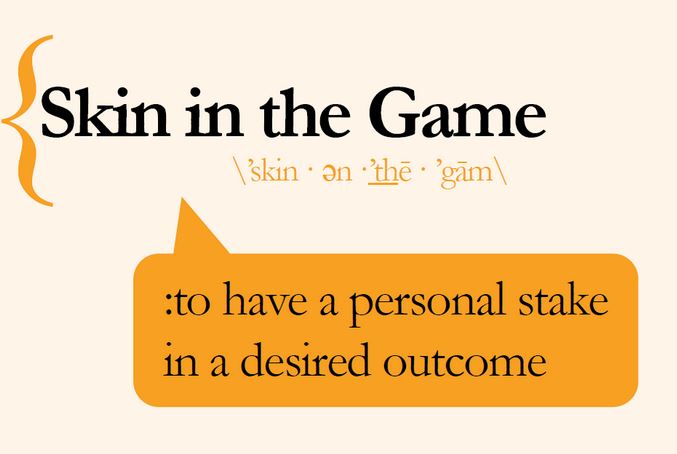
Skin In The Game - Overview
The phrase "skin in the game" has commonly been attributed to Warren Buffet, referring to his own investment in his initial fund. But Buffet has denied this reflecting that he simply popularised the phrase.
It is said that the origin of the phrase “to have skin in the game” comes from horse racing and describes the situation where the owner of a horse competing in a race is said to have “skin” in “the game”, meaning that the owner has a lot riding on the outcome of the event.

More recently the phrase has been popularised by former trader and now popular writer Nassim Taleb, who in his latest book Skin In The Game describes it as:
"...an assessment of asymmetries in human interactions, aimed at helping you understand where and how gaps in uncertainty, risk, knowledge, and fairness emerge, and how to close them."
As with all his books, Taleb has a lot to say, says a lot about it and then takes a long time to say it... but in essence it all boils down to this:
Only
take advice from people who are already invested in the situation they
are advising you about, and where they have something to lose if you
fail as a result of following their advice.
Asymmetries & Disconnects
Taleb also counsels us to pay careful attention to the asymmetries and the disconnects:
- Asymmetries arise where those dispensing advice are not exposed to your downside risk.
- Disconnects occur when there is a gap between what people say and what they do, when they are not walking their talk.
Taleb is known for his aphorisms and here are a few on this subject:
[3] Until you have clear and repeated evidence, and thus a good understanding, of someone's circle of competence watch the other guy's actions, pay close attention to the detail, specifically:
- Watch out for early warning signals of “talk-walk” gap.
- Watch out for early signs of those who “punch above their weight”.
- Be wary of people who are distrusting and overly protective of disclosure – they are often hiding something and/or untrustworthy.
- Ambition in a business partner is a good thing but identify early warning signals of people who: “don’t know what they don’t know, and don’t know that they don’t know”.
[4] You
really cannot truly know someone’s strengths and weaknesses until you
have been in action with them for an extended period of time.
- Knowledge is subordinate to results.
[5] In a competitive world of "smoke and mirrors" always watch the other guy's feet to see his true intentions.
- When there is a disconnect between someone's words and actions, always pay close attention to their actions.
- You can forgive a guy one wrong step, two is a problem and three is a pattern and reveals the truth.
Return from "Skin In The Game" to: Mental Models

LATEST ARTICLES


Belief and Thought: What Zen Tools Works With - What It Leaves Alone
 A Clarification Of Scope Within Zen Tools - Not A Position On Belief As soon as people begin to notice their own thinking more clearly, questions about belief and thought naturally follow: - If though…
How Thought Becomes Identity - The Hidden Mechanism Behind Overthinking, Self-Worth, and Inner Conflict
 Thought Is an Event, Not a Self Most people believe identity is something they have - a stable sense of who they are. In reality, identity is something the mind is continuously producing. It is not fo…
When the Brain Is Hijacked - Where Does Choice Sit?"
 Pressure, the Hijacked Brain, and the Question of Authority
When the brain is hijacked, people are often told they have “lost control”.That language is understandable - and misleading. In reality, man…
Pressure, the Hijacked Brain, and the Question of Authority
When the brain is hijacked, people are often told they have “lost control”.That language is understandable - and misleading. In reality, man…Reduce Digital Overthinking To Lower Your Constant Inner Noise
 Why Constant Micro-Stimulation Increases Your Internal Noise. Modern digital life generates a level of mental activity that previous generations never had to deal with, and this is fundamentally why w…
Pausing Before You Act - Make It a Meta-Habit
 How A Tiny Moment Unlocks Clarity, Choice, And Self-Leadership. There is a moment in life so subtle you barely register it. A colleague questions your idea. A notification flashes. A moment of uncerta…
How to Interrupt Emotional Spirals Using Thought-Awareness
 The spiral is fueled by your mind believing the story your thoughts tell. No one sets out to be swept away by a surge of emotion. One second you’re handling life, and the next, your mind has broken in…
Universal Awareness and the Machinery of Thought
 You Can’t Control Thoughts - But You Can Learn To See Them. Why do our thoughts have so much power over us - and how do we reclaim clarity? The foundation of thought-awareness is the ability to see yo…
Rewiring Your Autopilot – How To Harness Your Subconscious Mind
 How to harness your subconscious mind and move from passenger to pilot. The case for rewiring your autopilot is that most of what drives your thoughts, reactions, and decisions happens below your cons…
Why You Need To Be Intimate With Your Own Thinking
 How self-awareness and insight transforms delusion into wisdom. We live inside an invisible weather system - one made not of clouds and wind, but of thoughts - and this invisibilty is why you need to…
The Illusion of Closeness in Always-On Relationships
 Closeness that cannot survive absence was never intimacy - only constant stimulation mistaken for connection. We live inside an unprecedented experiment in human connection. For the first time in hist…
Why Approval Feels Like Safety And Distance Feels Like Danger
 Safety is not found in being approved - it appears when approval is no longer required. When approval feels like safety, connection stops being something we enjoy and quietly becomes something we rely…
You Do Not Need Better Boundaries - You Need Clearer Thought
 What no longer feels like your responsibility no longer crosses your boundaries. This article explains why you don’t need better boundaries - you need clearer thought - how modern life systematically…