Hindsight Bias
I Knew It All Along
Why do we see unpredictable events as predictable after they occur?
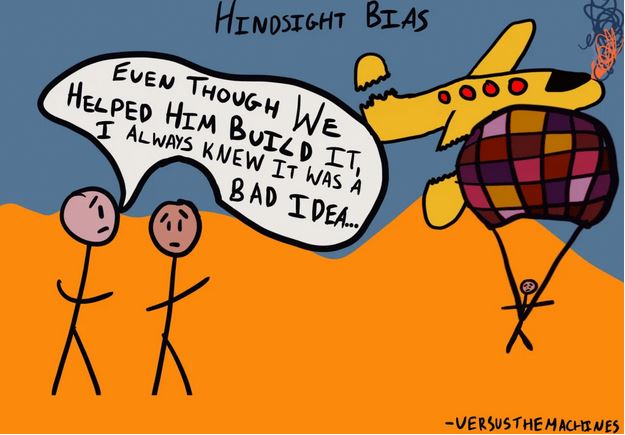
Hindsight Bias - Overview
Hindsight bias occurs when you look back in time and see an unpredictable event as predictable or, at least, more predictable than it was at the point it in time when the decision was made.
This is often referred to the annoying "I knew it all along" or the "I told you so" tendency.
Hindsight bias can be a damaging self-delusion, it can cause you to:
- Deceive yourself into thinking that your judgement is better than it is
- Be less accountable for your judgement calls
- Criticise others for their poor judgement
Why You Exercise Hindsight Bias
The hindsight bias can occur as a result of a memory distortion or "misremembering" of a prior judgement call.
This self-deception occurs when fresh current information overlays a past event or experience and allows/causes you to reinterpret the original assessment into something that fits the current information.
Your beliefs an also have a distorting effect, for example, in the light of current information you delude yourself into seeing the past event as inevitable and/or foreseeable.
According to psychologists Roese and Vohs, three variables are potentially at work in these distortions :
[1] Cognition
You selectively remember information that confirms what you already think you know to be true to create a story that makes sense to you - see confirmation bias.
[2] Metacognition
When you are thinking about your thinking of a past event and reviewing those thought processes in the light of current information, you can easily fall prey to the availability heuristic and selectively remember those elements of your prior knowledge that you can most easily recall.
[3] Motivation
You would like to believe that the world is safe, orderly and predictable rather than the unpredictable and seemingly random and meaningless way life unfolds, you would also like to boost your self esteem, and for these and other related reasons we unconsciously reorder our memories and cognitive processing to arrive at the comforting "I knew it all aong conclusion.
Rudiger Pohl in Cognitive Illusions offers an evolutionary explanation of hindsight bias:
[4] Adaptive Learning
"...hindsight bias is not necessarily a bothersome consequence of a “faulty” information process system, but that is may rather represent an unavoidable by-product of an evolutionary evolved function, namely adaptive learning.
According to this view, hindsight bias is seen as the consequence of our most valuable ability to update previously held knowledge.
This may be seen as a necessary process in order to prevent memory overload and thus to maintain normal cognitive functioning.
Besides, updating allows us to keep our knowledge more coherent and to draw better inferences."
How To Avoid Hindsight Bias
Falling into the self delusion of Hindsight Bias can have serious implications for you:
- Ill-founded over confidence in your decision making capabilities can cause you to make unrealistic predictions and decisions that may have damaging consequences/.
- It can stop you learning from new experiences. If you really did know it all already you will be unable and unwilling to learn.
There are 2 practical ways you can counteract the impact of hindsight bias:
- Keep a record! With business and career related decisions email a trusted friend or colleague with your assessment and predictions of anticipated outcomes of your decisions. Alternatively, keep a personal log or journal - or you could even email yourself, like I do! Doing this enables you to gain insight and learn.
- Consider alternative outcomes. Review the outcomes that did not occur and consider how they might have. This also causes you to expand your perspective to the wider scope of potential outcomes.
Resources:
Excellent and comprehensive article from Shane Parrish of Farnam St: Hindsight Bias: Why You’re Not As Smart As You Think You Are
Another comprehensive and easy to read article from The Decision Lab:
Why do we see unpredictable events as predictable after they occur?
Return from "Hindsight Bias" to: Cognitive Distortion

LATEST ARTICLES


When Insight Is Not Enough - The Missing Piece in Behaviour Change
 What Mindfulness Reveals - And What It Leaves Unresolved. Many people reach a point where something genuinely shifts. They can see their thoughts as thoughts. Patterns are recognised.Triggers are obvi…
Why the Brain Replays Threat at Night - And What It’s Responding To
 Bad Dreams, Mental Overload, and the Cost of Unresolved Threat Processing in the Brain. Many people lie awake at night wondering why the mind turns hostile when the day goes quiet. Thoughts that felt…
The Kingdom Is Here, Now - Awakening Is Not Later
 What contemplative traditions point to - and how progress quietly replaces presence. Across contemplative traditions, a strikingly consistent message appears: truth is not somewhere else, not in the…
Adult Development Without Becoming Someone Else - Growth Without Identity Upgrade
 You do not grow by becoming someone else - you grow by placing authority where choice becomes possible. So much of what is written and taught about personal growth quietly assumes an identity upgrade…
Belief and Thought: What Zen Tools Works With - What It Leaves Alone
 A Clarification Of Scope Within Zen Tools - Not A Position On Belief As soon as people begin to notice their own thinking more clearly, questions about belief and thought naturally follow: - If though…
How Thought Becomes Identity - The Hidden Mechanism Behind Overthinking, Self-Worth, and Inner Conflict
 Thought Is an Event, Not a Self Most people believe identity is something they have - a stable sense of who they are. In reality, identity is something the mind is continuously producing. It is not fo…
When the Brain Is Hijacked - Where Does Choice Sit?"
 Pressure, the Hijacked Brain, and the Question of Authority
When the brain is hijacked, people are often told they have “lost control”.That language is understandable - and misleading. In reality, man…
Pressure, the Hijacked Brain, and the Question of Authority
When the brain is hijacked, people are often told they have “lost control”.That language is understandable - and misleading. In reality, man…Reduce Digital Overthinking To Lower Your Constant Inner Noise
 Why Constant Micro-Stimulation Increases Your Internal Noise. Modern digital life generates a level of mental activity that previous generations never had to deal with, and this is fundamentally why w…
Pausing Before You Act - Make It a Meta-Habit
 How A Tiny Moment Unlocks Clarity, Choice, And Self-Leadership. There is a moment in life so subtle you barely register it. A colleague questions your idea. A notification flashes. A moment of uncerta…
How to Interrupt Emotional Spirals Using Thought-Awareness
 The spiral is fueled by your mind believing the story your thoughts tell. No one sets out to be swept away by a surge of emotion. One second you’re handling life, and the next, your mind has broken in…
Universal Awareness and the Machinery of Thought
 You Can’t Control Thoughts - But You Can Learn To See Them. Why do our thoughts have so much power over us - and how do we reclaim clarity? The foundation of thought-awareness is the ability to see yo…
Rewiring Your Autopilot – How To Harness Your Subconscious Mind
 How to harness your subconscious mind and move from passenger to pilot. The case for rewiring your autopilot is that most of what drives your thoughts, reactions, and decisions happens below your cons…