Myers Briggs ENTJ
The Commander
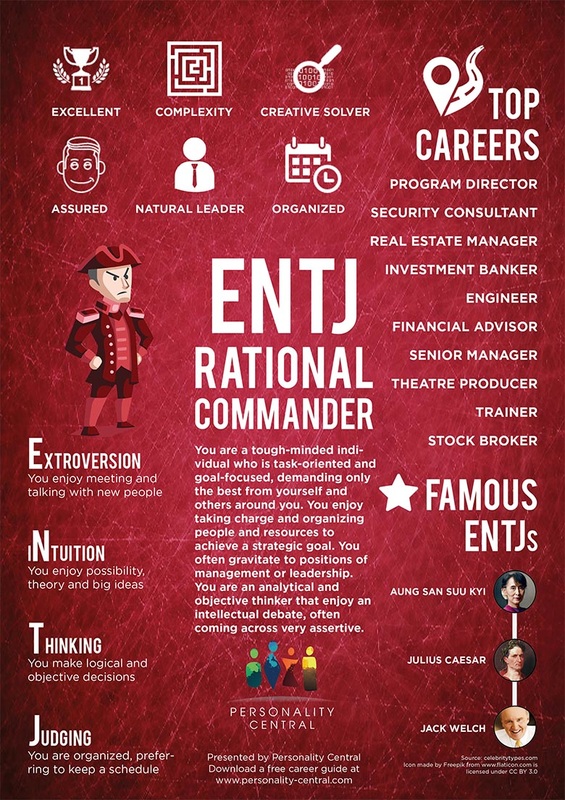
Myers Briggs ENTJ - Summary
- Frank, decisive, assumes leadership readily.
- Quickly see illogical and inefficient procedures and policies.
- Develop and implement comprehensive systems to solve organisational problems.
- Enjoy long term planning and goal setting.
- Usually well informed and well read, enjoy expanding their knowledge and passing it on to others.
- Forceful in presenting their ideas.
Myers Briggs ENTJ - Characteristics
- Myers Briggs ENTJS focus on the most efficient and organised means of performing a task. This quality, along with their goal orientation, often makes ENTJs superior leaders, both realistic and visionary in implementing a long-term plan.
- They tend to be fiercely independent in their decision-making, having a strong will that insulates them against external influence.
- Generally highly competent, they analyse and structure the world around them in a logical and rational way. Due to this straightforward way of thinking, they tend to have the greatest difficulty of all the types in applying subjective considerations and emotional values into the decision-making process.
- They often excel in business and other areas that require systems analysis, original thinking, and an economically savvy mind. They are dynamic and pragmatic problem solvers.
- They tend to have a high degree of confidence in their own abilities, making them assertive and outspoken.
- In their dealings with others, they are generally outgoing, charismatic, fair-minded, and unaffected by conflict or criticism. However, these qualities can make them appear arrogant, insensitive, and confrontational.
- They can overwhelm others with their energy, intelligence, and desire to order the world according to their own vision. As a result, they may seem intimidating, hasty, and controlling.
- ENTJs tend to cultivate their personal power. They often end up taking charge of a situation that seems (to their mind, at least) to be out of control, or that can otherwise be improved upon and strengthened. They strive to learn new things, which helps them become resourceful problem-solvers.
- However, since they rely on provable facts, they may find subjective issues pointless. They appear to take a tough approach to emotional or personal issues, and so can be viewed as aloof and cold-hearted.
- In situations requiring feeling and value judgments, they are well served to seek the advice of a trusted Feeling type.
Take the Myers Briggs Test [Note: This currently costs $49.99]
Return to main page: Myers Briggs Type Indicators

LATEST ARTICLES


Belief and Thought: What Zen Tools Works With - What It Leaves Alone
 A Clarification Of Scope Within Zen Tools - Not A Position On Belief As soon as people begin to notice their own thinking more clearly, questions about belief and thought naturally follow: - If though…
How Thought Becomes Identity - The Hidden Mechanism Behind Overthinking, Self-Worth, and Inner Conflict
 Thought Is an Event, Not a Self Most people believe identity is something they have - a stable sense of who they are. In reality, identity is something the mind is continuously producing. It is not fo…
When the Brain Is Hijacked - Where Does Choice Sit?"
 Pressure, the Hijacked Brain, and the Question of Authority
When the brain is hijacked, people are often told they have “lost control”.That language is understandable - and misleading. In reality, man…
Pressure, the Hijacked Brain, and the Question of Authority
When the brain is hijacked, people are often told they have “lost control”.That language is understandable - and misleading. In reality, man…Reduce Digital Overthinking To Lower Your Constant Inner Noise
 Why Constant Micro-Stimulation Increases Your Internal Noise. Modern digital life generates a level of mental activity that previous generations never had to deal with, and this is fundamentally why w…
Pausing Before You Act - Make It a Meta-Habit
 How A Tiny Moment Unlocks Clarity, Choice, And Self-Leadership. There is a moment in life so subtle you barely register it. A colleague questions your idea. A notification flashes. A moment of uncerta…
How to Interrupt Emotional Spirals Using Thought-Awareness
 The spiral is fueled by your mind believing the story your thoughts tell. No one sets out to be swept away by a surge of emotion. One second you’re handling life, and the next, your mind has broken in…
Universal Awareness and the Machinery of Thought
 You Can’t Control Thoughts - But You Can Learn To See Them. Why do our thoughts have so much power over us - and how do we reclaim clarity? The foundation of thought-awareness is the ability to see yo…
Rewiring Your Autopilot – How To Harness Your Subconscious Mind
 How to harness your subconscious mind and move from passenger to pilot. The case for rewiring your autopilot is that most of what drives your thoughts, reactions, and decisions happens below your cons…
Why You Need To Be Intimate With Your Own Thinking
 How self-awareness and insight transforms delusion into wisdom. We live inside an invisible weather system - one made not of clouds and wind, but of thoughts - and this invisibilty is why you need to…
The Illusion of Closeness in Always-On Relationships
 Closeness that cannot survive absence was never intimacy - only constant stimulation mistaken for connection. We live inside an unprecedented experiment in human connection. For the first time in hist…
Why Approval Feels Like Safety And Distance Feels Like Danger
 Safety is not found in being approved - it appears when approval is no longer required. When approval feels like safety, connection stops being something we enjoy and quietly becomes something we rely…
You Do Not Need Better Boundaries - You Need Clearer Thought
 What no longer feels like your responsibility no longer crosses your boundaries. This article explains why you don’t need better boundaries - you need clearer thought - how modern life systematically…