Myers Briggs ESFJ
The Provider
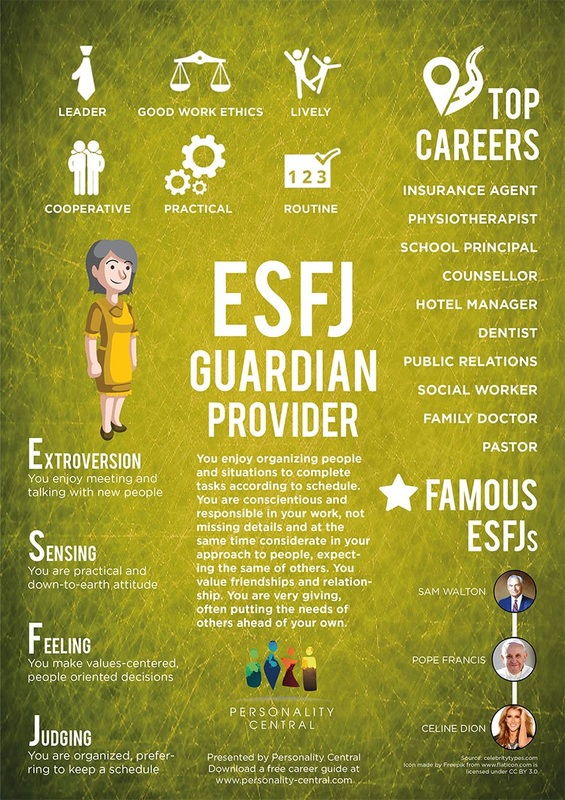
Myers Briggs ESFJ - Summary
- Warm hearted, conscientious and cooperative.
- Want harmony in their environment; work with determination to establish it.
- Like to work with others to complete tasks accurately and on time.
- Loyal, follow through even in small matters.
- Notice what others need in their day-to-day lives and try to provide it.
- Want to be appreciated for who they are and what they contribute.
Myers Briggs ESFJ - Characteristics
- Myers Briggs ESFJs focus on the outside world and assess their experiences subjectively. They largely base their judgments on their belief system and on the effects of actions on people. They are literal and concrete, trusting the specific, factual information gathered through their physiological senses.
- They project warmth through a genuine interest in the well-being of others. They are often skilled at bringing out the best in people, and they want to understand other points of view. They are serious about their responsibilities, seeing what needs to be done and then doing it. Generally proficient at detailed tasks, they enjoy doing little things that make life easier for others. They value tradition and the security it offers.
- Easily hurt, they seek approval. They take pleasure in other people's happiness. They give generously but expect appreciation in return. Sensitive to the physical needs of others, they respond by offering practical care. As expert people readers, ESFJs often adapt their manner to meet the expectations of others. However, they may have difficulty recognizing the shortcomings of loved ones.
- They tend to be vocal in expressing their sense of right and wrong. Their value system derives from the external standards defined by their community, as opposed to a personal set of ethics. (This is one of the traits that distinguish them from their ENFJ counterparts.)
- Raised in an environment of high ethical standards they tend to display true generosity and kindness. However, those who grow up surrounded by a skewed set of values may develop a false sense of integrity and use their people skills to selfishly manipulate others—particularly if their intuition is poorly developed, leaving them unable to foresee the consequences of their actions.
- They seek structured, controlled environments, and tend to be good at creating a sense of order. They generally feel insecure in an atmosphere of uncertainty. They value the rule of law and expect the same of others. ESFJs may be less interested in understanding the concepts behind the rules, tending to shy away from the abstract and impersonal.
Take the Myers Briggs Test [Note: This currently costs $49.99]
Return to main page: Myers Briggs Type Indicators

LATEST ARTICLES


Adult Development Without Becoming Someone Else - Growth Without Identity Upgrade
 You do not grow by becoming someone else - you grow by placing authority where choice becomes possible. So much of what is written and taught about personal growth quietly assumes an identity upgrade…
Belief and Thought: What Zen Tools Works With - What It Leaves Alone
 A Clarification Of Scope Within Zen Tools - Not A Position On Belief As soon as people begin to notice their own thinking more clearly, questions about belief and thought naturally follow: - If though…
How Thought Becomes Identity - The Hidden Mechanism Behind Overthinking, Self-Worth, and Inner Conflict
 Thought Is an Event, Not a Self Most people believe identity is something they have - a stable sense of who they are. In reality, identity is something the mind is continuously producing. It is not fo…
When the Brain Is Hijacked - Where Does Choice Sit?"
 Pressure, the Hijacked Brain, and the Question of Authority
When the brain is hijacked, people are often told they have “lost control”.That language is understandable - and misleading. In reality, man…
Pressure, the Hijacked Brain, and the Question of Authority
When the brain is hijacked, people are often told they have “lost control”.That language is understandable - and misleading. In reality, man…Reduce Digital Overthinking To Lower Your Constant Inner Noise
 Why Constant Micro-Stimulation Increases Your Internal Noise. Modern digital life generates a level of mental activity that previous generations never had to deal with, and this is fundamentally why w…
Pausing Before You Act - Make It a Meta-Habit
 How A Tiny Moment Unlocks Clarity, Choice, And Self-Leadership. There is a moment in life so subtle you barely register it. A colleague questions your idea. A notification flashes. A moment of uncerta…
How to Interrupt Emotional Spirals Using Thought-Awareness
 The spiral is fueled by your mind believing the story your thoughts tell. No one sets out to be swept away by a surge of emotion. One second you’re handling life, and the next, your mind has broken in…
Universal Awareness and the Machinery of Thought
 You Can’t Control Thoughts - But You Can Learn To See Them. Why do our thoughts have so much power over us - and how do we reclaim clarity? The foundation of thought-awareness is the ability to see yo…
Rewiring Your Autopilot – How To Harness Your Subconscious Mind
 How to harness your subconscious mind and move from passenger to pilot. The case for rewiring your autopilot is that most of what drives your thoughts, reactions, and decisions happens below your cons…
Why You Need To Be Intimate With Your Own Thinking
 How self-awareness and insight transforms delusion into wisdom. We live inside an invisible weather system - one made not of clouds and wind, but of thoughts - and this invisibilty is why you need to…
The Illusion of Closeness in Always-On Relationships
 Closeness that cannot survive absence was never intimacy - only constant stimulation mistaken for connection. We live inside an unprecedented experiment in human connection. For the first time in hist…
Why Approval Feels Like Safety And Distance Feels Like Danger
 Safety is not found in being approved - it appears when approval is no longer required. When approval feels like safety, connection stops being something we enjoy and quietly becomes something we rely…