Myers Briggs ISFP
The Artist
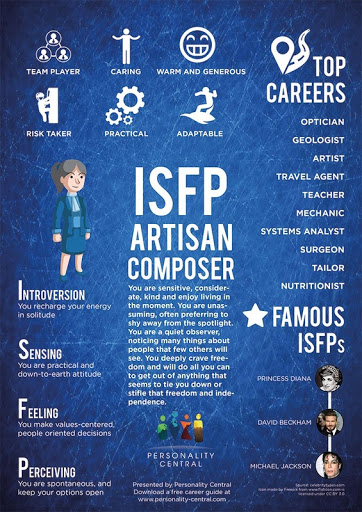
Myers Briggs ISFP - Summary
- Quiet friendly, sensitive and kind.
- Enjoy the here and now and what's going on around them.
- Like to have their own space and work to their own time frame.
- Loyal, and committed to their values and to people who are important to them.
- Dislike disagreements and conflicts, and do not force their opinions or values on others.
Myers Briggs ISFP - Characteristics
- Myers Briggs ISFP are peaceful, easygoing people who adopt a "live and let live" approach to life. They enjoy taking things at their own pace and tend to live in the moment.
- Although quiet, they are pleasant, considerate, and caring, devoted to the people in their lives. Though not inclined to debate or necessarily even air their views, their values are important to them.
- They filter information based on interpretations of worth, forming judgments according to criteria that are often intangible. They constantly balance an internal set of values such as harmony and authenticity. Attuned to subtle distinctions, they innately sense what is true and what is false in a situation.
- ISFPs focus on the experiences and sensations of the immediate, physical world. With an acute awareness of the present surroundings, it brings relevant facts and details to the forefront and may lead to spontaneous action.
- Attracted to symbolic actions or devices, they synthesise seeming paradoxes to create the previously unimagined. These realisations come with a certainty that demands action to fulfil a new vision of the future, solutions that may include complex systems or universal truths.
- They organise and schedule ideas and the environment to ensure the efficient, productive pursuit of objectives. They seek logical explanations for actions, events, and conclusions, looking for faulty reasoning and lapses in sequence.
Take the Myers Briggs Test [Note: This currently costs $49.99]
Return to main page: Myers Briggs Type Indicators

LATEST ARTICLES


When Insight Is Not Enough - The Missing Piece in Behaviour Change
 What Mindfulness Reveals - And What It Leaves Unresolved. Many people reach a point where something genuinely shifts. They can see their thoughts as thoughts. Patterns are recognised.Triggers are obvi…
Why the Brain Replays Threat at Night - And What It’s Responding To
 Bad Dreams, Mental Overload, and the Cost of Unresolved Threat Processing in the Brain. Many people lie awake at night wondering why the mind turns hostile when the day goes quiet. Thoughts that felt…
The Kingdom Is Here, Now - Awakening Is Not Later
 What contemplative traditions point to - and how progress quietly replaces presence. Across contemplative traditions, a strikingly consistent message appears: truth is not somewhere else, not in the…
Adult Development Without Becoming Someone Else - Growth Without Identity Upgrade
 You do not grow by becoming someone else - you grow by placing authority where choice becomes possible. So much of what is written and taught about personal growth quietly assumes an identity upgrade…
Belief and Thought: What Zen Tools Works With - What It Leaves Alone
 A Clarification Of Scope Within Zen Tools - Not A Position On Belief As soon as people begin to notice their own thinking more clearly, questions about belief and thought naturally follow: - If though…
How Thought Becomes Identity - The Hidden Mechanism Behind Overthinking, Self-Worth, and Inner Conflict
 Thought Is an Event, Not a Self Most people believe identity is something they have - a stable sense of who they are. In reality, identity is something the mind is continuously producing. It is not fo…
When the Brain Is Hijacked - Where Does Choice Sit?"
 Pressure, the Hijacked Brain, and the Question of Authority
When the brain is hijacked, people are often told they have “lost control”.That language is understandable - and misleading. In reality, man…
Pressure, the Hijacked Brain, and the Question of Authority
When the brain is hijacked, people are often told they have “lost control”.That language is understandable - and misleading. In reality, man…Reduce Digital Overthinking To Lower Your Constant Inner Noise
 Why Constant Micro-Stimulation Increases Your Internal Noise. Modern digital life generates a level of mental activity that previous generations never had to deal with, and this is fundamentally why w…
Pausing Before You Act - Make It a Meta-Habit
 How A Tiny Moment Unlocks Clarity, Choice, And Self-Leadership. There is a moment in life so subtle you barely register it. A colleague questions your idea. A notification flashes. A moment of uncerta…
How to Interrupt Emotional Spirals Using Thought-Awareness
 The spiral is fueled by your mind believing the story your thoughts tell. No one sets out to be swept away by a surge of emotion. One second you’re handling life, and the next, your mind has broken in…
Universal Awareness and the Machinery of Thought
 You Can’t Control Thoughts - But You Can Learn To See Them. Why do our thoughts have so much power over us - and how do we reclaim clarity? The foundation of thought-awareness is the ability to see yo…
Rewiring Your Autopilot – How To Harness Your Subconscious Mind
 How to harness your subconscious mind and move from passenger to pilot. The case for rewiring your autopilot is that most of what drives your thoughts, reactions, and decisions happens below your cons…