Myers Briggs ISTJ
The Inspector
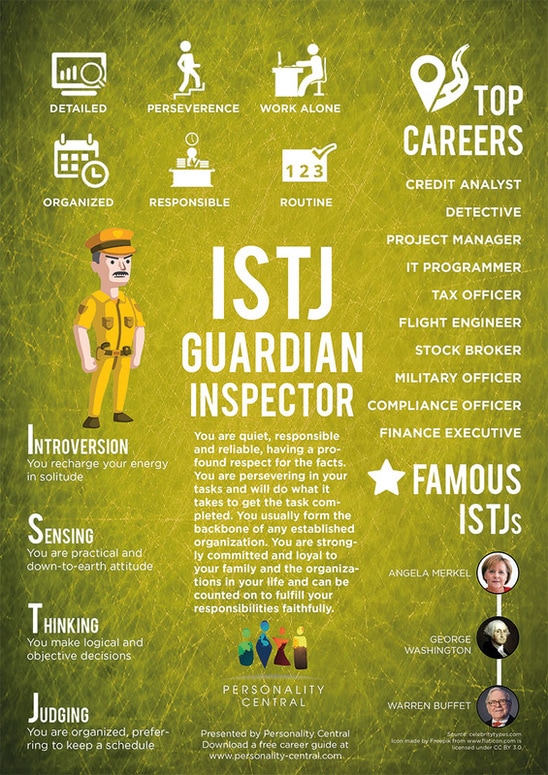
Myers Briggs ISTJ - Summary
- Quiet serious; earn success by thoroughness and dependability.
- Practical, matter of fact, realistic and responsible.
- Decide logically what should be done and work towards it steadily regardless of distractions.
- Take pleasure in making everything orderly and organised - their work, home and life.
- Value traditions and loyalty.
Myers Briggs ISTJ - Characteristics
- Myers Briggs ISTJs thrive on organisation and keep their lives and environments well regulated. They bring painstaking attention to detail in their work and will not rest until a job is well completed. They are often dissatisfied with unresolved issues, whether in life or in fiction.
- They are faithful, logical, organized, sensible, and earnest traditionalists. They earn success by thoroughness and dependability. Shutting out distractions, they take a practical, logical approach to their endeavours. Realistic and responsible, they work steadily toward their goals. They enjoy creating order in both their professional and personal lives.
- Despite their focus on their internal world, they prefer dealing with the present and the factual. Keen observers of life, they weigh various options when making decisions. They are well prepared for most eventualities and have a good understanding of most situations. They believe in practical objectives, and they value traditions and loyalty.
- ISTJs learn best and apply themselves to subjects that they deem practical and useful. As learners, they tend to need materials, directions, and teachers to be precise and accurate if they are to trust the information that is presented. They prefer concrete and useful applications and will tolerate theory only if it leads to these ends.
- They like learning activities that allow them time to reflect and think. Material that seems too easy or too enjoyable leads them to tend to be sceptical of its merit. Because of their practical outlook, they clearly delineate between work and play. Therefore, their ideal learning environment is task-oriented, has a clear schedule, and has a clear and precise assignment.
- ISTJs respect facts. They hold a tremendous store of data within themselves, gathered through their fensing function. They may have difficulty valuing a theory or idea that differs from their own perspective. However, if they are shown the importance or relevance of the idea by someone whom they respect or care about, the idea becomes a fact that the ISTJ will internalise and vigorously support.
- They often work for long periods, devoting their energy to tasks that they see as important to fulfilling a goal. However, they resist putting energy into things that don't make sense to them, or for which they can't see a practical application. They prefer to work alone but can work well in teams when the situation demands it. They like to be accountable for their actions, and they enjoy positions of responsibility. They have little use for theory or abstract thinking, unless the practical application is clear.
Overall:
In general, they are capable, logical, reasonable, and effective
individuals with a deeply driven desire to promote security and peaceful
living. They can be highly effective at achieving their goals.
Take the Myers Briggs Test [Note: This currently costs $49.99]
Return to main page: Myers Briggs Type Indicators

LATEST ARTICLES


Why the Brain Replays Threat at Night - And What It’s Responding To
 Bad Dreams, Mental Overload, and the Cost of Unresolved Threat Processing in the Brain. Many people lie awake at night wondering why the mind turns hostile when the day goes quiet. Thoughts that felt…
The Kingdom Is Here, Now - Awakening Is Not Later
 What contemplative traditions point to - and how progress quietly replaces presence. Across contemplative traditions, a strikingly consistent message appears: truth is not somewhere else, not in the…
Adult Development Without Becoming Someone Else - Growth Without Identity Upgrade
 You do not grow by becoming someone else - you grow by placing authority where choice becomes possible. So much of what is written and taught about personal growth quietly assumes an identity upgrade…
Belief and Thought: What Zen Tools Works With - What It Leaves Alone
 A Clarification Of Scope Within Zen Tools - Not A Position On Belief As soon as people begin to notice their own thinking more clearly, questions about belief and thought naturally follow: - If though…
How Thought Becomes Identity - The Hidden Mechanism Behind Overthinking, Self-Worth, and Inner Conflict
 Thought Is an Event, Not a Self Most people believe identity is something they have - a stable sense of who they are. In reality, identity is something the mind is continuously producing. It is not fo…
When the Brain Is Hijacked - Where Does Choice Sit?"
 Pressure, the Hijacked Brain, and the Question of Authority
When the brain is hijacked, people are often told they have “lost control”.That language is understandable - and misleading. In reality, man…
Pressure, the Hijacked Brain, and the Question of Authority
When the brain is hijacked, people are often told they have “lost control”.That language is understandable - and misleading. In reality, man…Reduce Digital Overthinking To Lower Your Constant Inner Noise
 Why Constant Micro-Stimulation Increases Your Internal Noise. Modern digital life generates a level of mental activity that previous generations never had to deal with, and this is fundamentally why w…
Pausing Before You Act - Make It a Meta-Habit
 How A Tiny Moment Unlocks Clarity, Choice, And Self-Leadership. There is a moment in life so subtle you barely register it. A colleague questions your idea. A notification flashes. A moment of uncerta…
How to Interrupt Emotional Spirals Using Thought-Awareness
 The spiral is fueled by your mind believing the story your thoughts tell. No one sets out to be swept away by a surge of emotion. One second you’re handling life, and the next, your mind has broken in…
Universal Awareness and the Machinery of Thought
 You Can’t Control Thoughts - But You Can Learn To See Them. Why do our thoughts have so much power over us - and how do we reclaim clarity? The foundation of thought-awareness is the ability to see yo…
Rewiring Your Autopilot – How To Harness Your Subconscious Mind
 How to harness your subconscious mind and move from passenger to pilot. The case for rewiring your autopilot is that most of what drives your thoughts, reactions, and decisions happens below your cons…
Why You Need To Be Intimate With Your Own Thinking
 How self-awareness and insight transforms delusion into wisdom. We live inside an invisible weather system - one made not of clouds and wind, but of thoughts - and this invisibilty is why you need to…