Myers Briggs ISTP
The Artisan
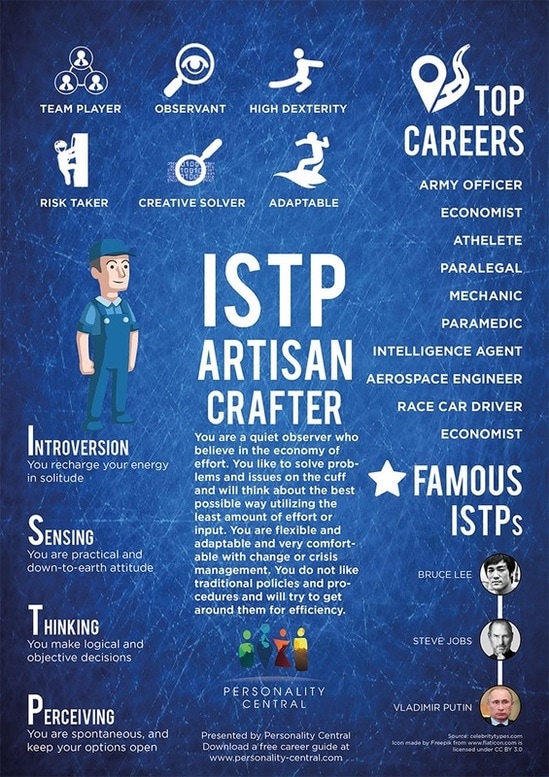
Myers Briggs ISTP - Summary
- Tolerant and flexible quiet observers until a problem appears, then act quickly to find workable solutions.
- Analyses what makes things work and readily get through large amounts of data to isolate the core of practical problems.
- Interested in cause and effect, organise facts using logical principles, value efficiency.
Myers Briggs ISTP - Characteristics
- Myers Briggs ISTP excel at analysing situations to reach the heart of a problem so that they can swiftly implement a functional repair, making them ideally suited to the field of engineering.
- Naturally quiet people, they are interested in understanding how systems operate, focusing on efficient operation and structure. They are open to new information and approaches.
- But contrary to their seemingly detached natures, ISTPs are often capable of humorously insightful observations about the world around them, and can be closet daredevils who gravitate toward fast-moving or risky hobbies (such as bungee jumping, hang gliding, racing, motorcycling, and parachuting), recreational sports (such as downhill skiing, paintball, ice hockey, and scuba diving), and careers (such as aviation and firefighting).
- They seeks precision, such as the exact word to express an idea - noticing the minute distinctions that define the essence of things, then analyses and classifies them. They examine all sides of an issue, looking to solve problems while minimising effort and risk and use models to root out logical inconsistency.
- They live in a world of logic, on which they base their decisions. They process information from their auxiliary function to create strategies for action at a moment's notice. They love to examine complicated systems.
- They focus on the experiences and sensations of the immediate, physical world. With an acute awareness of the present surroundings, it brings relevant facts and details to the forefront and may lead to spontaneous action.
- This function drives ISTPs to embrace opportunities to plunge headfirst into experiences. It also gives them a keen insight into situations similar to that of the ISTJ.
- Their occasionally tunnel-visioned curiosity for the world around them gives them a "leap before you look" tendency. They are notorious for taking apart a device to see how it works before considering whether they can put it back together.
- Attracted to symbolic actions or devices they synthesise seeming paradoxes to create the previously unimagined. These realisations come with a certainty that demands action to fulfil a new vision of the future, solutions that may include complex systems or universal truths.
- Never as open in their theorising as INTPs, they prefer to keep themselves grounded in the physical situation, visualising components and concepts that they cannot see and touch firsthand, such as the wiring in a circuit board.
- ISTPs seek social connections and creates harmonious interactions through polite, considerate, and appropriate behaviour.
- They respond to the explicit (and implicit) wants of others, and may even create an internal conflict between the subject’s own needs and the desire to meet the needs of others.
- A weak point is that they can tend to interpret criticisms of their ideas as criticisms of their competence.
- Although ISTPs strive to follow the edicts of logic, when they are under stress, their inferior function can lead them to illogically and stubbornly cling to their own ideas even when proven wrong.
Take the Myers Briggs Test [Note: This currently costs $49.99]
Return to main page: Myers Briggs Type Indicators

LATEST ARTICLES


Belief and Thought: What Zen Tools Works With - What It Leaves Alone
 A Clarification Of Scope Within Zen Tools - Not A Position On Belief As soon as people begin to notice their own thinking more clearly, questions about belief and thought naturally follow: - If though…
How Thought Becomes Identity - The Hidden Mechanism Behind Overthinking, Self-Worth, and Inner Conflict
 Thought Is an Event, Not a Self Most people believe identity is something they have - a stable sense of who they are. In reality, identity is something the mind is continuously producing. It is not fo…
When the Brain Is Hijacked - Where Does Choice Sit?"
 Pressure, the Hijacked Brain, and the Question of Authority
When the brain is hijacked, people are often told they have “lost control”.That language is understandable - and misleading. In reality, man…
Pressure, the Hijacked Brain, and the Question of Authority
When the brain is hijacked, people are often told they have “lost control”.That language is understandable - and misleading. In reality, man…Reduce Digital Overthinking To Lower Your Constant Inner Noise
 Why Constant Micro-Stimulation Increases Your Internal Noise. Modern digital life generates a level of mental activity that previous generations never had to deal with, and this is fundamentally why w…
Pausing Before You Act - Make It a Meta-Habit
 How A Tiny Moment Unlocks Clarity, Choice, And Self-Leadership. There is a moment in life so subtle you barely register it. A colleague questions your idea. A notification flashes. A moment of uncerta…
How to Interrupt Emotional Spirals Using Thought-Awareness
 The spiral is fueled by your mind believing the story your thoughts tell. No one sets out to be swept away by a surge of emotion. One second you’re handling life, and the next, your mind has broken in…
Universal Awareness and the Machinery of Thought
 You Can’t Control Thoughts - But You Can Learn To See Them. Why do our thoughts have so much power over us - and how do we reclaim clarity? The foundation of thought-awareness is the ability to see yo…
Rewiring Your Autopilot – How To Harness Your Subconscious Mind
 How to harness your subconscious mind and move from passenger to pilot. The case for rewiring your autopilot is that most of what drives your thoughts, reactions, and decisions happens below your cons…
Why You Need To Be Intimate With Your Own Thinking
 How self-awareness and insight transforms delusion into wisdom. We live inside an invisible weather system - one made not of clouds and wind, but of thoughts - and this invisibilty is why you need to…
The Illusion of Closeness in Always-On Relationships
 Closeness that cannot survive absence was never intimacy - only constant stimulation mistaken for connection. We live inside an unprecedented experiment in human connection. For the first time in hist…
Why Approval Feels Like Safety And Distance Feels Like Danger
 Safety is not found in being approved - it appears when approval is no longer required. When approval feels like safety, connection stops being something we enjoy and quietly becomes something we rely…
You Do Not Need Better Boundaries - You Need Clearer Thought
 What no longer feels like your responsibility no longer crosses your boundaries. This article explains why you don’t need better boundaries - you need clearer thought - how modern life systematically…