Enneagram Of Personality Types
Plotting Your Position In Life, The Universe, and Everything
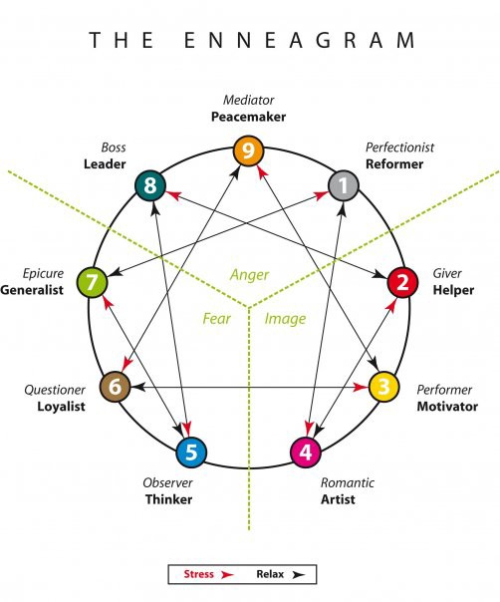
Introduction To The Enneagram Of Personality Types
The Enneagram of Personality Types was originally devised by Oscar Ichazo.
The symbol has roots in antiquity and can be traced back at least as far as the works of Pythagoras. The symbol was reintroduced to the modern world by George Gurdjieff.
Ichazo drew on his knowledge of variety of spiritual and esoteric traditions, but the actual combination of those traditions connected with the symbol is purely his creation.
"The 'Traditional
Enneagram' only goes back to the 1960's when Ichazo was first teaching
it, although the philosophy behind the Enneagram contains components
from mystical Judaism, Christianity, Islam, Taoism, Buddhism, and
ancient Greek philosophy (particularly Socrates, Plato, and the
Neo-Platonists)—all traditions that stretch back into antiquity." [Enneagram Institute]
It is in many ways a modern synthesis of various wisdom
traditions sometimes referred to as Integral Theory and associated with Ken Wilber et al which attempts to synthesise a multi-disciplinary approach to the evolution of life and consciousness into one holistic framework.
Ichazo saw the Enneagram as a tool for looking at specifics of the structure of the human soul and how it becomes distorted by the developing ego.
"We have to distinguish between a man as he is in essence, and as he is in ego or personality. In essence, every person is perfect, fearless, and in a loving unity with the entire cosmos; there is no conflict within the person between head, heart, and stomach or between the person and others. Then something happens: the ego begins to develop, karma accumulates, there is a transition from objectivity to subjectivity; man falls from essence into personality." [Oscar Ichazo]
Enneagram - Descriptions of Personality Types
As you can see from the graphic of the enneagram above, it is represented by a circle with nine equidistant points marked on its circumference, and each point is designated by a number from one to nine, and by convention with nine at the top. Each point represents one of nine basic personality types.
In overview, the Enneagram can be seen as a set of nine distinct personality types, with each number on the Enneagram denoting one type.
It is common to find a little of yourself in all nine of the types, although one of them should stand out as being closest to yourself.
According to the Enneagram system:
- We are all born with a dominant personality type, and this innate orientation shapes how we adapt to our early childhood environment
- We do not change from one basic personality type to another
- The personality types are apply equally to males and females
- Because we fluctuate between the various traits that make up our personality type, not every detail of the description of our type will apply to us all of then time
- Numbers are used to designate types in the enneagram system because they are value neutral
- There is no significance to the numerical ranking of the types
The 9 Types
For an introduction to 9 personality types and the connections between them, please refer to:
The Traditional Enneagram Overview
Do The Tests
Identify your basic personality type:
Free Enneagram Test @ Personality Path
Enneagram Personality Tests @Ecletic Energies
Return to: Managing Personal Change

LATEST ARTICLES


When Insight Is Not Enough - The Missing Piece in Behaviour Change
 What Mindfulness Reveals - And What It Leaves Unresolved. Many people reach a point where something genuinely shifts. They can see their thoughts as thoughts. Patterns are recognised.Triggers are obvi…
Why the Brain Replays Threat at Night - And What It’s Responding To
 Bad Dreams, Mental Overload, and the Cost of Unresolved Threat Processing in the Brain. Many people lie awake at night wondering why the mind turns hostile when the day goes quiet. Thoughts that felt…
The Kingdom Is Here, Now - Awakening Is Not Later
 What contemplative traditions point to - and how progress quietly replaces presence. Across contemplative traditions, a strikingly consistent message appears: truth is not somewhere else, not in the…
Adult Development Without Becoming Someone Else - Growth Without Identity Upgrade
 You do not grow by becoming someone else - you grow by placing authority where choice becomes possible. So much of what is written and taught about personal growth quietly assumes an identity upgrade…
Belief and Thought: What Zen Tools Works With - What It Leaves Alone
 A Clarification Of Scope Within Zen Tools - Not A Position On Belief As soon as people begin to notice their own thinking more clearly, questions about belief and thought naturally follow: - If though…
How Thought Becomes Identity - The Hidden Mechanism Behind Overthinking, Self-Worth, and Inner Conflict
 Thought Is an Event, Not a Self Most people believe identity is something they have - a stable sense of who they are. In reality, identity is something the mind is continuously producing. It is not fo…
When the Brain Is Hijacked - Where Does Choice Sit?"
 Pressure, the Hijacked Brain, and the Question of Authority
When the brain is hijacked, people are often told they have “lost control”.That language is understandable - and misleading. In reality, man…
Pressure, the Hijacked Brain, and the Question of Authority
When the brain is hijacked, people are often told they have “lost control”.That language is understandable - and misleading. In reality, man…Reduce Digital Overthinking To Lower Your Constant Inner Noise
 Why Constant Micro-Stimulation Increases Your Internal Noise. Modern digital life generates a level of mental activity that previous generations never had to deal with, and this is fundamentally why w…
Pausing Before You Act - Make It a Meta-Habit
 How A Tiny Moment Unlocks Clarity, Choice, And Self-Leadership. There is a moment in life so subtle you barely register it. A colleague questions your idea. A notification flashes. A moment of uncerta…
How to Interrupt Emotional Spirals Using Thought-Awareness
 The spiral is fueled by your mind believing the story your thoughts tell. No one sets out to be swept away by a surge of emotion. One second you’re handling life, and the next, your mind has broken in…
Universal Awareness and the Machinery of Thought
 You Can’t Control Thoughts - But You Can Learn To See Them. Why do our thoughts have so much power over us - and how do we reclaim clarity? The foundation of thought-awareness is the ability to see yo…
Rewiring Your Autopilot – How To Harness Your Subconscious Mind
 How to harness your subconscious mind and move from passenger to pilot. The case for rewiring your autopilot is that most of what drives your thoughts, reactions, and decisions happens below your cons…