The Checklist Manifesto
Your Personal Safety Net
Under conditions of complexity, not only are checklists a help, they are required for success.
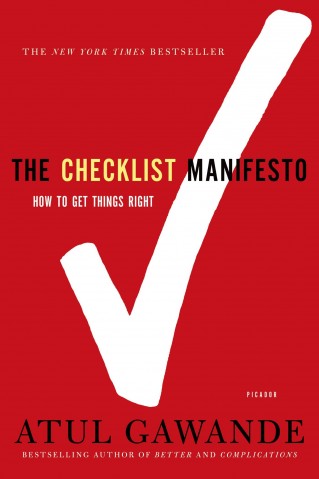
Introducing The Checklist Manifesto
The Checklist Manifesto is the latest book by surgeon, researcher and writer Atul Gawande and is based on his medical experiences.
The wider relevance of this book is how Gawande addresses a problem that is endemic in modern life.
As technology develops and areas of specialist expertise become increasingly niche this creates an environment of ever increasing complexity.
Dealing with complexity
The challenge is how professionals in any sphere of expertise cope with this complexity and specifically how they avoid making avoidable mistakes and errors of judgement.
Gawande illustrates his thesis with a series of medical examples showing how the routine procedures of surgeons are now so complex and inter-dependent on other supporting specialisations that mistakes are almost inevitable leading to an otherwise competent doctor missing a step in the real time stress and pressure of the moment.
His researches led him to specialists in other high-risk fields such as airline pilots and constructors of high rise buildings and large scale civil-engineering projects.
His solution is checklists that walk these specialists through the key steps of any complex procedure.
Wider applications
The message of the checklist manifesto has wider applications than the rarefied environment of the highly skilled professionals.
In a recent article on how not to be stupid we looked at the seven causes of everyday stupidity, and we noted that whilst we will never fully eliminate stupidity from our own behaviour, we can reduce the likelihood of it occurring and take practical steps to mitigate its effects when it does, and I shared an example of how I use checklists.
The checklist manifesto offers a simple and effective antidote to the avoidable mistakes and stupidities caused by human failing and weakness.
As Gawande says:
“Whether running to the store to buy ingredients for a cake, preparing an airplane for takeoff, or evaluating a sick person in the hospital, if you miss just one key thing, you might as well not have made the effort at all.”
The Characteristics Of An Effective Checklist
Checklists:
- Are not detailed manuals but brief and convenient tools built to improve performance and avoid unnecessary errors
- Are effective and easy to use even in the most complicated circumstances
- Are concise and coherent and only include the most significant and crucial actions
- Are unambiguous and accurate
- Fit on one page.
- Consist of only five to nine steps [this is the memory limit]
- Should not take more than 60-90 secs to read
- Can be for the DO-CONFIRM or a READ-DO format
- Ensure that important items are not missed
- Ensure that people speak, organize, and embrace accountability
- Maintain the capacity to handle unpredictability
The Checklist Manifesto - in his own words:
“The volume and complexity of what we know has exceeded our individual ability to deliver its benefits correctly, safely, or reliably. Knowledge has both saved us and burdened us.”
“Checklists seem to provide protection against such failures. They remind us of the minimum necessary steps and make them explicit. They not only offer the possibility of verification but also instill a kind of discipline of higher performance.”
“Under conditions of complexity, not only are checklists a help, they are required for success. There must always be room for judgment, but judgment aided—and even enhanced—by procedure.”
Further Reading:
The Checklist Manifesto - Book Summary
The Checklist Manifesto - Reviews
Next Article: How Not To Be Stupid - 4 Key Tips
Return from "The Checklist Manifesto" to: Walking The Talk

LATEST ARTICLES


Belief and Thought: What Zen Tools Works With - What It Leaves Alone
 A Clarification Of Scope Within Zen Tools - Not A Position On Belief As soon as people begin to notice their own thinking more clearly, questions about belief and thought naturally follow: - If though…
How Thought Becomes Identity - The Hidden Mechanism Behind Overthinking, Self-Worth, and Inner Conflict
 Thought Is an Event, Not a Self Most people believe identity is something they have - a stable sense of who they are. In reality, identity is something the mind is continuously producing. It is not fo…
When the Brain Is Hijacked - Where Does Choice Sit?"
 Pressure, the Hijacked Brain, and the Question of Authority
When the brain is hijacked, people are often told they have “lost control”.That language is understandable - and misleading. In reality, man…
Pressure, the Hijacked Brain, and the Question of Authority
When the brain is hijacked, people are often told they have “lost control”.That language is understandable - and misleading. In reality, man…Reduce Digital Overthinking To Lower Your Constant Inner Noise
 Why Constant Micro-Stimulation Increases Your Internal Noise. Modern digital life generates a level of mental activity that previous generations never had to deal with, and this is fundamentally why w…
Pausing Before You Act - Make It a Meta-Habit
 How A Tiny Moment Unlocks Clarity, Choice, And Self-Leadership. There is a moment in life so subtle you barely register it. A colleague questions your idea. A notification flashes. A moment of uncerta…
How to Interrupt Emotional Spirals Using Thought-Awareness
 The spiral is fueled by your mind believing the story your thoughts tell. No one sets out to be swept away by a surge of emotion. One second you’re handling life, and the next, your mind has broken in…
Universal Awareness and the Machinery of Thought
 You Can’t Control Thoughts - But You Can Learn To See Them. Why do our thoughts have so much power over us - and how do we reclaim clarity? The foundation of thought-awareness is the ability to see yo…
Rewiring Your Autopilot – How To Harness Your Subconscious Mind
 How to harness your subconscious mind and move from passenger to pilot. The case for rewiring your autopilot is that most of what drives your thoughts, reactions, and decisions happens below your cons…
Why You Need To Be Intimate With Your Own Thinking
 How self-awareness and insight transforms delusion into wisdom. We live inside an invisible weather system - one made not of clouds and wind, but of thoughts - and this invisibilty is why you need to…
The Illusion of Closeness in Always-On Relationships
 Closeness that cannot survive absence was never intimacy - only constant stimulation mistaken for connection. We live inside an unprecedented experiment in human connection. For the first time in hist…
Why Approval Feels Like Safety And Distance Feels Like Danger
 Safety is not found in being approved - it appears when approval is no longer required. When approval feels like safety, connection stops being something we enjoy and quietly becomes something we rely…
You Do Not Need Better Boundaries - You Need Clearer Thought
 What no longer feels like your responsibility no longer crosses your boundaries. This article explains why you don’t need better boundaries - you need clearer thought - how modern life systematically…