The Conscious Mind Is Limited - Be Aware And Be Prepared
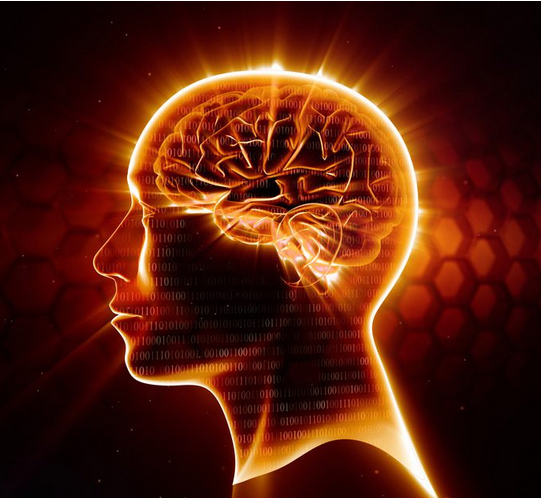
The Conscious Mind Is Limited In So Many Ways
The conscious mind is limited in so many ways. There are some who would argue that there is no such thing as conscious thought and that it represents little more than an internal multi-modal display of thoughts arising from processes that are hidden to us.
There appears to be a sound neurological basis to this perspective and the process [based on principles derived from complex systems] is known as emergence.
The conventional perception is that conscious thought directly guides and controls our actions. However there is growing body of research that suggests that conscious thought does not guide moment-to-moment actions but serves social and cultural functions.
But for our current purpose, let's continue with conventional understanding of the conscious mind as that part of us where we are aware of our thoughts as they take place.
Let's temporarily park the idea that the
content of the conscious mind is an illusion and take a practical look at some of
the many ways in which the conscious mind is limited.
Being aware is the first stage of being prepared.
[1] The Linear Scanning System Of Conscious Attention

Human intelligence has a serious limitation. It is a scanning system of conscious attention, and that scanning system is linear. It examines the world in lines, as you would pass a flashlight beam across a darkened room, focusing on one thing at a time, sequentially.
For example, to gain an education, we scan millions of lines of information.
We do it that way because that’s the best our attention can do, scanning and taking in one or at least just a few bits of information at a time, one after another.
But the kicker is that the real world doesn’t happen one thing at a time, one thing after another.
The real world is multidimensional, with a lot happening all at once, and it comes at us so fast and all at once in such a way that we could never scan it in the narrow focused linear way humans typically think.
[2] Thought vs Experience
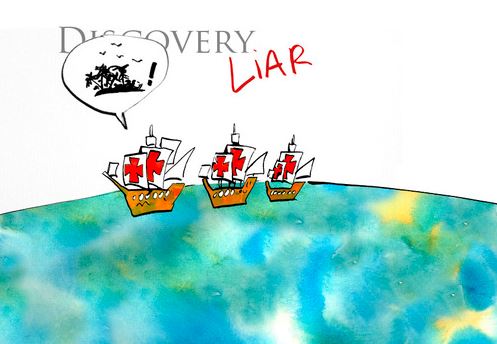
The conscious mind is limited by the abstractions, concepts, beliefs and maps we make to try to make sense of the complex world we live in.
Because in so doing we confuse 'the world as-it-is' with 'the world as-it-is-thought-about-and-described'. This is often expressed as confusing the map and the territory.
We confuse our thoughts and more importantly our emotional associations with an experience – with the experience. Reality is the territory – the unfiltered, uncategorized, direct experience now in the present moment.
The direct experience of eating tasty food – the unconditional love of a parent or child – the energy and abandonment of a good sexual experience - cannot be confused with our inner representations of them or the words we may use to attempt to describe these powerful experiences.
Imagine how many words you would need to describe the taste of freshly ground coffee to someone who has never heard of nor seen yet alone tasted coffee, compared with the directness of brewing them a cup and letting them taste it for themselves.
And the difference between 'the world as-it-is' with 'the world as-it-is-thought-about-and-described' is vast.
One is the map, and the other is the actual territory. And when you’re not aware of yourself except in a symbolic way, when you’re only aware of the map you’ve made of yourself, the "you" that consists of consciously reviewed words and symbols, the concept you have of who you are, you’re not really aware of yourself at all.
[3] The Limitations Of Language
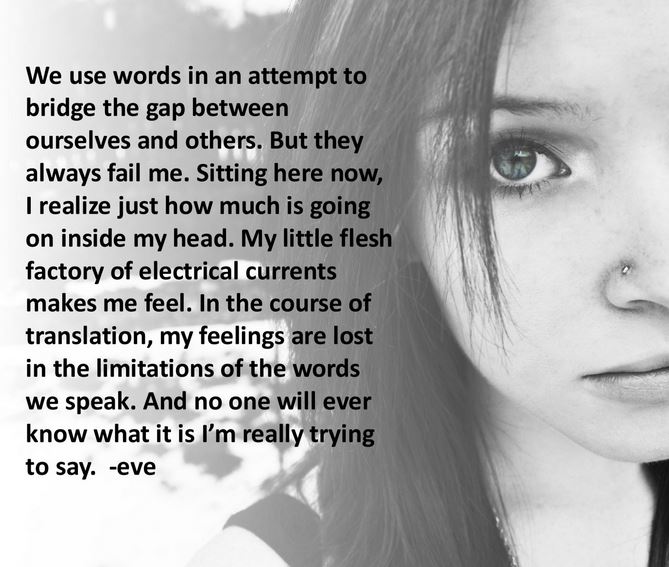
The conscious mind is limited by the torrent of inner noise pouring from our thought stream. We are in a profound sense lost for words.
A lot of what causes us to identify with this image we have, of ourselves and the world is built into our language. Notice that in our language, every sentence has a verb, an action of some sort, and a noun that does the action. But is this really the way it is?
So if there are no separate things, how can we have a noun, a separate thing, doing something? Isn’t this, too, just a social convention, but one that doesn’t describe reality accurately.
The structure of our language just reinforces that our concept of what is real (that there are separate things, that acts on other separate things) is real, when it isn’t.
Your image of yourself is deficient. It has to be. It’s just a map, an image, a concept you have of "you." It’s the menu, but you are the meal itself.
You really are all the connections, all the processes of the universe, a centre of awareness smack in the middle of everything, and that everything is you.
The concepts we employ, the categorizations we apply and the words we choose and use to articulate a direct experience put us in a double bind, and it is this:
For everything we gain by being able to verbalize and articulate an experience we lose an equal if not greater amount of the full meaning of that experience by the very process of articulation.
[4] The Limitations Of Context & Framing

The conscious mind is limited by the lost meaning in our words and this becomes exacerbated as the words we use to describe something are always heard or read within a context and a framing.
To illustrate and personalize this right now, the words that I am writing to you here in this article - and that I can hear in my head as I type this - have a meaning to me that is created and shaped by my inner map of reality.
However you, as you read this will be receiving, filtering and interpreting these words with your own inner map of reality.
What I mean to say and what you hear may not be the same thing!
This insight has serious and dramatic ramifications because families and societies have been divided and many wars have been fought over the meaning and interpretation of words.
[5] The limitations Of Dogmas And Beliefs

The conscious mind is limited
by the beliefs it holds and the dogmas that it adheres to.
In the field of religious beliefs there is so much
argument, conflict and suffering over “correct” beliefs – or orthodoxy –
declarations and adherence to propositional statements of faith.
As Eckhart Tolle put it:
"Dogmas – religious, political, scientific – arise out of the erroneous belief that thought can encapsulate reality or the truth.
Dogmas are collective conceptual prisons. And the strange things is that people love their prison cells because they give them a sense of security and a false sense of 'I know'.
Nothing has inflicted more suffering on humanity than its dogmas. It is true that every dogma crumbles sooner or later, because reality will eventually disclose its falseness; however, unless the basic delusion of it is seen for what it is, it will be replaced by others."
[6] The conscious mind is also limited in other ways it:
- Gets sabotaged by your lizard brain
- Falls for the illusion of a separate self
- Forgets that you are not your thoughts
- Gets caught up in the thought stream
- Is subject to a range of cognitive biases
So where does this leave us?
In my experience there are 2 basic ways of dealing with all this:
- Be aware, understand and accept the considerable limitations of your conscious mind and don't take it too seriously!
- Learn how to stop thinking and turn it off and how to gain a greater level of control over your conscious mind.
Next Article: Duality & Life Beyond Your Thinking Mind
Return to: Keeping It Real - Self Improvement Articles

LATEST ARTICLES


The Kingdom Is Here, Now - Awakening Is Not Later
 What contemplative traditions point to - and how progress quietly replaces presence. Across contemplative traditions, a strikingly consistent message appears: truth is not somewhere else, not in the…
Adult Development Without Becoming Someone Else - Growth Without Identity Upgrade
 You do not grow by becoming someone else - you grow by placing authority where choice becomes possible. So much of what is written and taught about personal growth quietly assumes an identity upgrade…
Belief and Thought: What Zen Tools Works With - What It Leaves Alone
 A Clarification Of Scope Within Zen Tools - Not A Position On Belief As soon as people begin to notice their own thinking more clearly, questions about belief and thought naturally follow: - If though…
How Thought Becomes Identity - The Hidden Mechanism Behind Overthinking, Self-Worth, and Inner Conflict
 Thought Is an Event, Not a Self Most people believe identity is something they have - a stable sense of who they are. In reality, identity is something the mind is continuously producing. It is not fo…
When the Brain Is Hijacked - Where Does Choice Sit?"
 Pressure, the Hijacked Brain, and the Question of Authority
When the brain is hijacked, people are often told they have “lost control”.That language is understandable - and misleading. In reality, man…
Pressure, the Hijacked Brain, and the Question of Authority
When the brain is hijacked, people are often told they have “lost control”.That language is understandable - and misleading. In reality, man…Reduce Digital Overthinking To Lower Your Constant Inner Noise
 Why Constant Micro-Stimulation Increases Your Internal Noise. Modern digital life generates a level of mental activity that previous generations never had to deal with, and this is fundamentally why w…
Pausing Before You Act - Make It a Meta-Habit
 How A Tiny Moment Unlocks Clarity, Choice, And Self-Leadership. There is a moment in life so subtle you barely register it. A colleague questions your idea. A notification flashes. A moment of uncerta…
How to Interrupt Emotional Spirals Using Thought-Awareness
 The spiral is fueled by your mind believing the story your thoughts tell. No one sets out to be swept away by a surge of emotion. One second you’re handling life, and the next, your mind has broken in…
Universal Awareness and the Machinery of Thought
 You Can’t Control Thoughts - But You Can Learn To See Them. Why do our thoughts have so much power over us - and how do we reclaim clarity? The foundation of thought-awareness is the ability to see yo…
Rewiring Your Autopilot – How To Harness Your Subconscious Mind
 How to harness your subconscious mind and move from passenger to pilot. The case for rewiring your autopilot is that most of what drives your thoughts, reactions, and decisions happens below your cons…
Why You Need To Be Intimate With Your Own Thinking
 How self-awareness and insight transforms delusion into wisdom. We live inside an invisible weather system - one made not of clouds and wind, but of thoughts - and this invisibilty is why you need to…
The Illusion of Closeness in Always-On Relationships
 Closeness that cannot survive absence was never intimacy - only constant stimulation mistaken for connection. We live inside an unprecedented experiment in human connection. For the first time in hist…