Myers Briggs ESFP
The Artist
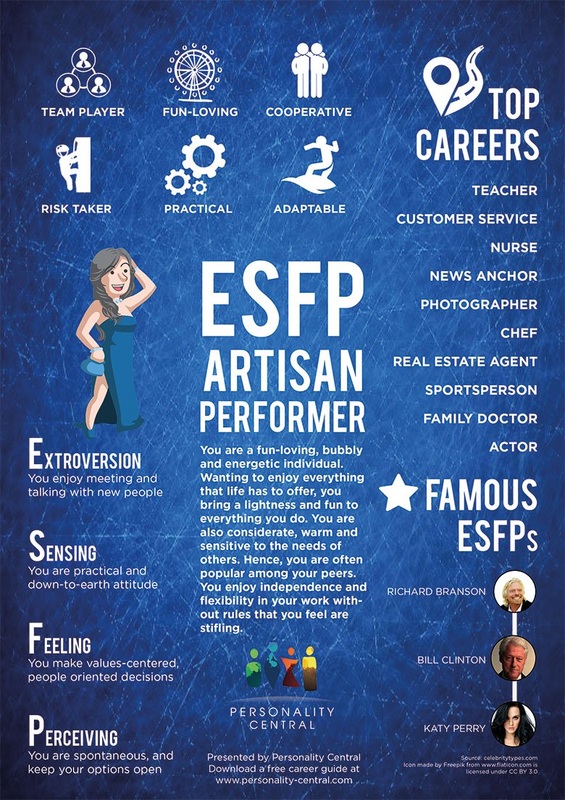
Myers Briggs ESFP - Summary
- Outgoing friendly and accepting.
- Exuberant lovers of life, people and material comforts.
- Enjoy working with others to make things happen.
- Bring common sense and a realistic approach to their work, and make work fun.
- Flexible and spontaneous, adapt readily to new environments.
- Learn best by trying a new skill with other people.
Myers Briggs ESFP - Characteristics
- Myers Briggs ESFPs live in the moment, experiencing life to the fullest. They enjoy people, as well as material comforts. Rarely allowing conventions to interfere with their lives, they find creative ways to meet human needs.
- They are excellent team players, focused on completing the task at hand with maximum fun and minimum discord. Active types, they find pleasure in new experiences.
- ESFPs take a hands-on approach in most things. Because they learn more by doing than by studying or reading, they tend to rush into things, learning by interacting with their environment.
- They usually dislike theory and written explanations. Traditional schools can be difficult for them, although they tend to do well when the subject of study interests them, or when they see the relevance of a subject and are allowed to interact with people.
- Observant, practical, realistic, and specific, they make decisions according to their own personal standards. They use their "feeling judgment" internally to identify and empathise with others.
- Naturally attentive to the world around them, ESFPs are keen observers of human behaviour. They quickly sense what is happening with other people and immediately respond to their individual needs. They are especially good at mobilising people to deal with crises.
- Generous, optimistic, and persuasive, they are good at interpersonal interactions. They often play the role of peacemaker due to their warm, sympathetic, and tactful nature.
- They love being around people and having new experiences. Living in the here-and-now, they often do not think about long-term effects or the consequences of their actions. While very practical, they generally despise routines, instead desiring to 'go with the flow.'
- They are, in fact, very play minded. Because they learn better through hands-on experience, classroom learning may be troublesome for many of them, especially those with a very underdeveloped intuitive side.
- Others usually see ESFPs as resourceful and supportive, as well as gregarious, playful, and spontaneous. They get a lot of satisfaction out of life and are fun to be around. Their exuberance and enthusiasm draw others to them. They are flexible, adaptable, congenial, and easygoing. They seldom plan ahead, trusting their ability to respond in the moment and deal effectively with whatever presents itself. They dislike structure and routine and will generally find ways to bend the rules.
Take the Myers Briggs Test [Note: This currently costs $49.99]
Return to main page: Myers Briggs Type Indicators

LATEST ARTICLES


Why Approval Feels Like Safety And Distance Feels Like Danger
 Safety is not found in being approved - it appears when approval is no longer required. When approval feels like safety, connection stops being something we enjoy and quietly becomes something we rely…
You Do Not Need Better Boundaries - You Need Clearer Thought
 What no longer feels like your responsibility no longer crosses your boundaries. This article explains why you don’t need better boundaries - you need clearer thought - how modern life systematically…
When Relationships Become Identity - Self-Worth is Based On Connection
 Much of our relationship suffering comes from a subtle cognitive shift in which relationships become fused with identity. When relationships become identity, connection is no longer simply experienced…
How Digital Communication Fuels Relationship Anxiety
 Micro-Signals, Macro-Meaning. Modern relationships based on digital communication do not usually break down because of betrayal, cruelty, or lack of care. They fracture under the weight of interpretat…
Why Absence Feels Like Rejection - Thought Patterns in Relationships
 The mind doesn’t just experience absence. It interprets absence. You send a message. It’s casual. Nothing heavy. Maybe a question, maybe a light comment. Normally you’d get a reply within an hour or t…
Why Insight Alone Does Not Change Behaviour - Locking In The Gains
 Insight Changes Understanding, But Not Jurisdiction. This article explores why insight alone does not change behaviour, not by dismissing thought awareness, but by showing what must come after it if c…
The Mechanics Of Inner Conflict - Not Confusing Signals As Instructions
 No Internal Signal Requires Immediate Obedience. Most people experience inner conflict as something emotional: tension, anxiety, guilt, hesitation, self‑doubt. It feels personal and psychological. Som…
Master The Season You Are In - The Key to Fulfilling Your Purpose
 To fulfil your purpose, you must first master the season you are in. One of the biggest mistakes you can make in life is focusing all your energy on the next season instead of learning to master the s…
The Inner Weight of Shame - Sustained By Attentional Fixation
 A Mind That Is Continuously Engaged In Self-Surveillance. Shame is one of the heaviest inner burdens a human being can carry. It does not announce itself loudly or demand attention through drama. Inst…
Does Prayer Work? The Psychology of Prayer, Meditation and Outcomes
 Reality Is A Complex System Of Countless Interactions - Including Yours. So does prayer work? The problem is that the question itself is usually framed in a way that guarantees confusion. We tend to a…
Living in Survival Mode Without Surrendering Mental Authority
Living in Survival Mode Without Surrendering Mental Authority
 Clear Thinking When You’re Just Trying to Stay Afloat. Many people today are overwhelmed because they are living in survival mode - not temporarily, but as a persistent condition of life. For many, th…