Myers Briggs INFP
The Healer
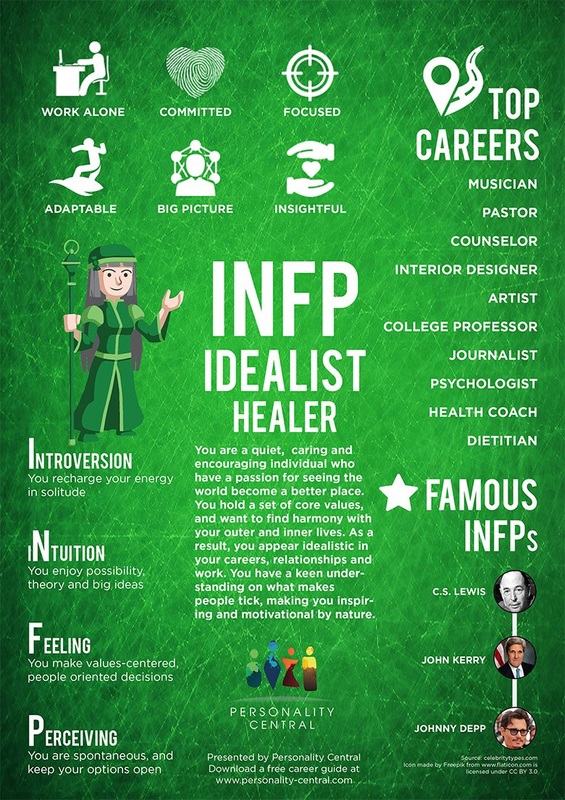
Myers Briggs INFP - Summary
- Idealistic and loyal to their values and to people who are important to them.
- Want an external life that is congruent with their values.
- Curious quick to see possibilities, can be a catalyst for implementing ideas.
- Seek to understand people and to help them fulfil their potential.
- Adaptable, flexible and accepting unless a value is threatening.
Myers Briggs INFP - Characteristics
- Myers Briggs INFP focus much of their energy on an inner world dominated by intense feeling and deeply held ethics.
- They seek an external life that is in keeping with these values. Loyal to the people and causes important to them, INFPs can quickly spot opportunities to implement their ideals. They are curious to understand those around them, and so are accepting and flexible except when their values are threatened.
- Their polite, reserved exterior can at first make them difficult to get to know. They enjoy conversation, however, taking particular delight in the unusual. When INFPs are in a sociable mood, their humour and charm shine through. Disposed to like people and to avoid conflict, they tend to make pleasant company.
- Devoted to those in their inner circle, they guard the emotional well-being of others, consoling those in distress.
- Guided by their desire for harmony, they prefer to be flexible unless their ethics are violated. Then, they become passionate advocates for their beliefs. They are often able to sway the opinions of others through tact, diplomacy, and an ability to see varying sides of an issue.
- They develop these insights through reflection, and they require substantial time alone to ponder and process new information.
- While they can be quite patient with complex material, they are generally bored by routine. Though not always organized, they are meticulous about things they value.
- Perfectionists, they may have trouble completing a task because it cannot meet their high standards. They may even go back to a completed project after the deadline so they can improve it.
- They are creative types and often have a gift for language. As introverts, they may prefer to express themselves through writing.
- Their dominant feeling drives their desire to communicate, while their auxiliary intuition supplies the imagination. Having a talent for symbolism, they enjoy metaphors and similes. They continually seek new ideas and adapt well to change. They prefer working in an environment that values these gifts and allows them to make a positive difference in the world, according to their personal beliefs.
Take the Myers Briggs Test [Note: This currently costs $49.99]
Return to main page: Myers Briggs Type Indicators

LATEST ARTICLES


Belief and Thought: What Zen Tools Works With - What It Leaves Alone
 A Clarification Of Scope Within Zen Tools - Not A Position On Belief As soon as people begin to notice their own thinking more clearly, questions about belief and thought naturally follow: - If though…
How Thought Becomes Identity - The Hidden Mechanism Behind Overthinking, Self-Worth, and Inner Conflict
 Thought Is an Event, Not a Self Most people believe identity is something they have - a stable sense of who they are. In reality, identity is something the mind is continuously producing. It is not fo…
When the Brain Is Hijacked - Where Does Choice Sit?"
 Pressure, the Hijacked Brain, and the Question of Authority
When the brain is hijacked, people are often told they have “lost control”.That language is understandable - and misleading. In reality, man…
Pressure, the Hijacked Brain, and the Question of Authority
When the brain is hijacked, people are often told they have “lost control”.That language is understandable - and misleading. In reality, man…Reduce Digital Overthinking To Lower Your Constant Inner Noise
 Why Constant Micro-Stimulation Increases Your Internal Noise. Modern digital life generates a level of mental activity that previous generations never had to deal with, and this is fundamentally why w…
Pausing Before You Act - Make It a Meta-Habit
 How A Tiny Moment Unlocks Clarity, Choice, And Self-Leadership. There is a moment in life so subtle you barely register it. A colleague questions your idea. A notification flashes. A moment of uncerta…
How to Interrupt Emotional Spirals Using Thought-Awareness
 The spiral is fueled by your mind believing the story your thoughts tell. No one sets out to be swept away by a surge of emotion. One second you’re handling life, and the next, your mind has broken in…
Universal Awareness and the Machinery of Thought
 You Can’t Control Thoughts - But You Can Learn To See Them. Why do our thoughts have so much power over us - and how do we reclaim clarity? The foundation of thought-awareness is the ability to see yo…
Rewiring Your Autopilot – How To Harness Your Subconscious Mind
 How to harness your subconscious mind and move from passenger to pilot. The case for rewiring your autopilot is that most of what drives your thoughts, reactions, and decisions happens below your cons…
Why You Need To Be Intimate With Your Own Thinking
 How self-awareness and insight transforms delusion into wisdom. We live inside an invisible weather system - one made not of clouds and wind, but of thoughts - and this invisibilty is why you need to…
The Illusion of Closeness in Always-On Relationships
 Closeness that cannot survive absence was never intimacy - only constant stimulation mistaken for connection. We live inside an unprecedented experiment in human connection. For the first time in hist…
Why Approval Feels Like Safety And Distance Feels Like Danger
 Safety is not found in being approved - it appears when approval is no longer required. When approval feels like safety, connection stops being something we enjoy and quietly becomes something we rely…
You Do Not Need Better Boundaries - You Need Clearer Thought
 What no longer feels like your responsibility no longer crosses your boundaries. This article explains why you don’t need better boundaries - you need clearer thought - how modern life systematically…