The Art Of Saying No
Why You Need To Master It
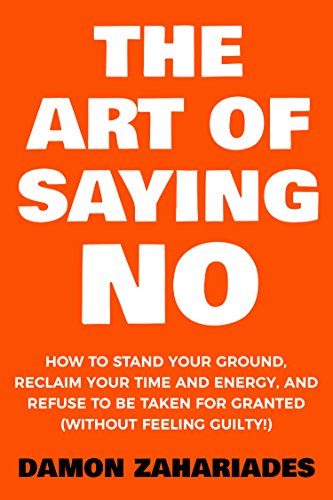
The Art Of Saying No - Overview
"The Art Of Saying No" is the title of a popular book by Damon Zahariades who specialises in writing and producing material on time management, improving personal productivity and developing habits to reinforce these skills.
The key themes of this book are learning how to:
- Set personal boundaries
- Stop being a people pleaser
- Stop being taken for granted
- Reclaim your personal authority
- Focus on your priorities and get things done
Why You Need To Master The Art Of Saying No
This article is about WHY you need to practise the art of saying no.
If you are clear about the "Why?" then the "How?" will follow because you will have the motivation.
This site is for people who are experiencing tough times, to show you how to cope in tough times, and to provide you with the tools to do this successfully.
The focus of this site is on learning how to think effectively, learning how to not think, and acquiring the skills to improve your responses to the events and situations that you encounter in life.
The bedrock of all this is that the stronger your responses are to what happens to you in life - the better will be the outcomes that you experience.
Let's ask 3 big questions then follow that with 2 big pegs in the ground :
3 QUESTIONS
[1] What is your core desire? Why are you here? What is your direction of travel?
[2] What is your point of focus? Are you clear on what you want out of life?
[3] What is your life purpose? If
you knew you were going to die tonight and you were given a few minutes
to reflect before that happened, what would you say was the meaning of
your life?
These are big questions and you may be wondering what all this has to do with an article on the art of saying no?
My response to that is to suggest that:
- If you accept that you are not a victim passively drifting through life like driftwood on an outgoing tide then you do have choices and those choices start within yourself.
- You are going to die [we are all going to die] the only unknowns are how and when. Faced with this certainty I suggest that a level of clarity about the focus and meaning of your life is important.
2 PEGS IN THE GROUND
The Art Of Saying No - Resources
The One Thing - a process for:
- Focusing your attention and your actions on the achievement of the one big thing you want to achieve.
- Narrowing your present focus down to the one next step you must take to progress you towards that one big thing.
Rather Than Trying To Win, Focus On Avoiding Losses
- Adjust your strategy to your abilities.
- For example, if you are an “ordinary” tennis player, this means understanding that amateur tennis is a “loser’s game” where success comes from avoiding losses.
Deep Work - Producing At Your Peak Level With Full Concentration
- The capacity to rapidly mentally get to grips with hard things and the resultant ability to produce at a consistently high-quality level, are core prerequisites for surviving and prospering in the current economy.
- “The differences between expert performers and normal adults reflect a life-long period of deliberate effort to improve performance in a specific domain.”
- “To produce at your peak level you need to work for extended periods with full concentration on a single task free from distraction.”
Atomic Habits - Tiny Changes Remarkable Results Over Time - they are:
- The single irreducible component that when practiced regularly yield incredible results through the power of compound growth.
- Comprised of small and seemingly insignificant changes that will compound into remarkable results if you persist with them consistently over many years.
- The result of having the right system in place. Bad habits are the result of you having the wrong system in place.
Playing The Long Game- Delay Gains Now To Get More Later
- The long game describes an approach to any area of life that sacrifices short term gains for long-term wins.
- It is about having a long term goal and taking the necessary steps now to set yourself up for long term success.
Points for Reflection
1. Who Is Really Making Your Choices?
Think about the last few times you agreed to something you didn't really want to do. Did you make a conscious choice, or were you influenced by guilt, obligation, fear of disappointing someone or simply the habit of saying yes?
2. What Are You Saying No to When You Say Yes?
Every commitment requires something from you — time, energy, attention or resources. When you agree to other people's requests, what personally important things might you be neglecting or sacrificing?
3. Are You Clear About What Really Matters to You?
Think about your core desires, your direction in life and what gives your life meaning. How much of your time and attention reflects these things, and how much is determined by other people's expectations?
4. Are You Taking Responsibility for Your Own Choices?
When you feel overwhelmed by demands and obligations, do you see yourself as having no choice? Are there situations where you have more freedom to choose your response than you currently recognise?
5. Are You Trying to Control What You Cannot Control?
How much of your difficulty in saying no comes from worrying about what other people will think, feel or do? Can you distinguish between your responsibility for your own choices and other people's responsibility for their reactions?Points for Action
__________
Action Points
1. Identify One Automatic Yes
Over the next few days, notice when you feel an immediate urge to agree to something. Before responding, pause and ask yourself: "Am I choosing this freely, or am I reacting to pressure, guilt or habit?"
2. Consider the Real Cost of Saying Yes
Choose one current commitment and consider what it costs you in time, energy or attention. Ask yourself what you might be able to do differently if you reduced, renegotiated or declined that commitment.
3. Establish One Personal Priority
Identify something that genuinely matters to you but has been repeatedly pushed aside by other people's demands. Decide on one practical step you can take to give it more attention.
4. Practise One Considered No
Find a relatively low-risk situation where you would normally agree automatically. This time, make a conscious decision. If declining is appropriate, communicate your decision politely, clearly and without unnecessary justification.
5. Take Responsibility — and Let Go of the Reaction
The next time you decline a request, focus on what you can control: your decision, your words and the respect with which you communicate them. Allow the other person to have their own response without automatically treating their disappointment as evidence that you made the wrong choice.
Return from "The Art Of Saying No" to: Mental Models

LATEST ARTICLES


When Responsibility Becomes Identity - The Family Provider Burnout Loop
 Why ‘If I Don’t, Who Will?’ Quietly Transfers Decision-Making Authority to Guilt and Urgency. There is often no single moment when the provider role begins. It usually starts with care, necessity, and…
Thought Awareness and Mindfulness - How to Develop Cognitive Clarity
 The Foundation of Clear Thinking and Reflective Action. At the heart of thought awareness and mindfulness lies a practical shift: learning to recognise thoughts as events rather than commands. Most pe…
Not Every Urge Is a Decision - The Missing Gap Between Feeling & Action
 Seeing the Urge Without Obeying It. An urge can feel immediate, compelling, and persuasive. It arrives with emotional charge and a sense of necessity. Yet not every urge is a decision. An urge is an i…
When Insight Is Not Enough - The Missing Piece in Behaviour Change
 What Mindfulness Reveals - And What It Leaves Unresolved. Many people reach a point where something genuinely shifts. They can see their thoughts as thoughts. Patterns are recognised.Triggers are obvi…
Why the Brain Replays Threat at Night - And What It’s Responding To
 Bad Dreams, Mental Overload, and the Cost of Unresolved Threat Processing in the Brain. Many people lie awake at night wondering why the mind turns hostile when the day goes quiet. Thoughts that felt…
The Kingdom Is Here, Now - Awakening Is Not Later
 What contemplative traditions point to - and how progress quietly replaces presence. Across contemplative traditions, a strikingly consistent message appears: truth is not somewhere else, not in the…
Adult Development Without Becoming Someone Else - Growth Without Identity Upgrade
 You do not grow by becoming someone else - you grow by placing authority where choice becomes possible. So much of what is written and taught about personal growth quietly assumes an identity upgrade…
Belief and Thought: What Zen Tools Works With - What It Leaves Alone
 A Clarification Of Scope Within Zen Tools - Not A Position On Belief As soon as people begin to notice their own thinking more clearly, questions about belief and thought naturally follow: - If though…
How Thought Becomes Identity - The Hidden Mechanism Behind Overthinking, Self-Worth, and Inner Conflict
 Thought Is an Event, Not a Self Most people believe identity is something they have - a stable sense of who they are. In reality, identity is something the mind is continuously producing. It is not fo…
When the Brain Is Hijacked - Where Does Choice Sit?"
 Pressure, the Hijacked Brain, and the Question of Authority
When the brain is hijacked, people are often told they have “lost control”.That language is understandable - and misleading. In reality, man…
Reduce Digital Overthinking To Lower Your Constant Inner Noise
 Why Constant Micro-Stimulation Increases Your Internal Noise. Modern digital life generates a level of mental activity that previous generations never had to deal with, and this is fundamentally why w…
Pausing Before You Act - Make It a Meta-Habit
 How A Tiny Moment Unlocks Clarity, Choice, And Self-Leadership. There is a moment in life so subtle you barely register it. A colleague questions your idea. A notification flashes. A moment of uncerta…