Transformational Life Hacks
To Understand Is To Know What To Do
This has to be one of the best ways for living the best life you can possibly live.

Transformational Life Hacks - Setting The Scene
An online search on life hacks will invariably provide you with multiple links to ways of increasing your productivity and efficiency in many areas of life.
But in this article I want to raise your sights and share two simple-to-understand science based principles that when combined will, over-time, transform your health, wealth and happiness.
I will tell you what to do, how to do it, and why you most likely won't!
There are no gimmicks here and this is absolutely not about how to "get rich quick".
Over the long run, the outcomes that you experience are determined by your responses to the events in your life.
I refer to this as the law of response and outcome.
The strength and quality of your response to the events in your life is determined by the skills and the experience you bring to it - and that is all based on knowing how to think effectively, and how to stop thinking.
My focus with this site is to educate you and to provide you with the resources to help you
develop these skills and thus:
- How to live the balanced life which is one where you recognise the full spectrum of possible responses and consistently choose the right one, and to do this you need to know:
- How to apply multi-disciplinary thinking.
To miss-quote Ludwig Wittgenstein:
What Are These Life Hacks - And How Are They Transformational?
To cut straight to it, these are the 2 life hacks which when combined will, over time, transform your life:
- Mirrored Reciprocation
- Compounding
Why is this transformational?
Because this is about how to get what you really want out of life by giving other people what they really want.
This goes beyond the transactional and is about building a "win-win" that addresses our deepest needs as human beings.
If you make this a habit in your interactions with other people and keep doing it throughout your life the compounded payback is very big in terms of:
- Your mental, emotional and physical health,
- Your wealth [both financial and non-financial], and
- Your overall well-being, fulfillment and happiness.
This has to be one of the best ways for living the best life you can possibly live.
To miss-quote Peter Kaufman, this transformational life hack can be simply stated as:
To get what you want you have to make the first move - you have to go first.
- If you encounter someone in a social situation for example standing in a queue at a bar waiting to buy a drink, or in an elevator, or on the same floor as your apartment and you ignore them - they will likely ignore you.
- If you scowl at them and look miserable - they will likely scowl back or ignore you.
- If you smile at them and say "Hi, how are you" and show interest - they will likely smile back and respond.
You have these same 3 choices in every interaction you have with other people.
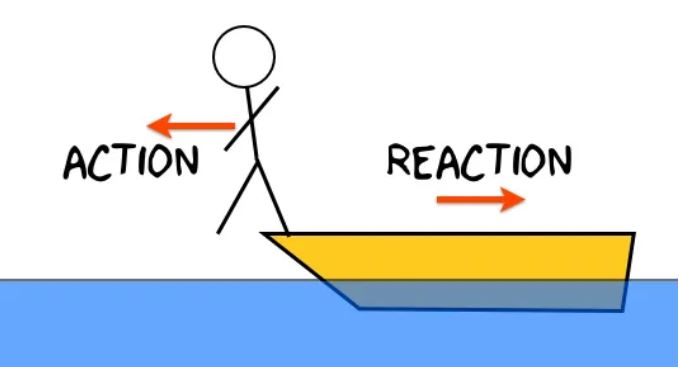
Why? This is Newtons Third Law Of Motion at work: "For every action there will ways be an equal and opposite reaction." Or as Peter Kaufman frames it: mirrored reciprocation.
Why do you find it so hard to act on these very simple things?
Short answer - fear.
Fear of appearing vulnerable.
Fear of looking stupid.
Fear of rejection.
At root, your ego!
But what if I told you that 90 plus per cent of the time people will respond positively to you?
Some calculate this as high as 98%, but let's stick with 90%.
Are you prepared to pay the price to receive all this?
Think about it, think about the 2-10% who ignore you or don't respond positively as the price you have to pay for the 90-98% of people responding positively and treating you well.
For much of my business career I have been involved in selling. When you run your own business, selling is an integral part of the job.
In my early years as a young salesman I was taught how to deal with rejection and the two main aspects of this were firstly not to take rejection personally and secondly to see each rejection as taking me one step nearer a sale.
Extend this principle across your life over the next 20 - 50 years across literally multiple thousands of encounters with other people.
Solution?
Life Hacks [2] Compounding

Compounding applies to relationships.
Albert Einstein is alleged to have said that:
"The most powerful force in the universe is compound interest."
As I am sure you know, compounding is the process whereby a gain made on an invested resource is reinvested alongside the original resource, and further gains are made on that gain.
What is not so well known is that the principle of compounding applies to ANY resource. It is not just limited to finance and investment. It can apply to knowledge, expertise, thinking skills and a whole range of "soft skills" - including relationships.
If you combine and apply the 2 life hacks of mirrored reciprocation and compounding across your life and do so consistently and persistently over the next 20 - 50 years across literally multiple thousands of encounters with other people the positive results this will bring you are truly staggering.
All that is required, as Peter Kaufman puts it, is:
"Dogged, incremental, constant progress over a very long time frame."
Why do you find compounding so difficult?
Short answer, because it requires delayed gratification.
The human brain is hardwired for an "immediate return environment" but we live in a "delayed return environment".
Our brains are hardwired for instant gratification, they process and evaluate potential rewards by ascribing a higher value to the present and a discount to the future, so there is a conflict.
As evolutionary psychologists will tell you:
"You can take the person out of the Stone Age, not the Stone Age out of the person."
The solution?
The key to reconciling our brain’s need for immediate feedback and at the same time taking the necessary steps to realise the major benefits of delayed gratification is to have a daily routine that rewards you right away [immediate return] and at the same time resolves your future problems [delayed return].
There are 2 components to this approach:
- Focus on the process not the goal. Pay attention to your social skills.
- Measure the small steps in the process. Each day, review your social interactions on a daily basis.
Next Article: This Too Shall Pass
Return from "Transformative Life Hacks" to: Walking The Talk

LATEST ARTICLES


Adult Development Without Becoming Someone Else - Growth Without Identity Upgrade
 You do not grow by becoming someone else - you grow by placing authority where choice becomes possible. So much of what is written and taught about personal growth quietly assumes an identity upgrade…
Belief and Thought: What Zen Tools Works With - What It Leaves Alone
 A Clarification Of Scope Within Zen Tools - Not A Position On Belief As soon as people begin to notice their own thinking more clearly, questions about belief and thought naturally follow: - If though…
How Thought Becomes Identity - The Hidden Mechanism Behind Overthinking, Self-Worth, and Inner Conflict
 Thought Is an Event, Not a Self Most people believe identity is something they have - a stable sense of who they are. In reality, identity is something the mind is continuously producing. It is not fo…
When the Brain Is Hijacked - Where Does Choice Sit?"
 Pressure, the Hijacked Brain, and the Question of Authority
When the brain is hijacked, people are often told they have “lost control”.That language is understandable - and misleading. In reality, man…
Pressure, the Hijacked Brain, and the Question of Authority
When the brain is hijacked, people are often told they have “lost control”.That language is understandable - and misleading. In reality, man…Reduce Digital Overthinking To Lower Your Constant Inner Noise
 Why Constant Micro-Stimulation Increases Your Internal Noise. Modern digital life generates a level of mental activity that previous generations never had to deal with, and this is fundamentally why w…
Pausing Before You Act - Make It a Meta-Habit
 How A Tiny Moment Unlocks Clarity, Choice, And Self-Leadership. There is a moment in life so subtle you barely register it. A colleague questions your idea. A notification flashes. A moment of uncerta…
How to Interrupt Emotional Spirals Using Thought-Awareness
 The spiral is fueled by your mind believing the story your thoughts tell. No one sets out to be swept away by a surge of emotion. One second you’re handling life, and the next, your mind has broken in…
Universal Awareness and the Machinery of Thought
 You Can’t Control Thoughts - But You Can Learn To See Them. Why do our thoughts have so much power over us - and how do we reclaim clarity? The foundation of thought-awareness is the ability to see yo…
Rewiring Your Autopilot – How To Harness Your Subconscious Mind
 How to harness your subconscious mind and move from passenger to pilot. The case for rewiring your autopilot is that most of what drives your thoughts, reactions, and decisions happens below your cons…
Why You Need To Be Intimate With Your Own Thinking
 How self-awareness and insight transforms delusion into wisdom. We live inside an invisible weather system - one made not of clouds and wind, but of thoughts - and this invisibilty is why you need to…
The Illusion of Closeness in Always-On Relationships
 Closeness that cannot survive absence was never intimacy - only constant stimulation mistaken for connection. We live inside an unprecedented experiment in human connection. For the first time in hist…
Why Approval Feels Like Safety And Distance Feels Like Danger
 Safety is not found in being approved - it appears when approval is no longer required. When approval feels like safety, connection stops being something we enjoy and quietly becomes something we rely…